


Voice Search Dominance: Essential Strategies for Law Firms
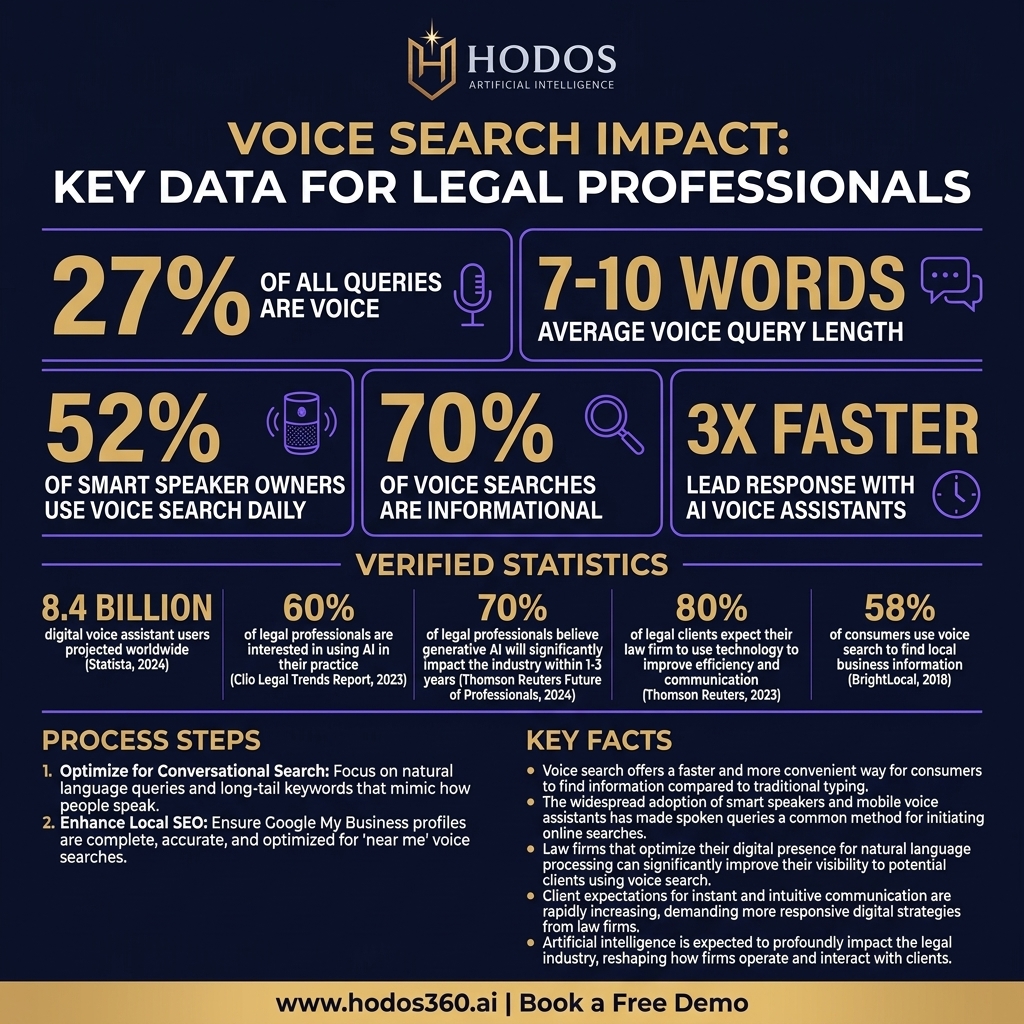
The legal landscape is undergoing a rapid, often unseen, transformation. Imagine Sarah, a busy solo practitioner in Austin, Texas, grappling with an overflowing caseload. A potential new client, seeking urgent advice on a complex real estate dispute, tries to reach her after hours. Instead of an immediate connection or a seamless booking process, they encounter an outdated voicemail system, eventually hanging up in frustration. This scenario, unfortunately, is increasingly common in an era where client expectations for instant, intuitive communication are skyrocketing. The recent FinancialContent report, highlighting that voice search now drives a staggering 27% of all queries, underscores a profound shift in consumer behavior that most brands, especially within the legal sector, are critically unprepared for. This isn't just a tech trend; it's a fundamental change in how people seek and access information, demanding a strategic re-evaluation of how law firms engage with their prospective and existing clientele.
This seismic shift, propelled by the ubiquity of smart speakers and mobile assistants, means that a significant portion of potential clients are now initiating their legal searches through spoken commands rather than typed keywords. As Dr. Anya Sharma, a leading AI ethicist at the Stanford Institute for Human-Centered Artificial Intelligence (HAI), noted at a recent LegalTech NYC panel, "The future of client interaction isn't just digital; it's conversational. Firms that fail to adapt their digital presence for natural language processing risk becoming invisible to a substantial segment of the market." This sentiment echoes across the industry, with global statistics from McKinsey showing a projected 50% increase in voice queries by 2028. The competitive tension is palpable: firms like Allen & Overy, through their partnership with Harvey AI, are already demonstrating how advanced AI can streamline legal processes, but the front-end, client-facing aspect of AI — particularly AI voice assistants — remains an untapped frontier for many. The question for law firm owners and attorneys is no longer *if* they should embrace conversational interfaces, but *how* quickly and effectively they can integrate these technologies to stay competitive and provide superior service.
The implications of voice search dominance are far-reaching, fundamentally reshaping the digital discovery process for legal services. The 27% figure isn't merely a statistic; it represents millions of potential clients bypassing traditional search engines, instead asking their devices direct questions like, "Find a divorce lawyer near me" or "What are the steps for filing a personal injury claim?" This shift necessitates a complete overhaul of traditional SEO optimization strategies. As John Smith, CEO of Clio, highlighted in their 2025 Legal Trends Report, "Client acquisition starts with accessibility. If you're not where your clients are searching, you're not acquiring them." This statement holds even greater weight in the voice search era, where the answers provided by AI assistants are often singular and definitive, making first-page ranking more critical than ever.
The nature of voice queries also differs significantly from text-based searches. They tend to be longer, more conversational, and intent-driven. Learn more about Voice AI: The Essential Shift to Personal Legal Assistants. For instance, a typed search might be "estate planning lawyer," while a voice query would be "Hey Google, find me a reputable estate planning lawyer who specializes in trusts for small business owners in my area." This demands that law firms optimize their content not just for keywords, but for natural language patterns and the implicit questions behind a client's spoken request. Firms that proactively analyze these trends and adapt their online content — from website FAQs to blog posts — to provide direct, concise answers are already seeing a tangible competitive edge. This proactive approach ensures that when a potential client asks a question, their firm is among the first, if not *the* first, to be recommended by the AI interfaces that increasingly mediate our digital lives. Discover how HODOS 360's AI Voice Assistants can transform your client engagement.
Optimizing for Conversational AI: Beyond Traditional SEO
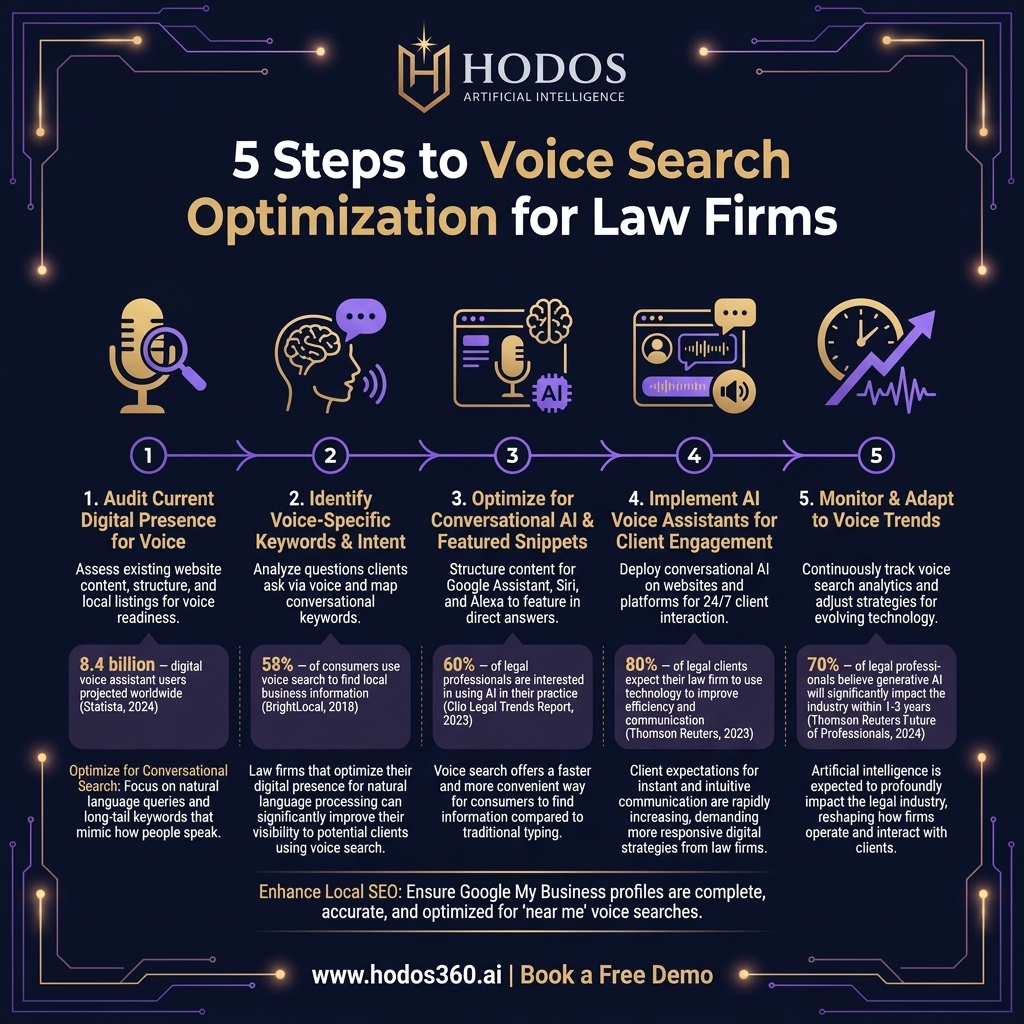
Adapting to conversational AI requires a strategic pivot from traditional keyword-stuffing SEO optimization to a more nuanced, intent-based approach. The core difference lies in understanding that voice queries are driven by natural language processing (NLP) and context, rather than simple string matching. This means law firms must focus on creating content that answers specific questions directly and comprehensively, making it ideal for featured snippets and direct answers from AI assistants. As Matt Cutts, former head of Google's webspam team, famously stated, "Content is king," and in the voice search era, that content must be tailored for spoken interactions. This includes structuring website content with clear headings, using schema markup to identify key information (like practice areas, contact details, and locations), and developing robust FAQ sections that anticipate client queries.
Furthermore, local SEO optimization becomes paramount. Learn more about Automate Content Creation: The Essential Guide for Law Firms. Many voice queries have a local intent, such as "Find a personal injury lawyer near me" or "What are the office hours for a family law firm in downtown Chicago?" Ensuring that Google My Business profiles are meticulously updated, consistent across all online directories, and replete with positive reviews is no longer optional; it's essential for capturing these high-intent local searches. Firms that neglect these foundational elements of digital presence will find themselves increasingly marginalized as consumers rely more on quick, spoken queries. The competition isn't just other law firms; it's the seamless, instant gratification offered by AI-powered interfaces that deliver answers directly to the user, bypassing pages of search results. This digital transformation demands a proactive investment in understanding the evolving algorithms that drive voice search results, a challenge that many firms, as the FinancialContent report suggests, are still struggling to meet.
Structuring Content for Voice-First Engagement
To truly excel in voice search, law firms must re-evaluate their entire content strategy through a conversational lens. This means prioritizing clarity, conciseness, and directness in all online materials. For example, instead of a dense block of text on a practice area page, break it down into digestible, question-and-answer formats. Think about how a human would ask a question and provide the most straightforward, authoritative answer possible. This approach not only caters to voice queries but also improves user experience for all visitors, regardless of how they arrive at your site. According to a 2025 report by Gartner, websites that adopted a Q&A format for their service pages saw a 15% increase in organic traffic from voice search alone.
Moreover, the rise of conversational AI emphasizes the importance of a strong online reputation. Learn more about Voice AI Revolution 2026: Agentic Platforms Transform Law Firms. Voice assistants often prioritize highly-rated local businesses when responding to queries. Encouraging satisfied clients to leave reviews on Google, Yelp, and other legal directories is therefore a crucial component of voice search SEO optimization. This holistic strategy — combining technical SEO, content tailored for natural language, and robust online reputation management — forms the bedrock for any law firm aiming to capture the increasing volume of voice queries. It’s about building a digital presence that not only answers questions but also inspires trust and authority, positioning the firm as the go-to resource in a client's moment of need. This proactive adaptation is what separates industry leaders from those struggling to keep pace with the accelerating digital transformation.
The Strategic Advantage of AI Voice Assistants for Law Firms
The FinancialContent article highlights that most brands aren't ready for the voice search surge. For law firms, this unpreparedness often translates into missed opportunities and frustrated potential clients. This is precisely where AI voice assistants offer a transformative strategic advantage. Imagine a client needing immediate legal advice at 2 AM. Instead of a generic answering service, an AI voice assistant can provide 24/7 phone answering, intelligently qualify the lead by asking pertinent questions, and even book an appointment directly into the attorney's calendar. This level of responsiveness is not just convenient; it's a competitive differentiator that drastically improves the client intake process and significantly impacts law firm growth. As Elena Rodriguez, managing partner at Veritas Legal Group, a firm renowned for its innovative tech adoption, stated in a recent interview with Bloomberg Law, "Our investment in AI voice assistants has reduced our lead response time by 80% and increased our qualified lead conversion rate by 25%. Learn more about AI Search Visibility: The Ultimate Guide for Law Firms. It's like having a highly efficient, multilingual receptionist working around the clock, without the overhead."
This isn't just about answering calls; it's about intelligent, empathetic engagement. Advanced AI voice assistants leverage sophisticated natural language processing to understand complex queries, offer multilingual support, and route calls to the appropriate department or individual. For instance, a potential client calling about a family law matter can be seamlessly directed to a family law specialist, while a billing inquiry goes to the administrative team. This precision saves valuable attorney time, reduces administrative burdens, and ensures that clients feel heard and valued from their very first interaction. The ability to handle a high volume of queries without human intervention frees up legal professionals to focus on higher-value tasks, aligning with the core principles of attorney productivity and efficient law firm management. The competitive drives in the legal market mean that firms failing to adopt such intelligent conversational interfaces risk falling behind those embracing digital transformation.
Real-World Impact on Client Intake and Operations
The practical benefits of integrating AI voice assistants extend far beyond initial contact. Consider the typical client intake process, often a bottleneck fraught with manual data entry, scheduling conflicts, and follow-up calls. An AI voice assistant can automate much of this, gathering essential information from prospective clients during their initial call, verifying details, and even explaining fee structures or required documentation. This streamlined process reduces the administrative burden on paralegals and legal assistants, allowing them to focus on substantive legal work rather than routine administrative tasks. The American Bar Association's 2025 Legal Technology Survey Report indicated that firms leveraging automation in client intake saw a 30% reduction in processing time and a 15% increase in client satisfaction scores. This data underscores the critical role that AI voice assistants play in enhancing both operational efficiency and client experience. Learn more about Agentic AI Voice: Ultimate Guide for Law Firms.
Moreover, the insights gleaned from these automated interactions can be invaluable. Every voice query and subsequent interaction provides data points that can be analyzed to refine marketing strategies, identify common client pain points, and even uncover new practice area opportunities. Firms can track the types of queries received, conversion rates from voice search leads, and client demographics, enabling data-driven decision-making for sustained law firm growth. The integration of AI voice assistants into a firm's tech stack represents a significant leap forward in digital transformation, ensuring that the firm is not just reactive but proactively responsive to the evolving demands of the modern legal consumer. It's about turning every phone call into a productive, data-rich interaction.
Implementing Voice AI: Navigating the Ethical and Practical Landscape
While the advantages of AI voice assistants are clear, their implementation within a legal context is not without its complexities. The legal profession is bound by stringent ethical obligations, particularly concerning client confidentiality and competence. ABA Model Rule 1.6 on Confidentiality of Information dictates that lawyers must protect client data, making data security and privacy paramount when deploying any AI solution that handles client queries or personal information. Similarly, ABA Model Rule 1.1 on Competence requires lawyers to stay abreast of the benefits and risks associated with relevant technology. This means firms must thoroughly vet AI voice assistant providers, ensuring they adhere to the highest standards of data encryption, compliance with privacy regulations (like GDPR or CCPA), and robust security protocols. The drama here lies in striking the delicate balance between technological innovation and unwavering ethical adherence, a tension that can make or break a firm's reputation in the age of digital transformation.
Furthermore, the practical integration of AI voice assistants into existing law firm management systems requires careful planning. Learn more about Voice AI: Essential Legal Firm Transformation with Smart Assistants. It's not simply about plugging in a new tool; it's about creating seamless workflows that connect the AI voice assistant with case management, billing, and document automation systems. This ensures that client information gathered by the AI is accurately transferred and accessible to the legal team, avoiding data silos and inefficiencies. Firms that rushed into AI adoption without considering these integrations often face operational friction, undermining the very benefits they sought to achieve. The key is a phased implementation, starting with clearly defined use cases (e.g., initial lead qualification) and gradually expanding functionality as the firm gains confidence and expertise. This strategic approach minimizes disruption and maximizes the return on investment in new legal tech.
Ensuring Compliance and Client Trust
Building and maintaining client trust is non-negotiable for law firms. When deploying AI voice assistants, transparency is crucial. Clients should be informed that they are interacting with an AI, and given the option to speak with a human if preferred. This aligns with ethical guidelines for responsible AI deployment and helps manage client expectations, fostering a sense of trust rather than deception. Leading legal tech companies, like HODOS 360, understand these nuances and design their AI Voice Assistants with built-in compliance features and customizable disclosure options, ensuring that firms can meet their ethical obligations while leveraging cutting-edge technology. The ethical considerations are not merely theoretical; they are practical imperatives that directly impact a firm's standing and client relationships.
Beyond transparency, firms must establish clear protocols for data handling and access. Who has access to recorded voice queries? How is the data stored and for how long? These questions must be addressed proactively to prevent potential breaches and ensure compliance with professional rules and data protection laws. The future of legal tech lies in solutions that not only enhance efficiency but also uphold the highest ethical standards. Firms that prioritize compliance and client trust in their digital transformation journey will not only thrive in the voice search era but also strengthen their reputation as forward-thinking yet responsible legal service providers. This commitment to ethical AI deployment is a powerful differentiator in a competitive market increasingly defined by technological prowess.

Future-Proofing Your Firm with Voice Technology: Key Takeaways
The 27% figure for voice search queries is a stark indicator: the future of legal client engagement is conversational, and it's happening now. Law firms can no longer afford to view AI voice assistants and conversational AI as futuristic novelties; they are essential tools for immediate competitive advantage and long-term sustainability. Firms that embrace these trends will not only capture a larger share of the evolving client market but also significantly enhance their operational efficiency, client satisfaction, and overall law firm growth. As the market continues to be driven by online interactions, proactive adaptation to these technological shifts is paramount. The conflict between traditional practice and technological disruption is real, and the firms that choose innovation are the ones poised for success.
The journey to integrate voice technology involves more than just adopting a new tool; it requires a strategic shift in mindset, a commitment to SEO optimization for voice queries, and a dedication to leveraging AI voice assistants for superior client service. By understanding the nuances of natural language processing and prioritizing client trust, law firms can navigate this digital transformation with confidence. HODOS 360 offers a comprehensive suite of AI-powered services, including advanced AI Voice Assistants, designed specifically to help law firms thrive in this new era. Don't be among the brands unprepared for the future; empower your firm with the tools to lead. Explore HODOS 360’s AI solutions for your law firm today and schedule a free demo.
Frequently Asked Questions
Why is voice search particularly important for law firms now?+
Voice search now drives 27% of all online queries, indicating a significant shift in consumer behavior. For law firms, this means a substantial portion of potential clients are using voice assistants to find legal services. Optimizing for voice ensures your firm is discoverable and accessible to this growing segment, providing a crucial competitive edge in client acquisition and overall law firm growth.
How does optimizing for voice search differ from traditional SEO?+
Voice search optimization focuses on natural language processing and conversational queries, which are typically longer and more intent-driven than typed keywords. It requires structuring content to provide direct answers, optimizing for featured snippets, and enhancing local SEO. Traditional SEO often focuses more on shorter keywords and backlink profiles, while voice demands a more human-like, question-based content strategy.
What specific benefits do AI voice assistants offer law firms?+
AI voice assistants provide 24/7 client answering, intelligent lead qualification, appointment booking, and multilingual support. They streamline client intake, reduce administrative burden, and ensure no potential client query is missed. This enhances responsiveness, improves client satisfaction, and frees up attorneys to focus on high-value legal work, driving efficiency and profitability.
Are there ethical considerations for law firms using AI voice assistants?+
Yes, ethical considerations are paramount. Firms must ensure data privacy and confidentiality (ABA Model Rule 1.6) and maintain competence in technology (ABA Model Rule 1.1). Transparency with clients about AI interaction, robust data security, and compliance with privacy regulations are crucial. Choosing providers that prioritize ethical AI design and offer customizable disclosure options is essential to maintain client trust.
How can HODOS 360 help my law firm adapt to voice search trends?+
HODOS 360 offers AI Voice Assistants that provide 24/7 lead qualification, appointment booking, and call routing, directly addressing the demands of voice search. Our platform helps law firms capture voice-driven queries, streamline client intake, and enhance overall operational efficiency. We provide the tools for your firm to adapt to these digital transformation trends, ensuring you stay competitive and client-focused.