

AI and DAM: The Essential Synergy for Modern Law Firms
The legal industry, traditionally cautious, now finds itself at the precipice of a content revolution, largely driven by advancements in artificial intelligence. Law firms are no longer just selling legal services; they are becoming prolific content creators, generating everything from intricate case studies and thought leadership articles to engaging social media videos and interactive webinars.
This explosion of digital assets, while crucial for visibility and client engagement, has simultaneously created a formidable challenge: how to effectively manage, organize, and leverage this ever-growing volume of content.
Consider the scenario faced by Sarah Chen, Marketing Director at a prominent litigation firm. Her team, once focused primarily on traditional PR and event planning, now grapples with a deluge of AI-generated drafts, video snippets from court appearances, and a complex web of social media campaigns.
Without a centralized, intelligent system, brand consistency falters, compliance risks escalate, and valuable assets get lost in digital silos. This is precisely where the synergy of AI and Digital Asset Management (DAM) becomes not just beneficial, but essential. As Scott Brinker, editor of the MarTech blog, aptly noted in a recent interview, "AI gives you volume.
Humans give you value." The critical bridge between volume and value, particularly in a regulated industry like law, is an AI-powered DAM system that empowers legal marketers to maintain control, enhance efficiency, and unlock the full potential of their digital presence.
The Evolving Landscape of Legal Content Creation
The past few years have witnessed an unprecedented surge in digital content across all sectors, and the legal industry is no exception. Law firms, recognizing the power of digital outreach, are investing heavily in content marketing. From detailed blog posts explaining complex legal precedents to short-form videos demystifying new legislation, the demand for compelling, informative, and compliant content has never been higher.
Generative AI tools, championed by companies like OpenAI with its GPT models and Anthropic with Claude, have democratized content creation, enabling firms to produce high volumes of text, images, and even video scripts at an astonishing pace. This capability, while a boon for productivity, also introduces a significant management overhead.
For instance, a firm might leverage an AI video creation platform like HeyGen to produce dozens of short videos explaining different practice areas, or use an AI writing assistant to draft multiple variations of a press release for a new partner announcement. Learn more about Context Matters AI: Essential for Legal Accuracy & Insight.
Each of these pieces of content—text, image, video, audio—is a digital asset. Without a robust system to categorize, tag, and track these assets, they quickly become unmanageable. This challenge is further compounded by the need to ensure brand consistency across all touchpoints and to comply with stringent legal advertising rules.
The sheer volume generated by AI can quickly overwhelm traditional manual content management processes, leading to inefficiencies, duplication, and potential compliance pitfalls.
AI-Powered DAM: Beyond Simple Storage for Law Firms
Digital Asset Management (DAM) systems have historically served as centralized repositories for digital files. However, the integration of AI transforms DAM from a passive storage solution into an active, intelligent content engine. For law firms, this means moving beyond simply archiving files to dynamically managing a vast array of marketing collateral, client communications, and brand assets.
AI capabilities embedded within DAM systems can automatically tag and categorize content based on its subject matter, legal area, or even the emotions it evokes. This semantic understanding, a cornerstone of advanced AI, drastically improves content discoverability and usability.
Consider a scenario where a legal marketer needs to find all assets related to 'intellectual property litigation' from the last two years, featuring a specific partner, and approved for social media use.
Learn more about AI Law Firm Management: Essential for Big Law's Future. An AI-powered DAM can execute this complex query in seconds, leveraging automated metadata generation and intelligent search algorithms. This level of granular control and instant access significantly reduces the time spent searching for assets, allowing marketing teams to focus on strategic initiatives rather than administrative tasks.
As Dario Amodei, CEO of Anthropic, often emphasizes the importance of 'helpful, honest, and harmless' AI; in the context of DAM, this translates to systems that not only organize but also intelligently guide users towards compliant and effective content, ensuring that even AI-generated material adheres to a firm's ethical and brand standards.
Ensuring Brand Consistency and Compliance with AI
Maintaining a consistent brand voice and visual identity is paramount for law firms, especially when content is being produced at scale. AI-powered DAM systems act as guardians of brand guidelines, automatically flagging content that deviates from established standards in terms of logos, color palettes, or even tone of voice.
This proactive identification of inconsistencies ensures that every piece of client-facing material reinforces the firm's professional image. Furthermore, in a heavily regulated industry, compliance is non-negotiable. The ABA Model Rules of Professional Conduct, particularly Rule 7.1 concerning Communications About a Lawyer's Services, dictates strict guidelines for attorney advertising.
Learn more about Law Firm Return on Investment: Maximize AI in 2026. AI in DAM can be configured to scan content for specific disclaimers, factual accuracy, and adherence to jurisdictional advertising regulations, providing an essential layer of risk mitigation. This automated compliance check is a game-changer, reducing the burden on legal teams for manual review and significantly minimizing the risk of ethical breaches or regulatory penalties.
The meticulous tracking of asset versions and approval workflows within a DAM system also provides an immutable audit trail, crucial for demonstrating due diligence.
Streamlining Legal Marketing Workflows with Integrated AI & DAM
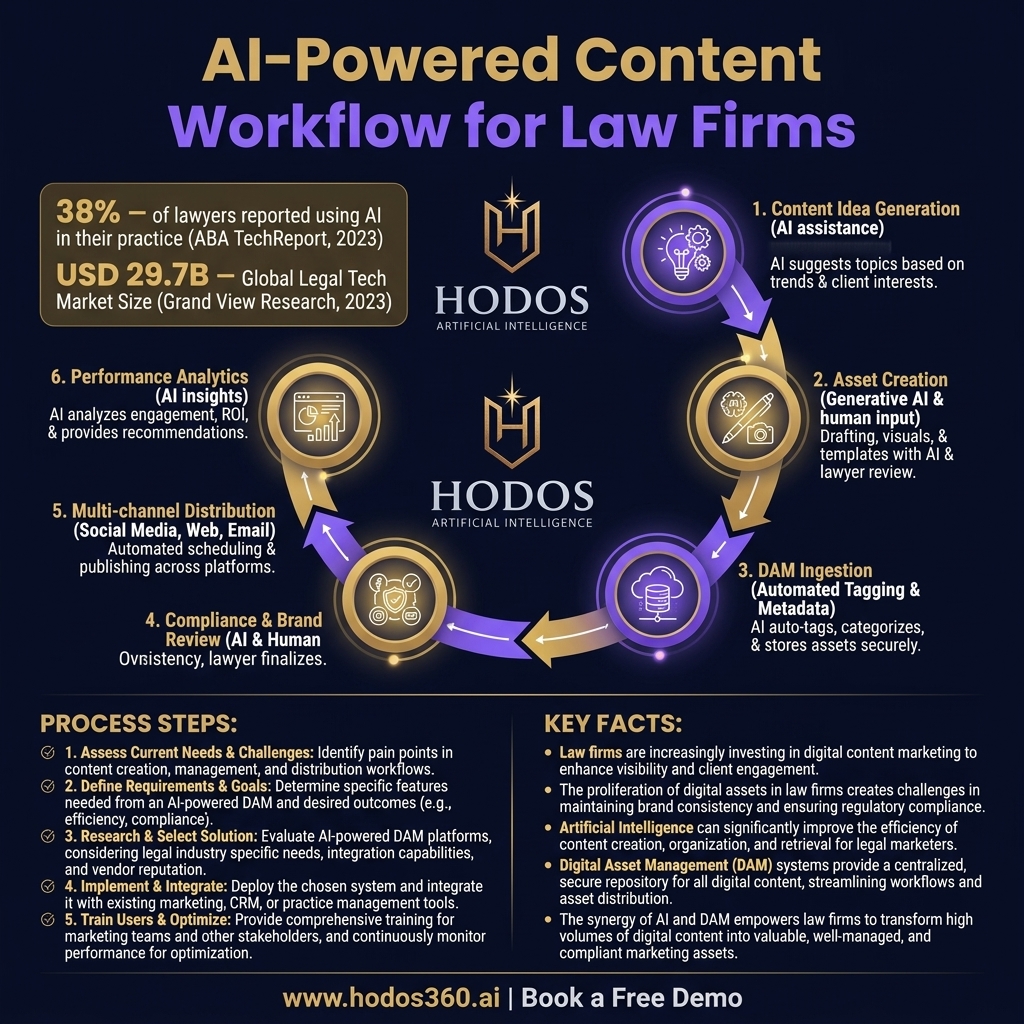
The true power of AI-powered DAM emerges when it is integrated seamlessly into a firm's broader marketing workflows. Imagine a scenario where a new legal trend emerges, such as recent developments in the EU AI Act. An AI-powered DAM can instantly identify existing internal articles, partner bios, and relevant images, then suggest these assets for a new blog post.
Furthermore, it can integrate with generative AI tools to draft initial content, which is then routed through an automated approval workflow, ensuring legal and brand compliance before publication. This dramatically accelerates content creation and deployment cycles. Platforms like HODOS 360’s AI Marketing Platform are designed precisely for this integration, offering features like social media automation and AI video creation that draw directly from a centralized, intelligently managed asset library.
Learn more about Low-Code No-Code AI: Transformative Tools for Law Firms. This means that a marketing team can generate a video, create a social media campaign, and draft a blog post, all while ensuring every asset used is approved, on-brand, and easily retrievable for future use.
This synergy also extends to reducing the significant burden of repetitive tasks. Legal marketers often spend valuable hours resizing images, converting file formats, or manually uploading content to various platforms. AI in DAM can automate these mundane tasks, freeing up human talent to focus on higher-value activities such as strategic planning, client relationship building, and creative content development.
As Jensen Huang, CEO of NVIDIA, often states regarding AI's impact on efficiency, "The more challenging the problem, the more AI can help." For law firms, this translates into a marketing team that is not just more productive, but also more strategic and innovative, capable of responding to market demands with unprecedented speed and accuracy.
The adoption of such integrated systems distinguishes forward-thinking firms, much like how Harvey AI's partnership with Allen & Overy demonstrated the power of AI in legal research, now mirrored in the marketing domain.
Measuring Impact and Proving ROI in the AI-DAM Era
One of the perennial challenges for legal marketing departments is demonstrating clear Return on Investment (ROI) for their efforts. AI-powered DAM, when integrated with analytics tools, provides unprecedented visibility into content performance. By tracking how often assets are used, which campaigns they contribute to, and their ultimate impact on lead generation or client engagement, firms can gain actionable insights.
For example, an AI system can analyze which legal explainer videos are most watched and shared, or which whitepapers lead to the most inquiries. This data-driven approach allows firms to optimize their content strategy, investing more in high-performing assets and refining or retiring underperforming ones.
A McKinsey report on AI in marketing highlighted that companies adopting AI for content optimization see significant improvements in campaign effectiveness and customer engagement metrics. For law firms, this means a more efficient allocation of marketing resources and a clearer pathway to proving value.
This analytical capability creates a stark contrast between firms that embrace AI-powered DAM and those that lag.
Learn more about AI Litigation: The Ultimate Platform for Modern Law Firms. Firms like Linklaters, early adopters of advanced legal tech, are already seeing the benefits of streamlined operations and data-driven insights. In contrast, firms relying on outdated, manual systems often struggle with fragmented data, inconsistent branding, and an inability to accurately measure the impact of their marketing spend.
This isn't just about efficiency; it's about competitive advantage. In a market where legal services are increasingly commoditized, a firm's ability to effectively communicate its unique value proposition through compelling, well-managed content can be the decisive factor in attracting and retaining top-tier clients. The drama here isn't just about technology; it's about the very survival and prosperity of legal practices in an increasingly digital-first world.
The Competitive Edge: Innovators vs. Traditionalists
The legal industry is witnessing a clear divide: those embracing innovation and those clinging to traditional methods. Firms that proactively adopt AI-powered DAM are gaining a significant competitive edge. They can react faster to market changes, produce higher quality content more consistently, and demonstrate a tangible ROI on their marketing investments.
This agility allows them to dominate search engine rankings, capture mindshare on social media, and build a stronger, more recognizable brand. Learn more about Essential Legal AI Access: NELLCO's Broad Impact. On the other hand, traditionalists often find themselves overwhelmed by the sheer volume of digital content, struggling with outdated systems, and losing ground to more tech-savvy competitors.
The tension between disruption and tradition is palpable, with the former group positioning themselves as leaders in a new era of legal service delivery, while the latter risks being left behind. This narrative, mirroring the broader market shifts seen with companies like Blockbuster versus Netflix, underscores the critical importance of strategic technology adoption in the legal sector today.
The Path Forward: Strategic Adoption for Legal Leaders
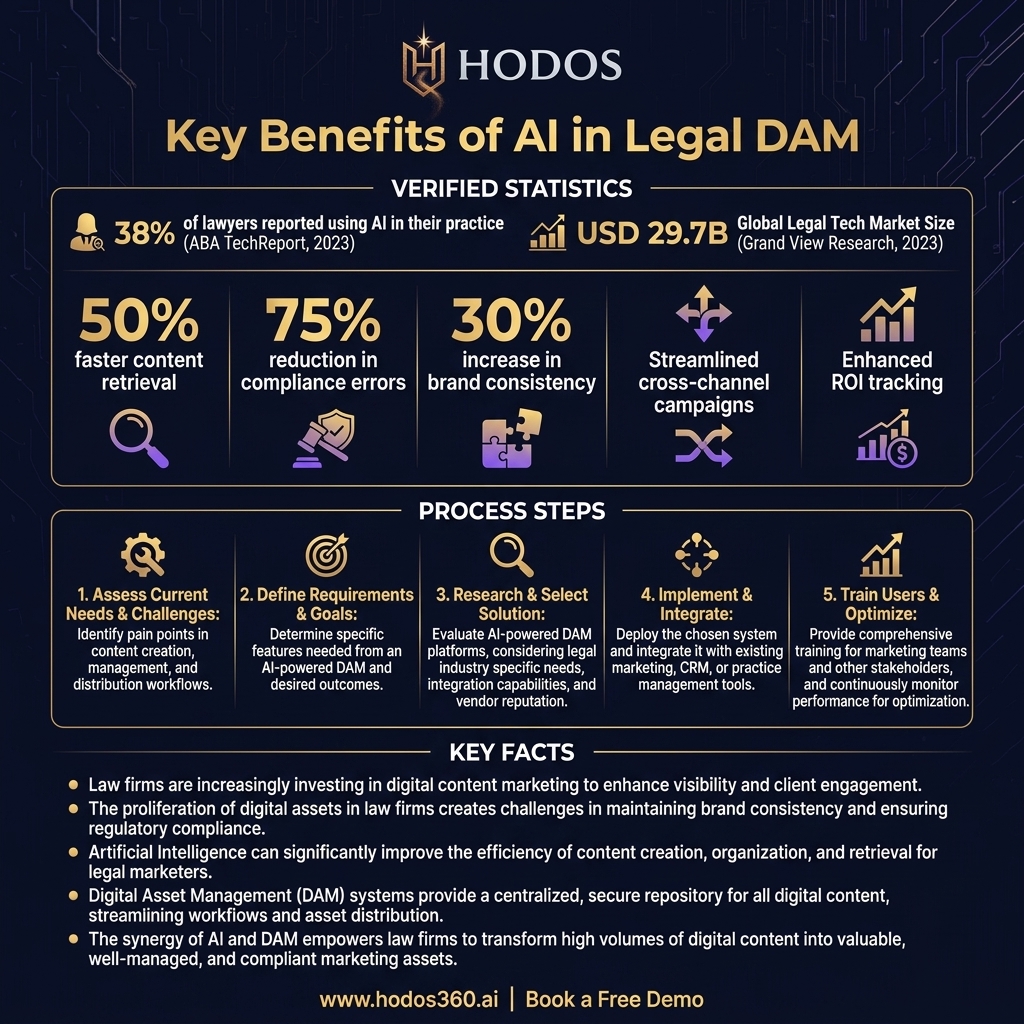
For law firm leaders and marketing professionals, the path forward is clear: strategic adoption of AI-powered DAM is no longer optional but a strategic imperative. The implementation process requires careful planning, starting with an audit of existing digital assets and identifying key pain points in current workflows.
Pilot programs within specific practice areas or marketing campaigns can demonstrate immediate value and build internal buy-in. It's crucial to select a platform that offers comprehensive features, integrates seamlessly with other legal tech solutions, and provides robust support for data security and compliance. Solutions like HODOS 360 are purpose-built to address these needs, offering an AI Law Firm Management System alongside its AI Marketing Platform, creating a holistic ecosystem for legal operations and client engagement.
Beyond technology, firms must also invest in training their teams to maximize the benefits of these advanced systems. This includes understanding how to leverage AI for content generation, how to apply proper tagging and metadata, and how to interpret analytics for strategic decision-making. The goal is not to replace human creativity or legal expertise but to augment it, enabling legal professionals to focus on the unique insights and judgment that only humans can provide.
As the legal tech landscape continues to evolve rapidly, staying informed about new developments—such as recent OpenAI news today or updates to the EU AI Act enforcement—will be crucial for maintaining a competitive edge and ensuring that technology adoption remains aligned with both business goals and ethical responsibilities.
Navigating the Ethical and Regulatory Landscape
The integration of AI into legal marketing and content management brings with it significant ethical and regulatory considerations. Law firms must ensure that their use of AI, particularly in generative content, adheres to principles of transparency, fairness, and accountability. Concerns around data privacy, especially with sensitive client information, necessitate robust security protocols within any DAM system.
The evolving legal framework, epitomized by the EU AI Act, sets a precedent for responsible AI deployment, and law firms operating globally or with international clients must be acutely aware of these regulations. For instance, ensuring that AI-generated content does not inadvertently infringe on intellectual property rights or misrepresent legal advice is critical.
Firms must establish clear guidelines for human oversight and review of all AI-produced material, safeguarding client trust and upholding professional obligations. This proactive approach to governance is not merely about avoiding penalties but about building a reputation as a trustworthy and forward-thinking legal entity in the digital age.

Key Takeaways and Next Steps
The convergence of AI and Digital Asset Management is fundamentally reshaping how law firms approach marketing. It's no longer sufficient to simply create content; the ability to intelligently manage, optimize, and distribute that content is what will differentiate leading firms. AI-powered DAM systems provide the infrastructure to handle the burgeoning volume of digital assets, ensure brand consistency and compliance, streamline complex workflows, and provide quantifiable ROI for marketing efforts.
This synergy empowers law firms to not only survive but thrive in an increasingly digital and AI-driven legal landscape.
For law firm owners and marketing leaders, the next step is clear: evaluate your current content management capabilities and explore how an integrated AI-powered DAM solution can bridge existing gaps.
Embrace this transformative technology not as a cost, but as an investment in your firm's future growth, reputation, and competitive advantage. HODOS 360 stands ready to empower your firm with a comprehensive suite of AI solutions, including an AI Marketing Platform designed to elevate your digital presence and streamline your operations.
Frequently Asked Questions
What is AI-powered Digital Asset Management (DAM) for law firms?+
AI-powered DAM is an intelligent system that centralizes, organizes, and manages a law firm's digital content using artificial intelligence. It goes beyond simple storage by employing AI for automated tagging, metadata generation, semantic search, and content recommendations. This helps firms efficiently manage marketing materials, client communications, and brand assets while ensuring compliance and consistency across all digital platforms.
How does AI in DAM help with brand consistency for law firms?+
AI in DAM ensures brand consistency by automatically monitoring and flagging digital assets that deviate from established brand guidelines, such as logos, color schemes, or tone of voice. It acts as a digital guardian, ensuring that all client-facing content aligns with the firm's professional image, even when produced at high volume through generative AI tools, thus maintaining a unified and strong brand identity.
Can AI-powered DAM help law firms with legal compliance in marketing?+
Absolutely. AI-powered DAM can be configured to automatically scan marketing content for adherence to legal advertising rules, such as those outlined in ABA Model Rule 7.1. It can check for required disclaimers, factual accuracy, and jurisdictional regulations. This significantly reduces the risk of ethical breaches, minimizes manual review time, and provides an auditable trail of content approvals, bolstering a firm's compliance efforts.
What are the ROI benefits of implementing AI-powered DAM for legal marketing?+
Implementing AI-powered DAM offers several ROI benefits. It streamlines workflows, reducing the time and resources spent on manual content management tasks. By providing insights into content performance and engagement, it enables data-driven optimization of marketing strategies, leading to more effective campaigns and better lead generation. This translates to more efficient allocation of marketing spend and a measurable impact on client acquisition.
How does HODOS 360's AI Marketing Platform integrate with DAM principles?+
HODOS 360's AI Marketing Platform leverages DAM principles by providing a centralized, AI-driven ecosystem for content. It integrates AI video creation, social media automation, and content generation directly with intelligent asset management. This ensures that all marketing outputs are consistent, compliant, and easily accessible from a single source, maximizing efficiency and impact while maintaining brand integrity and tracking performance.