
AI Marketing: The Ultimate Guide to Law Firm Authority
The legal landscape is perpetually reshaped by technological innovation, and few forces have proven as disruptive and transformative as generative AI. Just this week, Issuewire.com reported on Sutra Creative's launch of full-stack authority marketing programs, specifically designed to help brands get cited by AI tools. This pivotal shift from traditional search engine optimization (SEO) to a more nuanced 'Answer Engine Optimization' (AEO) and 'Generative Engine Optimization' (GEO) demands immediate attention from law firms. As AI models become the primary gateway for information discovery, the very definition of digital authority for legal practices is being rewritten. Firms that master this new paradigm will not only maintain their relevance but also unlock unprecedented growth opportunities, while those clinging to outdated strategies risk fading into obscurity.
Consider the experience of a prominent litigation boutique, 'LexVeritas LLP,' based in San Francisco. For years, LexVeritas relied on a robust SEO strategy focused on keywords and traditional link-building. However, as generative AI tools like Google's Search Generative Experience (SGE) began to integrate directly into search results, their organic traffic, while stable, started to see a decline in high-intent leads. Prospective clients were increasingly finding synthesized legal information and recommended firms directly through AI prompts, bypassing traditional search results pages. This prompted LexVeritas's managing partner, Eleanor Vance, to commission an overhaul of their digital strategy, recognizing that being 'cited by AI' was becoming as critical as ranking on the first page of Google. The firm's journey underscores a broader industry tension: the urgent need for legal practices to pivot from merely being discoverable to being authoritative in an AI-driven information ecosystem. This isn't just about visibility; it's about establishing genuine trust and credibility when AI acts as the initial gatekeeper of legal knowledge.
The Dawn of Generative AI: Reshaping Legal Marketing Landscapes
The advent of large language models (LLMs) like OpenAI's GPT-4, Google's Gemini, and Microsoft Copilot has fundamentally altered how users interact with information. These AI systems don't just point to websites; they synthesize, summarize, and often generate direct answers, complete with citations to their source material. For law firms, this means the game has changed from merely optimizing for keywords to optimizing for trust and contextual relevance that AI can understand and validate. As Rand Fishkin, co-founder of SparkToro, has frequently highlighted, the shift towards 'zero-click searches' and AI-generated answers means brands must focus on being the *answer source*, not just a link in a list. A 2025 report by Gartner predicted that by 2028, over 60% of online content consumption will be mediated or generated by AI, profoundly impacting industries from healthcare to legal services.
This seismic shift places a premium on content that is not only accurate and comprehensive but also structured in a way that AI models can easily ingest and attribute. The 'full-stack authority marketing' approach championed by agencies like Sutra Creative is a direct response to this new reality. Learn more about Web Application Development: Essential AI Workflows Emerge. It integrates traditional SEO with AEO and GEO, ensuring that legal content is designed to be recognized and cited by AI. For law firms, this means rethinking everything from blog post structure to case study presentations. It's no longer enough to publish; firms must publish with an intelligent design, anticipating how AI will parse, interpret, and ultimately recommend their expertise. This demands a sophisticated understanding of both legal principles and AI algorithms, a blend that many traditional legal marketing agencies are only now beginning to grasp.
Building Digital Authority: Why AI Citation Matters for Law Firms
For law firms, digital authority has always been paramount, but its definition is evolving. In the pre-AI era, authority was built through high-ranking search results, peer reviews, and traditional media mentions. Today, being cited by an AI tool—whether it's a legal research assistant like Harvey AI, a general search engine's generative answer, or a specialized legal AI platform—confers a new level of credibility. When a user asks an AI about 'intellectual property litigation in the tech sector,' and the AI cites a specific article or case study from your firm, that’s a powerful endorsement. This is particularly relevant in legal contexts, where accuracy and reliability are non-negotiable. The ABA Model Rules of Professional Conduct, particularly Rule 7.1 (Communications Concerning a Lawyer’s Services) and Rule 7.2 (Advertising), underscore the ethical imperative for clear, honest communication. In an AI-driven world, this means ensuring that the content AI tools draw upon is not only truthful but also accurately reflects the lawyer's qualifications and experience, avoiding any misleading implications.
The stakes are incredibly high. Learn more about Autonomous Marketing: The Ultimate Guide for Law Firms. A Thomson Reuters Legal Executive Institute report from 2024 highlighted that over 70% of legal professionals anticipate AI will significantly influence client intake and research within the next five years. Firms that proactively position themselves as trusted AI sources will gain a significant competitive edge. For example, when Allen & Overy partnered with Harvey AI, they weren't just adopting a tool; they were signaling a commitment to cutting-edge legal delivery, implicitly enhancing their authority in the eyes of future clients and AI systems alike. This proactive engagement allows firms to shape the narrative and ensure their expertise is accurately represented when AI acts as an intermediary. The HODOS 360 AI Marketing Platform is specifically designed to empower law firms to navigate this complex landscape, offering tools that streamline content creation and optimize for AI discoverability, ensuring their expertise translates into verifiable digital authority.
Beyond SEO: Understanding Answer Engine Optimization (AEO)
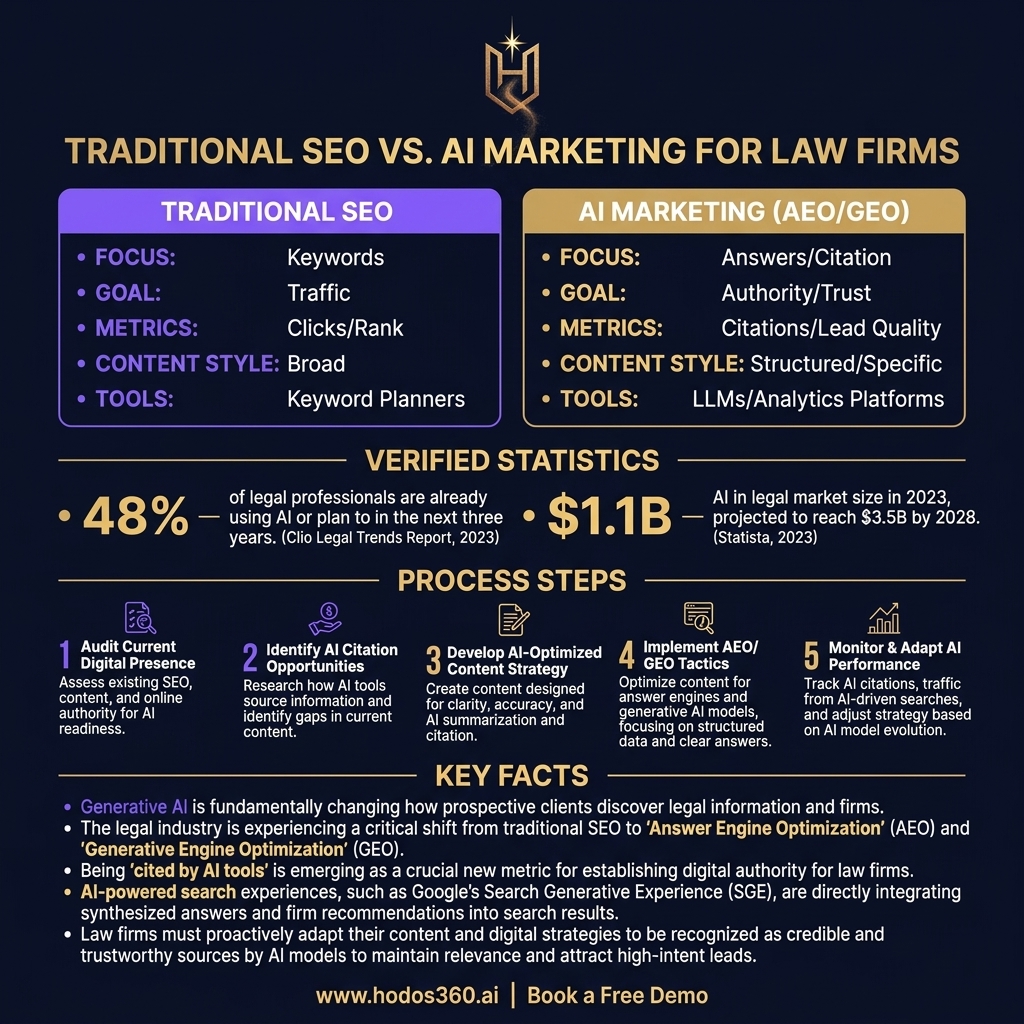
AEO is fundamentally different from traditional SEO because it targets the *answer* rather than just the *query*. AI models prioritize content that directly, concisely, and authoritatively answers specific questions. For law firms, this means restructuring content to provide clear, actionable insights on common legal issues. Instead of a broad article on 'Contract Law,' an AEO approach might involve a series of detailed FAQs like 'What are the essential elements of a valid contract in California?' or 'How does breach of contract impact business agreements?' Structured data, semantic markup, and a clear, logical content hierarchy become crucial. Learn more about AI Legal Research: The Ultimate Guide for Law Firms. This strategy ensures that when an AI system processes a user's legal question, it can quickly identify and extract the relevant, expert-backed answers from your firm's content, increasing the likelihood of direct citation and recommendation. The emphasis shifts from keyword stuffing to providing genuine value and clarity that AI can easily parse and present to users.
Strategies for AI-Powered Content and Brand Building
Leveraging AI for content generation and brand building in the legal sector requires a strategic, human-centric approach. While AI can rapidly draft initial content, the nuanced complexities of legal advice demand attorney oversight and refinement. Firms like 'LegalTech Innovations,' a startup specializing in AI-driven legal solutions, have demonstrated success by using AI to generate first drafts of legal explainers, blog posts on emerging regulations, and even social media updates. Their CTO, Dr. Anya Sharma, emphasizes that AI acts as a force multiplier, allowing their small team to produce high-volume, high-quality content that would be impossible with traditional methods. However, every piece is rigorously reviewed by a human attorney to ensure accuracy, ethical compliance, and alignment with the firm's specific brand voice. This hybrid approach ensures efficiency without compromising the critical human element of legal expertise.
Beyond text, AI is revolutionizing visual and multimedia content. Learn more about AI Operational Intelligence: The Essential Shift for Law Firms. AI video creation tools can transform written legal summaries into engaging animated explainers or short social media clips, making complex legal topics accessible to a broader audience. Social media automation, powered by AI, ensures consistent, strategic posting across platforms, keeping your firm top-of-mind. Furthermore, AI can analyze audience engagement data to identify trends and tailor content, allowing firms to build a digital brand that resonates deeply with their target demographic. Imagine an AI-powered system identifying a surge in queries about 'remote work compliance' in your region and automatically generating a series of LinkedIn posts, a short explainer video, and a blog update, all optimized for AI citation and client engagement. This proactive, data-driven content strategy is what differentiates leading firms in the current competitive landscape.
Crafting AI-Ready Legal Content
To truly thrive in the AI era, law firms must craft content specifically designed for AI consumption. This means prioritizing clarity, conciseness, and structured information. Think of your content as a knowledge base for AI. Utilize clear headings, bullet points, and summary paragraphs that directly answer common legal questions. Incorporate original research, unique case studies, and thought leadership pieces that demonstrate distinct expertise, as AI models are increasingly valuing novel insights over rehashed information. Learn more about AI Website Building: The Ultimate Guide for Law Firms. Ensure all claims are properly attributed and verifiable, aligning with the highest standards of legal scholarship. This meticulous approach not only enhances AI's ability to cite your firm but also reinforces your reputation as an authoritative and trustworthy source for legal information, appealing to both AI and human clients alike. Prioritize creating content that is comprehensive yet easily digestible by both algorithms and individuals.
- ✓Prioritize Clarity and Conciseness: AI thrives on direct, unambiguous language. Avoid jargon where possible, or clearly define it.
- ✓Structure for Scannability: Use headings (H1, H2, H3), bullet points, and numbered lists to break down complex legal topics.
- ✓Answer Specific Questions: Frame content around common legal queries, providing direct, authoritative answers.
- ✓Incorporate Structured Data: Utilize schema markup to help AI understand the context and nature of your content.
- ✓Cite Sources Rigorously: Just as in legal writing, proper citation builds trust with both human readers and AI models.
- ✓Focus on Original Thought Leadership: AI values unique insights and original research that adds new value to the knowledge base.
- ✓Regularly Update Content: Ensure legal information remains current and accurate, signaling reliability to AI systems.
Measuring Impact: Analytics and ROI in AI Marketing
In any marketing endeavor, measuring return on investment (ROI) is crucial, and AI marketing is no exception. However, the metrics shift. Beyond traditional website traffic and lead generation, firms must now track new indicators such as 'AI citation frequency'—how often their content is directly referenced by generative AI tools—and 'AI-attributed lead quality.' This requires sophisticated analytics that can trace client journeys from an AI-generated answer back to the firm. For instance, a 2023 report by the ABA's Legal Technology Resource Center indicated that firms utilizing advanced analytics saw a 15% increase in qualified leads compared to those relying on basic metrics. This data suggests that understanding the full impact of AI marketing extends beyond vanity metrics to tangible business outcomes.
Firms must invest in platforms that offer robust analytics and ROI tracking capabilities, allowing them to precisely understand which AI marketing efforts are yielding results. Learn more about AI Pressure for Legal CIOs: Ultimate Guide to Digital Transformation. This includes monitoring social media engagement driven by AI-generated content, analyzing the performance of AI-created video campaigns, and tracking the conversion rates of leads sourced via AI voice assistants. The HODOS 360 AI Marketing Platform provides comprehensive analytics and ROI tracking, giving law firms the granular data needed to refine their strategies, optimize their spend, and demonstrate the tangible value of their AI marketing investments. By understanding what resonates with AI systems and, by extension, with potential clients, firms can continuously adapt and improve their digital authority strategy, ensuring every marketing dollar is spent effectively.
Leveraging AI for Multichannel Engagement
AI's power extends beyond content creation to optimizing how law firms engage with clients across multiple channels. From personalizing email newsletters based on client interests identified by AI, to automating responses on social media, AI ensures a consistent and highly relevant client experience. For example, some progressive firms are integrating AI Voice Assistants, such as those offered by HODOS 360, to handle initial client inquiries, qualify leads, and even book appointments 24/7. This not only improves client satisfaction through immediate responses but also frees up legal staff to focus on complex legal work. AI-driven multichannel strategies allow firms to maintain a pervasive and authoritative presence, ensuring that their expertise is accessible and their brand is consistently reinforced wherever potential clients seek legal information.

Key Takeaways and Next Steps for Law Firms
The emergence of generative AI marks a definitive turning point in legal marketing. The days of passively waiting for clients to stumble upon your website are over. Law firms must proactively engage with AI, understanding its mechanisms and optimizing their digital presence to be not just discoverable, but citable and authoritative by these powerful tools. As Sutra Creative's new programs highlight, the future of brand visibility lies in mastering AI interaction. Firms that embrace this shift will solidify their reputation, attract high-value clients, and secure their position at the forefront of the legal industry. The competition is fierce, with early adopters already gaining significant ground. The time to act is now, not when your competitors have already cornered the AI-driven market.
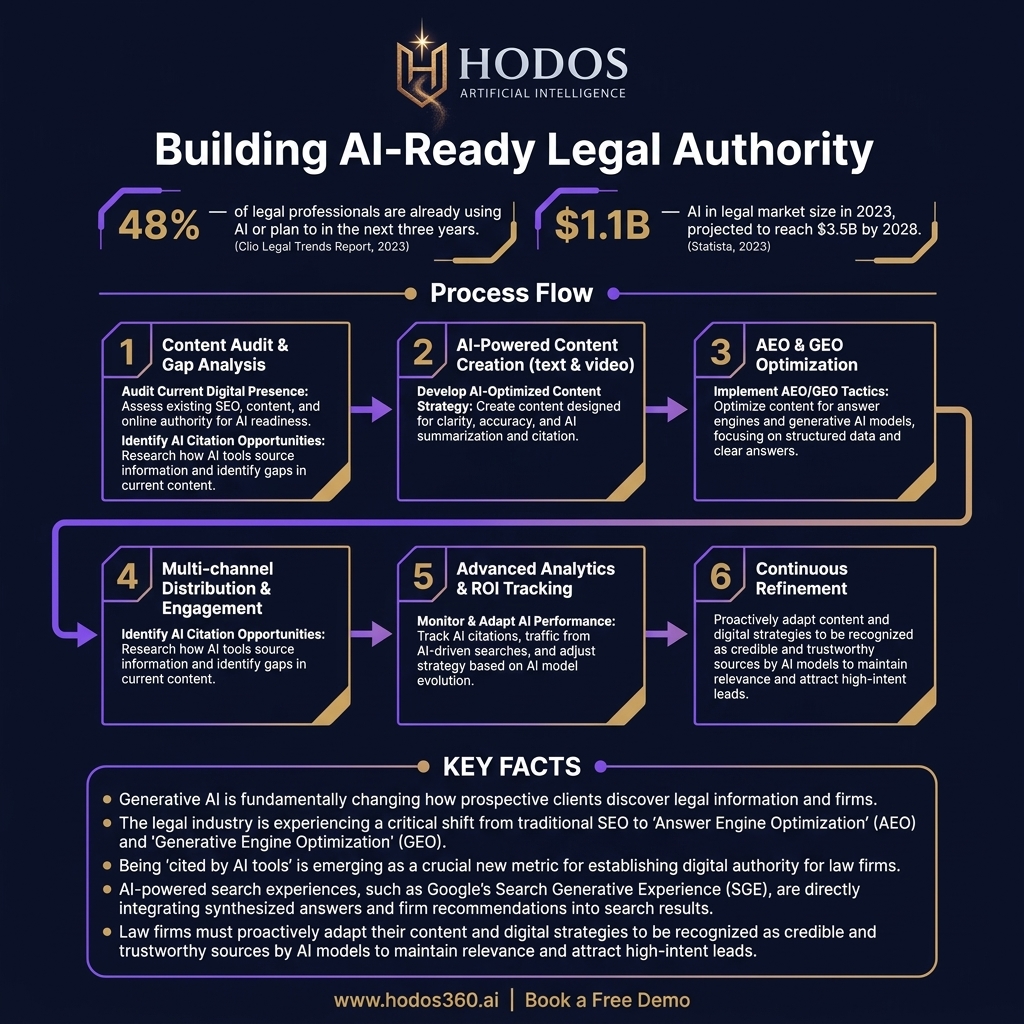
To begin your firm's journey into advanced AI marketing, consider a multi-pronged approach. First, conduct a thorough audit of your existing digital content to identify gaps and opportunities for AI optimization. Second, invest in AI-powered marketing platforms that offer comprehensive solutions, from content generation and social media automation to advanced analytics. Finally, foster a culture of continuous learning within your firm, ensuring your team is equipped to leverage these new technologies effectively. The future of legal authority is intertwined with AI, and HODOS 360 is here to help your firm navigate this exciting, complex, and ultimately rewarding path.
Frequently Asked Questions
What is AI marketing for law firms?+
AI marketing for law firms involves using artificial intelligence tools and strategies to enhance digital presence, attract clients, and build authority. This includes AI-powered content creation, social media automation, video generation, and optimizing for generative AI search results (AEO/GEO) to ensure the firm's expertise is cited by AI tools and recognized as a reliable source of legal information.
How does AI citation benefit my law firm?+
Being cited by AI tools like Google's SGE or legal research platforms offers unparalleled credibility. When AI references your firm's content, it acts as a powerful endorsement, positioning your practice as an authoritative source. This can significantly increase brand visibility, drive high-quality leads, and differentiate your firm in a competitive legal market, leading to greater client trust and engagement.
What is Answer Engine Optimization (AEO) and why is it important?+
AEO is the practice of optimizing content to directly answer user queries, making it easily digestible and citable by AI-powered search engines. It's crucial because AI models synthesize information into direct answers, often bypassing traditional search results. For law firms, AEO ensures their expert insights are prominently featured in AI-generated responses, enhancing authority and direct discoverability.
Can AI tools create legal content for my firm?+
Yes, AI tools can generate drafts of legal content like blog posts, articles, and social media updates, significantly boosting efficiency. However, human oversight by qualified attorneys is essential to ensure accuracy, ethical compliance (per ABA Model Rules 7.1 and 7.2), and alignment with the firm's specific expertise and brand voice. AI acts as a powerful assistant, not a replacement for legal judgment.
How can HODOS 360 help my law firm with AI marketing?+
HODOS 360 offers a comprehensive AI Marketing Platform designed for law firms. It includes AI video creation, social media automation, advanced content generation tools, and robust analytics with ROI tracking. These services empower your firm to build digital authority, optimize for AI citation, engage prospective clients across multiple channels, and measure the tangible impact of your AI marketing investments, driving growth and relevance.