

AI Marketing Measurement: Essential Strategies for Law Firms
The bustling energy of the MarTech Summit Bangkok 2026, held recently in October, reverberated with discussions on the future of digital client acquisition. Yet, amidst the excitement surrounding AI's transformative potential, a significant challenge emerged: the "AI marketing measurement gap." As reported by KoreaTechDesk, this gap highlights a widespread difficulty for businesses, including law firms, in accurately quantifying the return on investment (ROI) from their AI-powered marketing initiatives. For legal professionals, this isn't merely a technical hurdle; it represents a strategic imperative. In an industry where client acquisition costs are rising and competition is fierce, understanding precisely which AI marketing efforts drive genuine engagement and case intake is paramount. The stakes are higher than ever, demanding a sophisticated approach to AI marketing measurement that aligns with legal ethics and client confidentiality.
The legal landscape is undergoing a rapid digital transformation, fueled by innovations in artificial intelligence. From AI-powered content generation to sophisticated social media automation, law firms are increasingly leveraging these tools to expand their reach and attract new clients. However, the promise of these technologies can only be fully realized if firms can effectively track, analyze, and optimize their performance. Without a clear framework for AI marketing measurement, even the most advanced AI platforms risk becoming costly experiments rather than engines of growth. As Jack Newton, CEO of Clio, frequently emphasizes, data-driven decisions are the cornerstone of modern law practice management. The insights gleaned from robust marketing analytics not only justify investment in martech but also inform broader business strategies, enabling firms to adapt to evolving client expectations and market dynamics with agility. This post explores the dimensions of this measurement challenge and offers actionable strategies for law firms to bridge the gap, ensuring their AI marketing efforts translate into tangible legal business success.
Ready to transform your firm's marketing? Discover how HODOS 360's AI Marketing Platform can boost your ROI.
The AI Marketing Measurement Gap in Legal: A Deeper Dive
The "AI marketing measurement gap" isn't new, but its prominence at the MarTech Summit Bangkok 2026, where senior marketing leaders from across Thailand gathered to explore digital strategies, underscores its escalating urgency. For law firms, this challenge is nuanced due to the industry's unique regulatory environment and client relationship dynamics. Unlike e-commerce, legal services involve high-stakes decisions, longer client acquisition cycles, and stringent ethical guidelines that govern advertising, such as ABA Model Rule 7.1. This rule dictates that "a lawyer shall not make a false or misleading communication about the lawyer or the lawyer’s services," extending to AI-generated content and targeted digital campaigns, making accurate and transparent measurement critical for both ROI and compliance.
Consider the complexities: a law firm deploys an AI-powered content generation tool or social media automation. While engagement metrics like likes or website visits are easily tracked, attributing these top-of-funnel activities directly to a signed retainer agreement can be elusive. The journey from initial contact to client conversion often involves multiple touchpoints—an AI-driven ad, an informative blog post, a consultation with an AI voice assistant, and finally, a direct interaction with an attorney. Discerning which of these AI-powered interventions truly influenced the client's decision requires sophisticated attribution modeling, a capability many firms currently lack. This deficiency was a key point of discussion among attendees at the Hotel Nikko Bangkok, highlighting that even firms actively launching AI initiatives often struggle to prove their value beyond anecdotal evidence.
Furthermore, the legal sector grapples with inherent data privacy concerns that affect how marketing data can be collected and utilized. Regulations like the California Consumer Privacy Act (CCPA) and the EU's General Data Protection Regulation (GDPR) impose strict rules on data collection, processing, and storage. Learn more about AI Legal Workflows: Essential Guide to India's Tech Leap. Law firms, as custodians of highly sensitive client information, must navigate these meticulously, often limiting the granularity of data they can gather for marketing analytics. This creates a tension: the need for comprehensive data to fuel effective AI marketing and the ethical obligation to protect client privacy. This delicate balance means legal professionals must develop bespoke measurement strategies that respect privacy while still delivering actionable intelligence.
This competitive landscape further intensifies the need for precise AI marketing measurement. Firms that can effectively demonstrate the ROI of their digital marketing spend are better positioned to allocate resources strategically, outmaneuver competitors, and secure a greater market share. Conversely, those operating with a significant measurement gap risk inefficient spending, missed opportunities, and a gradual erosion of their competitive edge. As evidenced by the rapid adoption of AI by some of the largest firms—like Allen & Overy's partnership with Harvey AI for legal research—the legal industry is bifurcating. Firms that invest in and effectively measure their AI tools are pulling ahead, while those lagging risk becoming obsolete. This creates a human conflict: the disruption versus tradition narrative playing out in real-time, with data-driven insights becoming the arbiter of success.
Ethical AI and Data Privacy in Legal Marketing
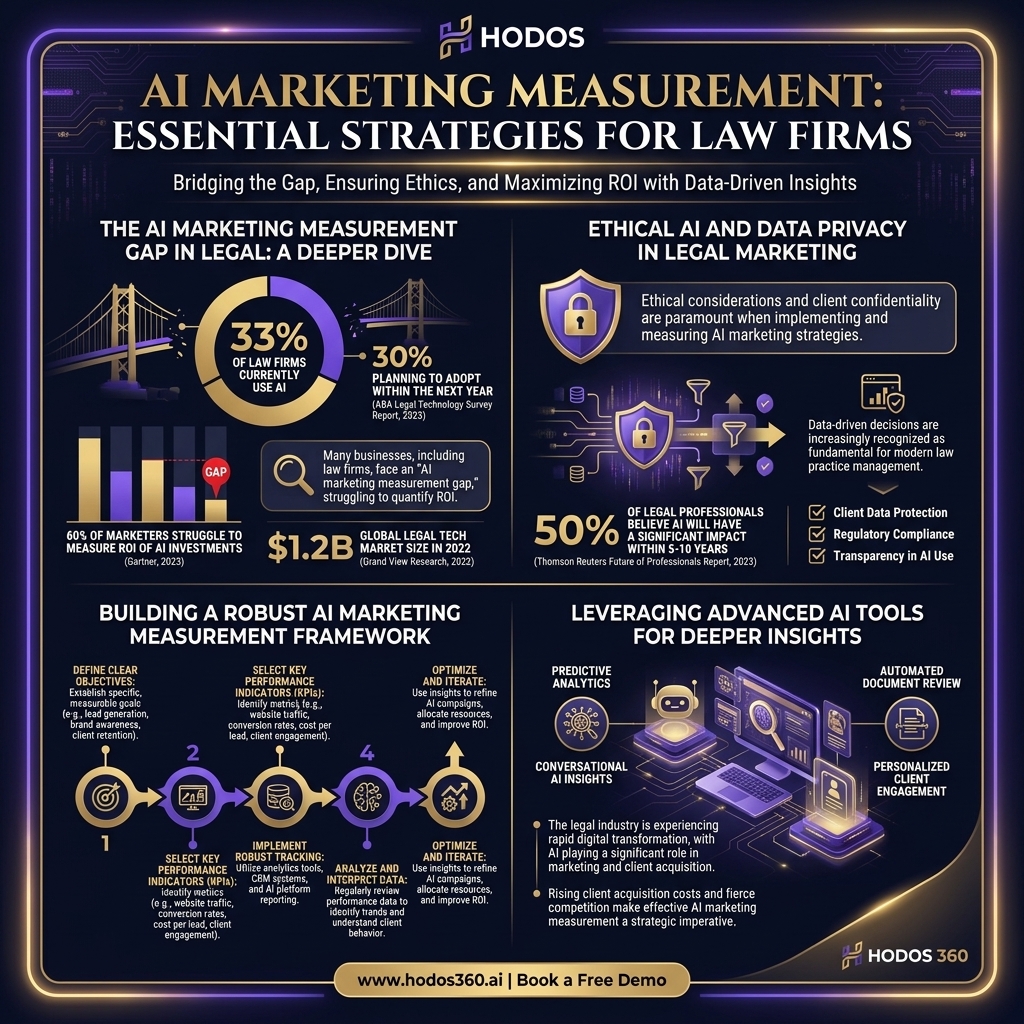
The ethical implications of AI in legal marketing are codified in professional conduct rules and data protection statutes. ABA Model Rule 7.1 mandates that lawyer communications must not be false or misleading, extending to AI-generated content and AI advertising. For instance, if an AI marketing platform inadvertently misrepresents a firm's expertise, the firm bears ethical responsibility. Beyond truthfulness, data collection for personalized marketing must adhere to privacy regulations like the CCPA. Learn more about Legal Website Builder: Essential Strategies for Law Firm Digital Growth. The Federal Trade Commission (FTC) also has jurisdiction over deceptive practices. Firms must ensure their AI marketing tools respect these boundaries, obtaining necessary consents and anonymizing data, to avoid ethical breaches and potential legal repercussions.
Building a Robust AI Marketing Measurement Framework
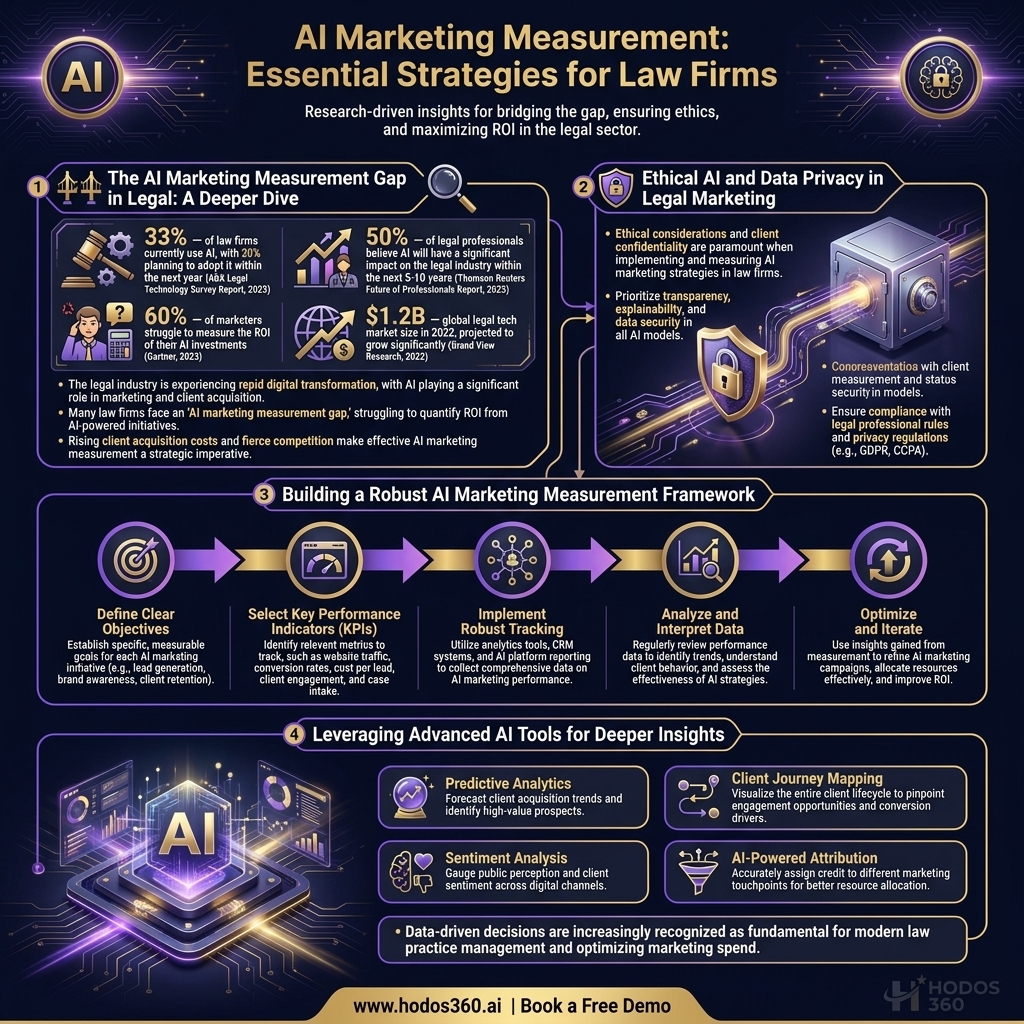
To effectively bridge the AI marketing measurement gap, law firms must move beyond superficial metrics and establish a robust framework that integrates AI's capabilities with clear strategic objectives. This begins with defining precise Key Performance Indicators (KPIs) that directly correlate with business growth, rather than vanity metrics. For a law firm, these might include qualified lead generation, client conversion rates for specific practice areas, average client lifetime value (CLTV), or the cost per acquisition (CPA) for a new case. Simply tracking website traffic generated by an AI-written blog post is insufficient; the true measure lies in how that traffic translates into actual client inquiries and signed retainers. Firms like Dentons, a global law firm known for its innovative approach, are increasingly leveraging sophisticated data analytics teams to track the entire client journey, identifying bottlenecks and optimizing touchpoints, often integrating AI-powered insights into their CRM systems.
A critical component is implementing advanced attribution models. Traditional "first-touch" or "last-touch" attribution often fails to capture the multi-faceted influence of AI in a complex client journey. Instead, law firms should explore multi-touch attribution models, such as linear or time decay, which assign credit to various AI-powered interactions across the client lifecycle. For example, an AI-generated social media ad might introduce a potential client, followed by an AI voice assistant answering initial queries, and finally, a human attorney closing the deal. A sophisticated attribution model can weigh each of these AI contributions, providing a more accurate picture of ROI. This requires integrating data from disparate sources—your AI marketing platform, CRM, website analytics, and even your case management system—to create a unified view of the client pipeline.
Data integration and hygiene are foundational to any effective AI marketing measurement strategy. Learn more about Legal AI: Essential Coordination for Firm Growth. Fragmented data across various platforms (e.g., social media analytics, email marketing tools) renders comprehensive analysis impossible. Law firms need systems that can centralize this data, clean it, and make it accessible for AI-driven analytics. This is where platforms like HODOS 360's AI Law Firm Management System become invaluable, offering not just case management and billing, but also robust client intake and document automation capabilities that can integrate seamlessly with marketing data. By unifying these systems, firms can gain a holistic understanding of how marketing efforts translate into operational efficiency and client satisfaction, providing a clear line of sight from initial marketing spend to final revenue.
The adoption of AI-powered analytics tools is also crucial. These tools go beyond basic reporting, utilizing machine learning algorithms to identify patterns, predict future trends, and uncover hidden correlations within vast datasets. For example, an AI analytics platform might predict which type of content or advertising channel is most likely to attract high-value clients for a specific practice area. This predictive intelligence allows firms to shift from reactive reporting to proactive, data-driven strategy, optimizing their marketing spend in real-time. By continuously testing, learning, and refining their AI marketing campaigns based on these insights, law firms can ensure their efforts are not just visible, but genuinely effective in driving sustainable growth.
Unlock the full potential of your firm's data. Schedule a free consultation to see HODOS 360's integrated AI solutions in action.
- ✓AI-Powered Content Generation: Tools that assist in drafting legal articles, blog posts, social media updates, and website copy, ensuring brand consistency and adherence to ethical guidelines.
- ✓Social Media Automation & Scheduling: Intelligent scheduling and distribution of content across various legal and general social platforms, optimized for audience engagement and reach.
- ✓Targeted Advertising & Campaign Management: AI algorithms that identify and target specific client demographics and legal needs, maximizing ad spend efficiency while respecting privacy.
- ✓Comprehensive Analytics & ROI Tracking: Dashboards and reporting tools that provide real-time insights into campaign performance, lead quality, conversion rates, and overall marketing ROI.
- ✓Client Intake & Lead Qualification Integration: Seamless connection with CRM and client intake systems to ensure a smooth transition from marketing lead to qualified prospect.
- ✓Multilingual Support & Localization: For global firms, AI tools that can adapt marketing content and campaigns for diverse linguistic and cultural audiences, enhancing global reach.
- ✓Predictive Analytics for Client Behavior: AI models that forecast future client needs, identify potential high-value leads, and personalize communication strategies.
Leveraging Advanced AI Tools for Deeper Insights
Beyond foundational measurement, the true power of AI lies in its ability to generate deeper, more nuanced insights previously unattainable. For law firms, this means moving beyond simple performance metrics to understanding the underlying motivations and behaviors of potential clients. Predictive analytics, for instance, can analyze historical data to forecast future trends in legal demand, allowing firms to proactively adjust marketing strategies. Imagine an AI identifying an emerging surge in demand for specific intellectual property litigation due to recent technological advancements. A firm equipped with such intelligence can launch targeted campaigns ahead of competitors, securing a first-mover advantage. This kind of strategic foresight, powered by sophisticated AI, transforms marketing from a reactive expense into a proactive growth engine.
Sentiment analysis is another powerful AI application for law firms. By analyzing public discourse across social media, legal forums, and news articles, AI can gauge public perception of legal issues, competitor firms, and even the firm itself. Understanding the sentiment surrounding particular legal topics can inform content strategy, allowing firms to create empathetic and relevant messaging. For example, if public sentiment around a specific corporate scandal is highly negative, a firm specializing in corporate governance can craft timely, authoritative content that addresses these concerns, positioning themselves as trusted advisors. This real-time understanding of public mood and legal discourse provides an invaluable edge in shaping brand reputation and client engagement.
The integration of AI-driven tools like those offered by HODOS 360's AI Marketing Platform extends to enhancing content performance tracking and optimization. Instead of manually reviewing which blog posts or social media campaigns perform best, AI can automatically analyze engagement rates, conversion paths, and even the sentiment generated by different pieces of content. Learn more about AI Voice Agent: Essential Legal Firm Automation for 2026. This allows for iterative improvements, where AI can suggest optimal keywords, content formats, or distribution channels based on real-time performance data. For a firm like Latham & Watkins, known for its extensive thought leadership, AI can ensure that their vast output of legal insights reaches the most relevant audiences, maximizing their influence and lead generation potential. This continuous feedback loop ensures that marketing efforts are constantly refined, leading to increasingly effective and efficient client acquisition.
Furthermore, AI can personalize the client experience at scale. By analyzing individual user behavior and preferences, AI can deliver highly relevant content, service recommendations, and communications. This hyper-personalization, a key theme at martech conferences globally, is particularly impactful in legal services, where trust and relevance are paramount. Imagine a potential client visiting a firm's website. An AI can dynamically adjust the displayed content to highlight relevant practice areas, case studies, or attorney profiles based on the visitor's browsing history or inferred legal needs. This level of personalized engagement builds rapport and trust, significantly increasing the likelihood of conversion. The ability to offer a tailored experience demonstrates that the firm understands the client's unique situation, a crucial factor in the legal decision-making process.
The Role of AI in Content Generation and Social Media Automation
AI's capacity for content generation and social media automation is revolutionizing how law firms communicate their expertise. Advanced large language models can draft initial versions of articles, case summaries, and marketing copy, freeing up attorneys to focus on complex legal work. While human oversight remains essential for accuracy and ethical compliance, AI significantly accelerates content creation. Similarly, AI-powered social media tools automate scheduling, posting, and basic interaction on platforms like LinkedIn. Learn more about AI Workflows: Essential for Modern Legal Teams' Efficiency. This automation ensures a consistent online presence, amplifies the firm's message, and allows for real-time engagement monitoring, all while adhering to brand voice and legal advertising standards. This efficiency is critical for firms aiming to maintain a strong digital footprint without overextending human resources.
Navigating the Competitive Landscape: Firms That Lead vs. Lag
The narrative of "disruption vs. tradition" is vividly playing out in the legal sector's adoption of AI marketing. On one side are the pioneering firms, often larger and more resource-rich, but increasingly including agile mid-sized firms, who have embraced AI not just as a tool, but as a strategic imperative. Firms like Allen & Overy, with their high-profile partnership with Harvey AI, exemplify this forward-thinking approach, demonstrating how technology can augment legal services and, by extension, market their innovative capabilities. These leaders are investing in robust AI marketing measurement platforms, integrating their data streams, and leveraging predictive analytics to gain a decisive competitive advantage. According to a 2024 Thomson Reuters report on the State of the Legal Market, firms that actively invest in and effectively utilize legal technology, including marketing automation, report up to a 15% higher growth rate in revenue compared to their less technologically advanced counterparts.
Conversely, many firms continue to lag, often due to a combination of technological inertia, skepticism regarding AI's efficacy, or a lack of understanding about how to implement and measure these tools effectively. This hesitation is creating a widening gap in client acquisition and retention. While these firms may still rely on traditional marketing channels or basic digital presence, they struggle to compete with the precision targeting, personalized engagement, and efficiency offered by AI-driven strategies. The market competition is intense, and clients, increasingly digital-native, are gravitating towards firms that demonstrate technological fluency and responsiveness. The "human conflict" here isn't just about technology, but about mindset—the willingness to adapt and innovate versus the comfort of established practices. Firms that fail to bridge the AI marketing measurement gap risk not only losing market share but also falling behind in talent acquisition, as tech-savvy lawyers seek out more progressive environments.
A compelling example of this divergence can be seen in lead qualification. Learn more about AI Marketing Automation: The Ultimate Guide for Law Firms. Firms leveraging AI voice assistants, such as those offered by HODOS 360, can provide 24/7 phone answering, instantly qualify leads, and book appointments, dramatically reducing response times and improving conversion rates. This immediate, efficient service stands in stark contrast to firms that rely solely on human receptionists during business hours, often missing potential clients who call after hours or require immediate assistance. The firms leading in AI adoption are converting more inquiries into clients, and they can prove it with data. This ability to quantify the impact of AI on their bottom line empowers them to make smarter investment decisions, further cementing their lead in the market.
The competitive edge gained by early adopters extends beyond just client acquisition. It also impacts brand perception and thought leadership. Firms that consistently publish high-quality, AI-assisted content on emerging legal trends, and effectively distribute it through automated social media channels, establish themselves as authoritative voices in their respective fields. This thought leadership, when measured through engagement, lead generation, and media mentions, translates into enhanced brand equity and a stronger reputation. For example, a firm that uses AI to analyze recent court rulings and quickly publish insights on their implications can become a go-ahead resource for clients and journalists alike. This proactive, data-driven approach to content and distribution ensures that their intellectual capital translates into tangible business development, further highlighting the stark contrast with firms that remain reactive or unmeasured in their digital presence.
Integrating AI Marketing with Law Firm Management Systems
The true synergy of AI in legal operations emerges when marketing insights are seamlessly integrated with broader law firm management systems. An AI Marketing Platform, like HODOS 360's, should not operate in a silo. Its data on lead sources, client acquisition costs, and conversion rates needs to flow directly into the AI Law Firm Management System. This integration allows for a holistic view of profitability, enabling firms to understand which marketing channels deliver the most profitable cases, not just the most leads. For example, knowing that "AI-generated content on personal injury law" consistently brings in higher-value cases allows the firm to allocate more marketing budget to that specific strategy. This connectivity also streamlines client intake, automates document creation for new matters, and ensures accurate billing from the outset, turning marketing success into operational efficiency.