


AI-Powered WordPress: The Ultimate Guide for Law Firms
The digital landscape for legal professionals is shifting dramatically, with technology now dictating the pace of client acquisition and firm growth. Consider the narrative of "Justice & Associates," a mid-sized firm in Austin, Texas, led by partners Sarah Chen and David Rodriguez. For years, their online presence was a static, outdated website, a digital relic that struggled to convert visitors into qualified leads. Despite their exceptional legal talent, they often found themselves losing potential clients to competitors with more dynamic, user-friendly, and search-engine-optimized platforms. The tension was palpable: how could they modernize their digital footprint without exorbitant costs or a lengthy development cycle that diverted focus from their core legal work?
The answer, increasingly, lies in the burgeoning field of AI-powered web development. The recent Namecheap webinar on AI-powered WordPress website creation, highlighted by FinancialContent, serves as a significant market signal: this isn't a niche trend, but a mainstream imperative. It underscores a pivotal moment where sophisticated web presence, once the exclusive domain of large corporations and their high-budget agencies, is now democratized for law firms of all sizes. This isn't just about building a pretty site; it's about crafting a strategic digital asset that performs, attracts, and converts. Firms like Justice & Associates are now realizing that leveraging AI in their WordPress hosting and design is not merely an upgrade, but a critical competitive differentiator in a crowded legal market. Ready to transform your law firm's digital footprint? Discover HODOS 360's Web & Mobile Development solutions today!
The Dawn of AI-Powered Legal Web Development
Historically, law firms have grappled with establishing a robust and effective web presence. Many have relied on generic templates, which fail to convey the firm’s unique value proposition, or have invested heavily in bespoke solutions from agencies unfamiliar with the nuances of legal marketing and ethical compliance. As Jack Newton, CEO of Clio, frequently emphasizes, a strong digital presence is no longer optional but fundamental to modern legal practice. Firms often face challenges in articulating their specialized services and building trust online, leading to missed opportunities and a perception gap between their actual expertise and their digital representation. This struggle has created a void that AI website builder technologies are now rapidly filling, offering tailored solutions without the traditional overhead.
Today, the advent of AI-powered website builders, exemplified by platforms like Sitejet AI Builder, which seamlessly integrates with WordPress, is revolutionizing this landscape. These tools leverage artificial intelligence to automate various aspects of web creation, from initial design concepts to content generation and image optimization. Imagine an AI analyzing your firm's practice areas, target audience, and competitive landscape to suggest optimal layouts, color schemes, and even write initial drafts of service pages. Learn more about Wordsmith AI's $100M Valuation: An Essential LegalTech Milestone. This capability significantly reduces the time and cost associated with web development, making professional, high-performing websites accessible to a broader range of law firms. According to Gartner, by 2027, 30% of new websites will be generated using AI, a dramatic increase from less than 5% in 2023, underscoring the rapid adoption and transformative potential of this technology.
The core benefit for law firms is the ability to project professionalism, establish trust, and enhance accessibility with unprecedented efficiency. AI can help tailor website content for specific legal niches, whether it’s a personal injury firm needing empathetic language and clear calls to action, or a corporate law practice requiring authoritative, data-driven content. This level of customization ensures that the website not only looks good but also effectively communicates the firm’s expertise and values. Moreover, the iterative nature of AI development means that these tools are constantly learning and improving, offering law firms an evolving platform that stays ahead of digital trends, ensuring their online presence remains cutting-edge and relevant in a dynamic legal market.
The Strategic Edge of AI-Driven Content
Beyond mere aesthetics, AI-driven content generation provides a strategic advantage. For law firms, this means AI can assist in drafting blog posts on recent court rulings, creating detailed FAQs for prospective clients, or even generating compelling case studies while ensuring ethical boundaries are respected. This significantly alleviates the burden on attorneys to constantly produce fresh content, freeing them to focus on their legal work. Learn more about Voice Agents: Essential AI for Law Firm Client Engagement. Furthermore, AI tools can analyze vast amounts of data to identify trending legal topics and client pain points, enabling firms to proactively create content that addresses these needs and positions them as thought leaders in their respective fields. This capability is particularly valuable for smaller firms without dedicated marketing teams, offering them a powerful tool to compete effectively with larger, more resourced competitors in the digital arena.
Crafting a High-Converting Legal Website with AI WordPress Tools
The practical application of AI in WordPress for law firms extends from the foundational aspects of site construction to advanced client conversion strategies. It begins with intelligent domain selection and robust WordPress hosting, where AI tools can analyze market trends and competitor presence to suggest optimal domain names that enhance searchability and brand recall. Once the foundation is laid, AI can assist in generating compelling content that resonates with target audiences. These tools can analyze top-ranking legal websites, identify high-value keywords for specific legal queries (e.g., "estate planning attorney in [City]"), and even suggest blog topics that address common client questions, ensuring every piece of content is strategically aligned with client needs and search intent. This data-driven approach ensures that the website isn't just informative but also a powerful lead generation engine.
SEO for law firms is critically enhanced by AI. Beyond keyword integration, AI can optimize meta descriptions, generate appropriate alt-text for images, and even refine site architecture for improved crawlability and search engine visibility. For instance, AI algorithms can identify local SEO opportunities, ensuring a firm targeting "Chicago personal injury lawyer" appears prominently in relevant local searches. The ABA's 2024 Legal Technology Survey Report highlighted client acquisition as a persistent challenge for many firms; AI-powered SEO directly addresses this by driving organic traffic. Learn more about AI Back Office: Ultimate Guide for Law Firm Efficiency. Furthermore, AI contributes significantly to superior user experience (UX) by ensuring responsive design across all devices, a crucial factor given that over 60% of website traffic now originates from mobile devices, according to recent web analytics data. AI can also assist in A/B testing different design elements and calls-to-action to optimize conversion rates, turning visitors into qualified leads.
Client intake and conversion are also profoundly transformed. AI-powered chatbots, seamlessly integrated into WordPress sites, can engage prospective clients 24/7, qualify leads based on predefined criteria, answer common legal questions, and even book initial consultations directly into the firm’s calendar. This automation streamlines a traditionally labor-intensive process, reducing administrative overhead and ensuring no lead is missed, even outside of business hours. For example, a chatbot can ask about the nature of a legal issue, gather contact information, and determine if the case aligns with the firm's expertise, providing a warm handover to a human attorney. This efficient funnel not only improves client satisfaction but significantly boosts the firm's capacity to handle new inquiries, turning website visitors into loyal clients. Ready to build a high-converting legal website? Explore HODOS 360's AI-Powered Web & Mobile Development services!
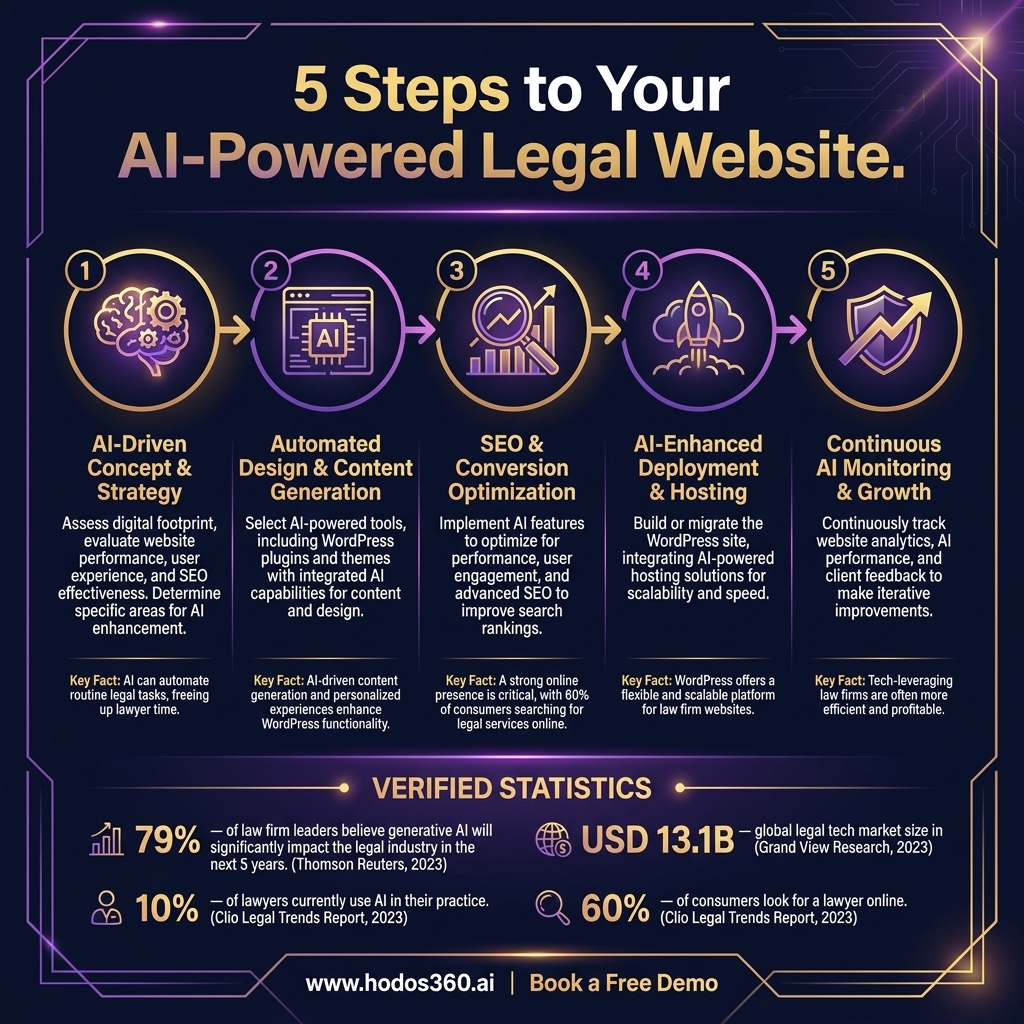
- ✓Automated Content Creation: AI assists in drafting blog posts, articles, and website copy tailored to legal topics, saving attorneys valuable time.
- ✓Enhanced SEO Capabilities: AI optimizes keywords, meta descriptions, and site structure, improving search engine rankings and visibility for specific legal queries.
- ✓24/7 Lead Qualification: AI-powered chatbots on your website can engage visitors, answer FAQs, qualify potential clients, and even schedule appointments around the clock.
- ✓Personalized User Experience: AI can dynamically adapt website content and navigation based on user behavior and preferences, increasing engagement and conversion rates.
- ✓Proactive Website Maintenance: AI tools continuously monitor site performance, identify security vulnerabilities, and suggest improvements, ensuring your site remains secure and efficient.
- ✓Data-Driven Marketing Insights: AI provides advanced analytics on client journeys and content effectiveness, allowing for precise ROI tracking and optimized marketing spend.
Beyond the Build: AI for Ongoing Website Management and Growth
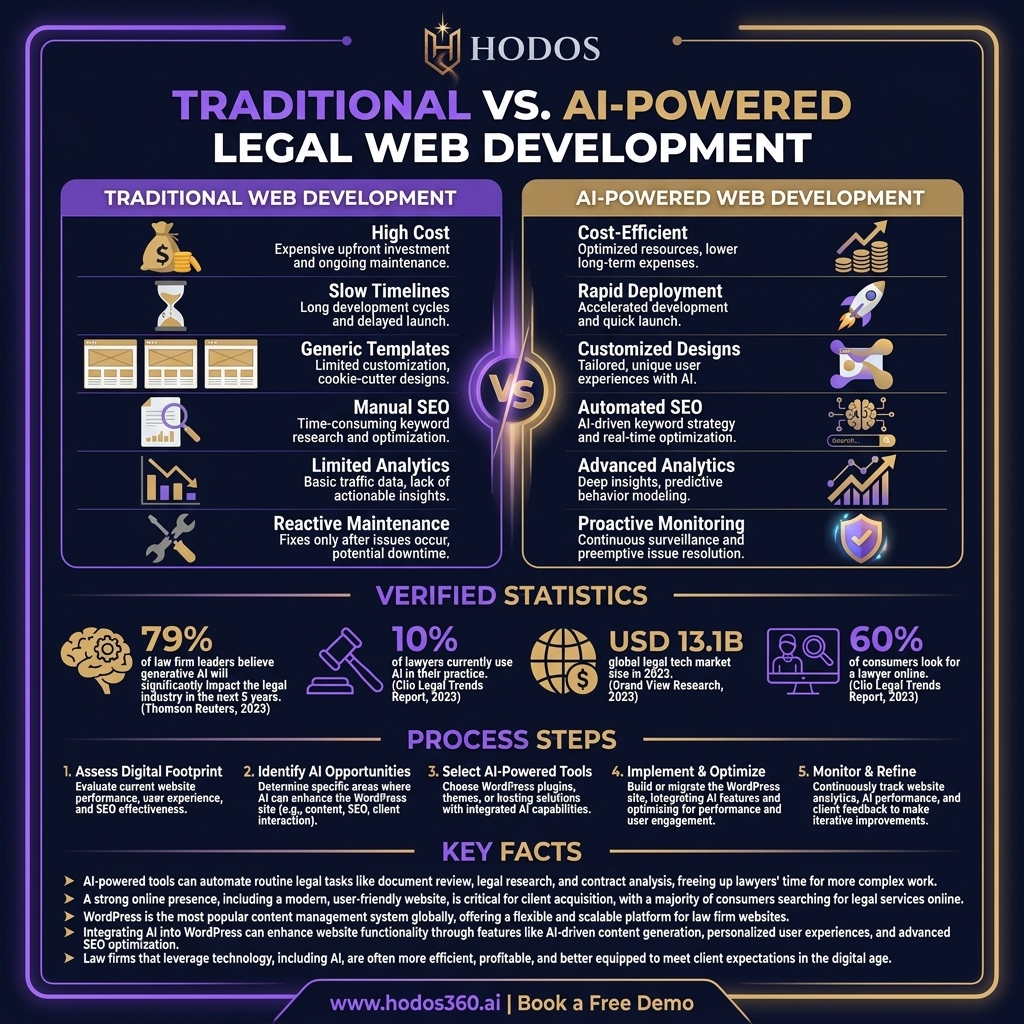
The utility of AI in legal web presence doesn't conclude with the initial site build; it extends dynamically into continuous management and strategic growth. AI tools are capable of constant site monitoring, proactively identifying and rectifying issues such as broken links, slow loading pages, or potential security vulnerabilities before they impact user experience or search engine rankings. This continuous oversight is critical for maintaining a reputable online presence and preventing costly downtimes that could deter potential clients. Firms that leverage AI for this purpose benefit from a website that is not only robust but also consistently optimized for peak performance and security, a stark contrast to the reactive maintenance often associated with traditional web management.
Furthermore, AI significantly bolsters a firm's content generation and social media automation efforts. Attorneys can utilize AI to draft compelling blog posts, articles, and even social media updates based on current legal news, firm achievements, or emerging case law. This continuous influx of fresh, relevant content is vital for maintaining SEO authority and engaging with a broader audience. AI-powered platforms can then automate the scheduling and posting of this content across various social media channels, ensuring consistent brand messaging and extending the firm's digital reach without requiring constant manual oversight. Learn more about Legaltech Rundown: Essential AI Features Transforming Law Firms. This synergy between content creation and distribution amplifies the firm's online visibility, transforming their WordPress site into a central hub for their entire digital marketing ecosystem.
Advanced analytics and precise ROI tracking are another cornerstone of AI-driven website management. Beyond basic traffic metrics, AI can dissect client journey patterns, pinpoint exactly where potential clients drop off, and even predict which content types or calls-to-action resonate most effectively. This granular, data-driven insight allows law firms to measure the return on investment (ROI) of their digital marketing efforts with unprecedented accuracy. By understanding precisely what drives engagement and conversion, firms can optimize their marketing spend, refine their content strategy, and allocate resources more efficiently. This capability transforms website analytics from a passive reporting function into an active, strategic tool for growth, directly impacting a firm’s bottom line by maximizing client acquisition effectiveness.
Personalization and Predictive Analytics in Legal Web Design
The next frontier in AI-powered web development for law firms involves hyper-personalization and predictive analytics. Imagine a website that dynamically adapts its content, calls-to-action, and even visual elements based on a user's previous browsing history, geographic location, or stated legal interests. For instance, a returning visitor who previously viewed estate planning services might be greeted with a prominent article on recent changes in inheritance law, or a direct link to a relevant attorney's profile. AI algorithms can achieve this by analyzing user data to create tailored experiences, significantly increasing engagement and the likelihood of conversion. Learn more about Ethical AI in Legal Tech: An Essential Guide for Law Firms. This predictive capability extends to identifying potential client needs even before they explicitly state them, allowing firms to offer highly relevant information and services. This level of personalized interaction, once reserved for e-commerce giants, is now becoming a powerful tool for law firms to forge deeper connections with their prospective clients.
Ethical Considerations and the Future of AI in Legal Web Presence
While the benefits of AI in web development for law firms are undeniable, their deployment must be navigated with careful consideration for ethical implications. Data privacy is paramount, particularly when AI tools process or store client information, even indirectly through website interactions. Firms must ensure strict compliance with regulations like GDPR, CCPA, and relevant state bar rules regarding confidentiality and client data. ABA Model Rule 1.6 (Confidentiality of Information) and ABA Model Rule 7.1 (Communications Concerning a Lawyer's Services) serve as critical guideposts, mandating transparency and accuracy in all public-facing communications. As Professor Frank Pasquale of Brooklyn Law School often articulates, the 'human element' in legal services remains irreplaceable, and AI should augment, not supplant, the attorney-client relationship, requiring clear disclaimers about AI-generated content or chatbot interactions.
The tension between automation and maintaining professional integrity is a central theme in legal tech. While AI can automate mundane tasks, the nuanced judgment, empathy, and strategic thinking of a human attorney are indispensable. Firms must adopt AI as a co-pilot, a powerful assistant that frees up time for complex legal analysis and client interaction, rather than a full replacement. The ethical use of AI also extends to avoiding algorithmic bias in content generation or client targeting, ensuring that AI-powered websites promote equitable access to justice and do not inadvertently discriminate. This requires ongoing vigilance and a commitment to audit AI systems for fairness and transparency, a responsibility that falls squarely on the shoulders of the firm and its technology partners.
The competitive landscape is already being reshaped. Learn more about Essential AI Deployment: Mastering Embedded AI for Law Firms. Firms that embrace legal tech innovation early, like those leveraging AI for their web presence, are gaining significant advantages in client acquisition and operational efficiency. Conversely, those that resist risk falling behind, potentially creating a 'digital desert' where smaller firms without access to or expertise in AI tools struggle to compete. This dynamic creates market pressure, but also an opportunity for platforms like HODOS 360 to democratize access to advanced AI tools, ensuring that even solo practitioners or small firms can build a sophisticated, high-performing online presence. The goal is to level the playing field, not widen the gap.
Looking ahead, the pace of AI development suggests a future where legal websites are even more integrated and intelligent. Imagine hyper-personalized legal content delivery, real-time preliminary legal advice chatbots (with clear disclaimers and attorney oversight), and even AI-driven legal education modules embedded directly into firm websites. Thomson Reuters' "Future of Legal" reports consistently project increased AI adoption across all facets of legal practice, and web presence is no exception. This evolving landscape demands continuous adaptation, strategic investment, and a forward-thinking approach to how law firms connect with their clients in the digital age. The firms that thoughtfully integrate AI into their web strategy today will be the leaders of tomorrow.
Navigating AI's Impact on Legal Marketing Ethics
Navigating the ethical implications of AI in legal marketing requires a proactive and informed approach. Law firms must ensure that any AI-generated content or automated communication adheres strictly to ABA Model Rule 7.1, which prohibits false or misleading communications about a lawyer's services. This means disclaimers are crucial when AI is used to draft preliminary content or engage in initial client interactions. Furthermore, firms must be transparent about their use of AI, building trust rather than eroding it through opaque practices. The rapidly evolving nature of AI necessitates that firms regularly review their AI policies and practices, perhaps even engaging legal tech ethicists or cybersecurity experts, to ensure ongoing compliance and to mitigate risks associated with data breaches or unintended biases. This vigilance is not just about avoiding penalties; it's about upholding the core values of the legal profession in a technologically advanced era.

Key Takeaways for Law Firms Navigating the AI Web Frontier
The integration of AI-powered WordPress is no longer a futuristic concept but a strategic imperative for law firms aiming to thrive in the digital-first legal landscape. From the initial build of a sophisticated online presence to its continuous management, and the crucial process of client conversion, AI offers unparalleled efficiency, precision, and scalability. Firms like Justice & Associates, once struggling with an outdated website, can now leverage these advanced tools to create dynamic, SEO-optimized platforms that attract and engage their target audience around the clock. The benefits extend beyond aesthetics, encompassing robust lead generation, streamlined client intake, and data-driven marketing decisions that directly impact a firm's growth trajectory.
For law firm owners and legal professionals, the actionable advice is clear: begin by critically assessing your current digital footprint. Explore the capabilities of AI website builder platforms and prioritize those that offer robust security, compliance features, and seamless integration with your existing workflows. Remember that adopting AI is an iterative process, not a one-time deployment; continuous learning and adaptation are key to maximizing its potential. Investing in cutting-edge web development is not merely an expense; it is a strategic investment in the longevity, competitiveness, and sustainable growth of your firm. The legal profession is evolving, and those who embrace technological innovation will be best positioned to lead.
Empower your firm with a state-of-the-art online presence that truly reflects your expertise and drives client acquisition. With HODOS 360’s comprehensive Web & Mobile Development services, including AI-powered website building, responsive design, and SEO optimization, your firm can achieve a high-converting digital footprint designed for the future. Schedule a personalized demo with HODOS 360's Web & Mobile Development experts today!
Frequently Asked Questions
What is AI-powered WordPress and why is it relevant for law firms?+
AI-powered WordPress integrates artificial intelligence tools directly into the WordPress platform, automating aspects of website creation, content generation, and optimization. For law firms, this means building professional, high-performing websites more efficiently, enhancing online visibility, and streamlining client acquisition processes with intelligent features that understand legal-specific needs.
How can AI improve my law firm's website SEO?+
AI significantly boosts SEO by automating keyword research, generating optimized meta descriptions and alt-text, and suggesting content topics based on trending legal queries. It helps refine site structure, ensures mobile responsiveness, and monitors performance to keep your firm's website highly visible on search engines, attracting more qualified leads.
Is it ethical for law firms to use AI for website content and client interaction?+
Yes, but with careful ethical consideration. Firms must ensure AI-generated content is accurate, not misleading (per ABA Model Rule 7.1), and that client confidentiality (Model Rule 1.6) is maintained. Transparency about AI use, clear disclaimers for chatbots, and human oversight are crucial to upholding professional integrity and trust.
What are the typical cost implications of an AI-powered website for a law firm?+
While initial setup might vary, AI-powered websites generally offer significant long-term cost efficiencies compared to traditional bespoke development. They reduce ongoing maintenance, content creation, and marketing expenses. Automation minimizes manual labor, allowing firms to achieve a sophisticated online presence at a more accessible price point, maximizing ROI.
Can AI help with client intake through my website?+
Absolutely. AI-powered chatbots can be integrated into your website to provide 24/7 client intake support. They can answer FAQs, pre-qualify leads based on specific criteria, gather essential contact information, and even schedule initial consultations directly, significantly streamlining your intake process and ensuring no potential client is overlooked.
How does AI handle multilingual support for legal websites?+
AI-powered tools can offer robust multilingual support by accurately translating website content into various languages, ensuring your firm can reach a broader, diverse clientele. Beyond direct translation, advanced AI can adapt content to cultural nuances and legal terminology specific to different regions, enhancing accessibility and engagement for international or non-English speaking clients.