
Essential AI for Vibe Coding: Elevating Legal Web Development
The digital frontier of legal practice is evolving at an unprecedented pace, demanding that law firms not only maintain a robust online presence but innovate with agility. Consider the journey of 'LexFrontier Legal,' a mid-sized firm in San Francisco, whose managing partner, Elena Rodriguez, faced a familiar dilemma in early 2026. Their existing website, built five years prior, was clunky, difficult to update, and failed to convert promising leads.
Elena recounted her frustration at LegalTech NYC 2026, stating, "Every minor change was a multi-week, multi-thousand-dollar ordeal. We knew we needed a site that reflected our forward-thinking practice, but the traditional development cycle was a black hole for resources and time." This sentiment echoes across the legal sector, where the pressure to deliver a seamless, intuitive digital experience for clients is paramount, yet the technical hurdles remain significant.
The recent Hostinger article, "Best AI for vibe coding: 9 tools for web application development," underscores a burgeoning solution: AI for vibe coding. This isn't just a buzzword; it's a paradigm shift in how digital platforms are conceived, built, and iterated upon, offering a lifeline to firms like LexFrontier Legal.
Historically, web development has been a complex, resource-intensive endeavor, often requiring a deep bench of specialized developers, designers, and project managers. For law firms, whose core competency lies in legal expertise, navigating this technical landscape has always been challenging. The market has been rife with generic templates or bespoke solutions that quickly become outdated, failing to meet the dynamic expectations of modern legal consumers.
However, the rapid advancements in generative AI, championed by visionaries like OpenAI's Sam Altman and Anthropic's Dario Amodei, have begun to democratize the creation of sophisticated digital assets. These breakthroughs are now filtering into practical tools that allow for what developers term 'vibe coding' – an intuitive, often conversational approach to crafting web applications that resonate with user needs and aesthetic preferences.
This methodology promises to drastically reduce development timelines and costs, empowering legal professionals to build highly functional and aesthetically pleasing websites faster.
This shift is not merely about efficiency; it's about competitive advantage. A recent Thomson Reuters study indicated that firms with superior digital client experiences report up to a 15% higher client retention rate.
The ability to rapidly prototype, test, and deploy web applications that capture the firm's unique 'vibe' and cater precisely to client needs is no longer a luxury but a necessity. AI for vibe coding tools are emerging as the linchpins of this transformation, allowing firms to bypass traditional bottlenecks and directly influence their digital presence.
From crafting dynamic client intake forms to interactive legal resource hubs, these tools offer unparalleled flexibility and speed. They enable law firms to create lovable digital products that enhance engagement and streamline operations, ultimately driving growth and client satisfaction. Discover how to harness these powerful capabilities for your firm's digital success.
The Rise of AI-Powered Web Development for Law Firms
The legal industry has long grappled with the dichotomy of tradition versus innovation. While the core tenets of legal practice remain sacrosanct, the mechanisms of client engagement, firm management, and service delivery are ripe for disruption. The advent of sophisticated AI models has catalyzed a new era for legal technology, moving beyond simple automation to generative capabilities.
According to a 2025 ABA TechReport, over 60% of law firms are actively exploring or implementing AI solutions, a significant jump from just 20% five years prior. This surge is largely driven by the promise of efficiency and enhanced client experience, particularly in client-facing digital assets.
The traditional model of commissioning a web development agency often involved lengthy discovery phases, multiple rounds of revisions, and a final product that might already feel dated upon launch. This iterative, often frustrating process is precisely where AI for vibe coding offers a compelling alternative, allowing legal teams to articulate their vision directly into functional code and design.
This shift isn't occurring in a vacuum. Learn more about AI Document Workflows: Revolutionize Your Firm in 2026 for Maximum ROI. Major tech players and legal tech startups alike are investing heavily in this space. Consider the significant funding rounds seen by companies like Vercel, creators of v0, an AI-powered UI generation tool, or the continuous evolution of platforms like Replit with its integrated AI coding assistants.
These tools are democratizing the ability to build complex web applications without requiring deep coding expertise. For law firms, this means that partners and marketing teams can now play a more direct role in shaping their digital storefronts and internal tools. Imagine a firm needing a new secure client portal for document sharing and case updates; instead of waiting months, an AI-powered platform could generate a robust prototype in days, significantly faster than conventional methods.
This empowerment aligns with the broader trend of legal professionals seeking greater control over their technology stack, fostering an environment where innovation can flourish internally.
Beyond the Hype: Practical Applications for Legal Professionals
While the concept of AI for vibe coding might sound futuristic, its practical applications for law firms are immediate and tangible. Beyond just aesthetic website design, these tools can streamline critical operations. For instance, an AI-driven platform can quickly generate sophisticated client intake forms that dynamically adapt based on user input, ensuring all necessary information is captured efficiently and accurately.
This reduces administrative overhead and improves the client's first impression. Furthermore, firms can leverage AI to build bespoke legal calculators, interactive FAQs, or even secure microsites for specific practice areas, all with a consistent brand 'vibe' and high functionality. The integration of such tools ensures that digital assets are not merely static brochures but dynamic, interactive extensions of the firm’s services, providing useful resources to clients and prospects.
Another significant application lies in enhancing internal firm operations. Learn more about AI Web Apps: Ultimate Legal Firms' Guide to Next-Gen Development. Imagine an AI assistant that helps legal staff rapidly prototype internal dashboards for case management, tracking billable hours, or monitoring marketing campaign performance.
This capability moves beyond simple document automation, extending to the very infrastructure of digital workflows. Firms can use AI for vibe coding to create custom internal tools that precisely meet their unique operational needs, rather than relying on off-the-shelf software that may only partially address their requirements.
This level of customization, once prohibitively expensive, is now within reach, allowing firms to optimize processes, improve data visualization, and foster a more efficient working environment. This proactive approach to digital development is crucial for maintaining a competitive edge in a rapidly evolving legal landscape, as highlighted by Jensen Huang, CEO of NVIDIA, who consistently emphasizes the transformative power of AI in every industry.
Decoding Vibe Coding: Principles and Practice
At its core, AI for vibe coding represents a shift from explicit, line-by-line programming to a more intuitive, intent-driven approach. It’s about translating human language and abstract concepts – the 'vibe' – into functional code. This is achieved through advanced natural language processing (NLP) and generative AI models that can interpret design preferences, functional requirements, and even emotional nuances expressed by the user.
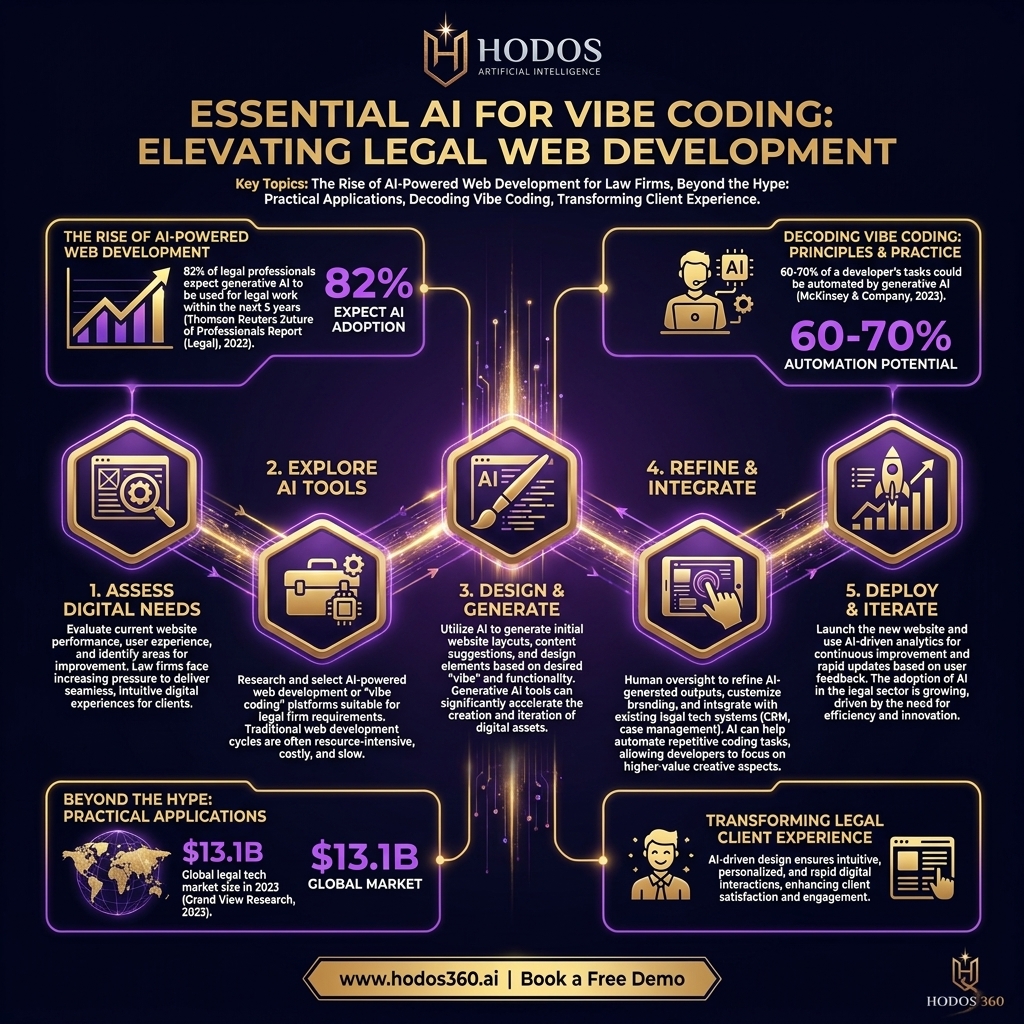
For instance, instead of writing CSS to define a button's style, a legal professional might describe it as 'a professional, trustworthy button with a subtle gradient, reflecting our firm's sophisticated brand.' The AI then generates the underlying code, whether it’s HTML, CSS, JavaScript, or even components for modern frameworks.
Tools like Cursor and Lovable are at the forefront of this trend, enabling developers and non-developers alike to write code with unprecedented speed and accuracy. This capability is not just about automating rote tasks; it's about making the creative and iterative process of web development more accessible and aligned with human intuition.
The practical workflow often begins with a high-level prompt or a rough sketch, which the AI interprets to generate initial design components or even entire page layouts. Users then provide feedback, refining the 'vibe' through conversational interactions or by making adjustments within a visual editor.
Learn more about Legal AI Gap Widens: Strategic Imperative for Law Firms 2026. The AI continuously learns and adapts, suggesting improvements, identifying potential design inconsistencies, and even optimizing for performance and SEO. This collaborative process between human and AI allows for rapid prototyping and iteration, drastically cutting down on the time and resources traditionally required.
It means a law firm can go from a conceptual idea for a new client resource center to a functional prototype in days, rather than weeks or months. This agility is a game-changer for legal marketing and client engagement strategies, enabling firms to respond to market demands and client feedback almost in real-time.
The ability to quickly build and test different versions of web applications ensures that the final product is not only functional but truly resonates with its intended audience.
- ✓Natural Language Interface: Users describe desired features or aesthetics in plain English, and the AI translates these into code. This democratizes coding for non-technical legal professionals.
- ✓Rapid Prototyping: Generate functional web application prototypes in hours or days, allowing for quick iteration and stakeholder feedback. This significantly accelerates the development cycle.
- ✓Contextual Design Suggestions: AI suggests design elements, layouts, and content based on best practices, brand guidelines, and user intent, ensuring a consistent 'vibe' and high quality.
- ✓Code Optimization: AI can automatically optimize generated code for performance, security, and SEO, leading to faster loading times and better search engine rankings.
- ✓Multi-Platform Compatibility: Easily generate responsive designs that work seamlessly across desktops, tablets, and mobile devices, crucial for modern client access.
- ✓Component-Based Architecture: AI often generates modular, reusable components, simplifying maintenance and future updates, making it easier to build new features.
- ✓Integration Capabilities: Designed to integrate with existing legal tech stacks, including CRM, case management, and AI Law Firm Management System platforms, enhancing overall workflow efficiency.
Transforming Legal Client Experience with AI-Driven Design
The modern legal client expects more than just legal expertise; they demand a seamless, intuitive, and personalized digital experience. A poorly designed website or a clunky client portal can erode trust and drive potential clients to competitors. Here, AI for vibe coding emerges as a powerful ally in crafting digital touchpoints that truly resonate.
By allowing firms to rapidly build and refine user interfaces, AI ensures that the client's journey – from initial inquiry to ongoing case updates – is smooth and engaging. For example, a lovable client portal generated with AI can offer personalized dashboards, secure document uploads, and direct communication channels, all tailored to the client's specific case and preferences.
This level of customization, once prohibitively expensive and time-consuming, is now achievable with agility, directly impacting client satisfaction and loyalty. The emphasis on user-centric development is further supported by statistics from Gartner, which predicts that by 2027, 25% of all digital products will be designed and built using AI-assisted tools, largely due to their ability to create highly optimized and user-favourite experiences.
Furthermore, AI-driven design extends beyond mere aesthetics; it encompasses functionality and accessibility. Learn more about Legal AI ROI: Maximizing Law Firm Value in 2026. AI tools can analyze user behavior data to identify pain points and suggest improvements, ensuring that web applications are not only visually appealing but also highly functional and easy to navigate.
This proactive optimization is crucial for legal websites, where clarity and ease of access to information are paramount. Consider the ethical implications of web accessibility, as outlined in the Americans with Disabilities Act (ADA) and similar global regulations; AI can assist in generating code that adheres to these standards, making legal services accessible to a broader audience.
This commitment to inclusive design, facilitated by AI for vibe coding, not only demonstrates social responsibility but also broadens a firm's potential client base, enhancing its reputation and reach. The ability to quickly adapt and refine digital interfaces based on real-time feedback ensures that legal firms remain responsive to client needs and market trends.
Optimizing User Interface and Experience (UI/UX)
The distinction between UI (User Interface) and UX (User Experience) is critical in legal web development. UI focuses on the visual elements users interact with, while UX encompasses the entire journey and feeling a user has while engaging with a digital product. AI for vibe coding excels at optimizing both.
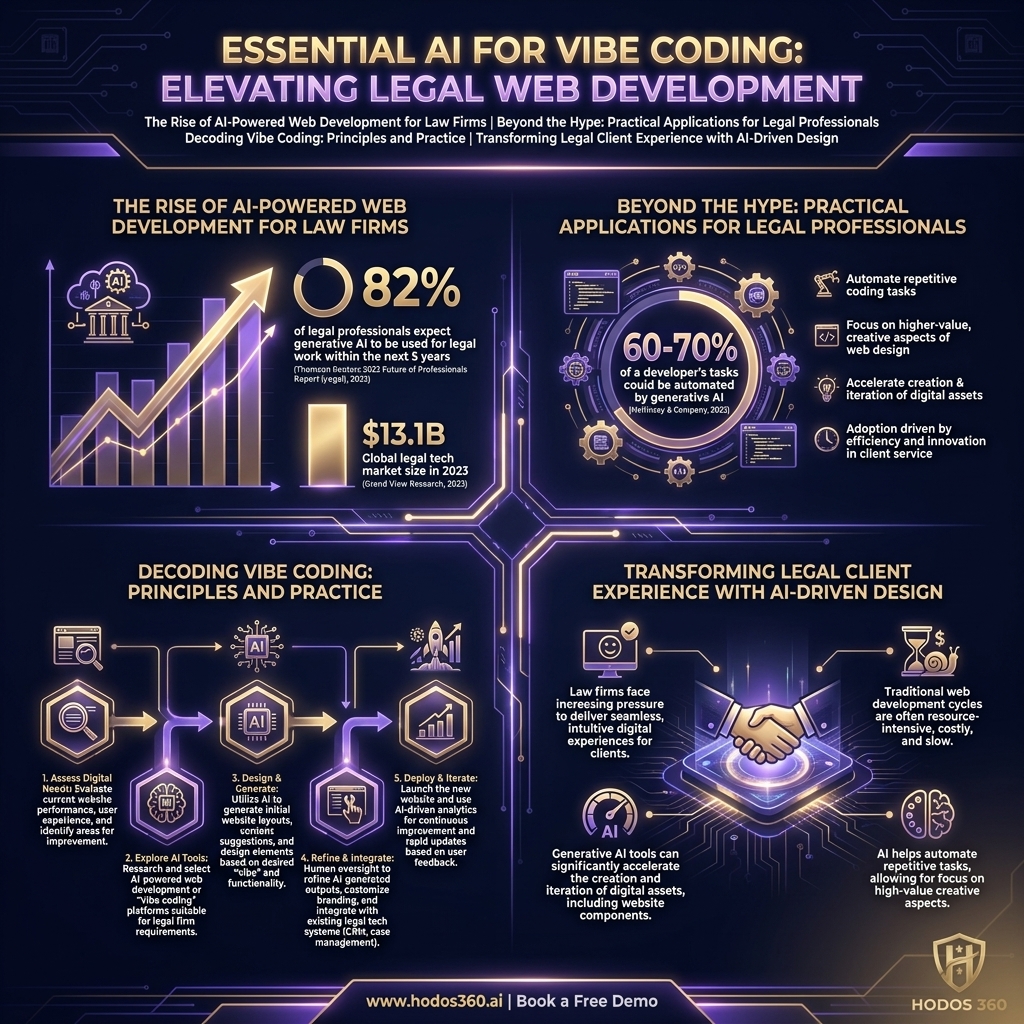
For UI, AI can generate various design options based on brand guidelines, color palettes, and psychological principles of trust and authority, ensuring that the visual presentation of a legal website or application is professional and inviting. This includes everything from typography and iconography to button placement and navigation menus, all designed to evoke the desired 'vibe' and user response.
The AI's ability to rapidly iterate on these elements allows firms to A/B test different designs faster, identifying what resonates most effectively with their target audience.
For UX, AI can analyze user flow, click patterns, and conversion rates to identify bottlenecks or areas of confusion.
Learn more about AI Settlement Rates: An Essential Guide to Maximizing Outcomes. It can then suggest structural changes, content improvements, or feature enhancements to streamline the user journey. For instance, if data shows clients are dropping off at a particular stage of an online form, the AI can propose redesigns or additional information prompts to guide them through more effectively.
This data-driven approach ensures that the client experience is not left to guesswork but is continuously refined based on empirical evidence. Tools that support AI for vibe coding are particularly adept at this, as they can quickly implement and test these suggested changes, allowing law firms to maintain a highly optimized and client-centric digital presence.
This continuous improvement cycle is vital for staying competitive and ensuring that every digital interaction adds value to the client relationship.
Strategic Implementation: Integrating AI Vibe Coding Tools into Your Firm
Successfully integrating AI for vibe coding tools into a law firm's operational framework requires a strategic approach that balances innovation with existing workflows. The first step involves identifying specific pain points or areas where traditional web development is a bottleneck. Is it client intake? Marketing campaign landing pages?
Internal knowledge bases? By pinpointing these areas, firms can prioritize the adoption of AI-powered tools for maximum impact. Training is also crucial; while these tools simplify coding, understanding their capabilities and best practices empowers legal professionals to leverage them effectively. Firms might designate a 'digital innovation lead' or a small team to become proficient in these tools, acting as internal champions.
This approach ensures that the initial investments yield tangible results and fosters a culture of technological adoption, critical for long-term success. As per ABA Model Rule 1.1 on Competence, lawyers have a duty to keep abreast of changes in the law and its practice, including the benefits and risks associated with relevant technology, making this a professional imperative.
Another key consideration is data security and compliance. Learn more about OpenAI Codex: Essential Guide to Faster Legal Web Development. When using AI for vibe coding to build client-facing applications, firms must ensure that the underlying platforms adhere to stringent privacy regulations like GDPR, CCPA, and HIPAA, especially concerning sensitive client data.
This involves vetting vendors thoroughly and understanding how AI models process and store information. Firms should establish clear protocols for data governance and privacy, ensuring that any AI-generated code or content respects client confidentiality, a cornerstone of legal ethics as articulated in ABA Model Rule 1.6. The focus should be on secure, enterprise-grade solutions that offer robust data encryption and compliance features.
By prioritizing security from the outset, law firms can confidently harness the power of AI to build innovative digital experiences without compromising their ethical obligations or client trust. This diligent approach is what separates truly transformative AI adoption from merely chasing trends.
Measuring ROI and Future-Proofing Your Digital Presence
The ultimate measure of any technology investment is its return on investment (ROI). For AI for vibe coding tools, ROI can be quantified through several metrics: reduced development costs, faster time-to-market for new digital initiatives, increased client engagement, higher conversion rates, and improved internal operational efficiency.
Firms should establish clear KPIs before implementation, such as website traffic growth, lead generation rates, client portal usage, and staff time saved on administrative tasks. Regular analysis of these metrics will provide concrete evidence of the value generated by AI-powered development. For instance, if an AI-generated landing page for a new service line sees a 20% higher conversion rate than previous manual designs, the value is clear.
This data-driven feedback loop also allows for continuous optimization, ensuring that the firm's digital assets remain cutting-edge and effective.
Future-proofing a law firm's digital presence in an era of rapid technological change requires agility and adaptability. AI for vibe coding provides this by enabling firms to quickly update, iterate, and even entirely redesign their web applications in response to evolving market demands or technological advancements.
The modular nature of AI-generated code means that components can be easily swapped out or upgraded, preventing the accumulation of technical debt that often plagues traditional development projects. Furthermore, by embracing platforms that offer AI-powered website building and responsive design, firms can ensure their digital infrastructure is robust and scalable.
This forward-thinking strategy, supported by tools that make coding more accessible and efficient, positions law firms not just to react to the future, but to actively shape their digital destiny, maintaining a competitive edge and a strong connection with their client base.