AI Voice Assistants: Essential Defenses Against Mass Attacks
The legal landscape, increasingly shaped by technological innovation, has seen a rapid adoption of artificial intelligence, particularly in client-facing applications like AI voice assistants. These sophisticated systems promise 24/7 availability, multilingual support, and efficient lead qualification, transforming how law firms manage client intake and communication. However, a recent revelation from researchers at George Mason University, highlighted by Tech Xplore, has sent a ripple of concern through the tech world: a single AI model can generate 'trillions of variants' of adversarial audio, capable of launching mass attacks on voice assistants. This discovery underscores a critical new frontier in cybersecurity, demanding immediate attention from legal professionals who rely on these tools for sensitive interactions.
Imagine a scenario where a malicious actor, armed with this capability, could bypass the security protocols of an AI voice assistant designed to handle confidential client inquiries or schedule critical court dates. The implications for client confidentiality, data integrity, and a firm's reputation are staggering. This isn't a theoretical threat; it's a rapidly evolving challenge that calls for a deeper understanding of the underlying mechanisms of these attacks and, more importantly, robust, proactive defense strategies. Law firms, custodians of highly sensitive information, must now confront the reality that their digital gatekeepers—their AI voice assistants—are facing an unprecedented level of sophisticated assault. The traditional cybersecurity playbook, often focused on singular attack vectors, is proving insufficient against an adversary capable of generating near-infinite, subtly varied malicious inputs.
This article delves into the intricacies of these 'trillions of variants' attacks, exploring the research behind them and the specific vulnerabilities they exploit. We will examine the critical need for advanced defensive measures, from adaptive AI counter-intelligence to stringent legal and ethical compliance frameworks. For law firm partners and legal tech leaders, understanding this evolving threat is no longer optional; it's an imperative for maintaining client trust and operational integrity in the age of AI. The competition in the legal tech market, with players like Clio and LegalZoom constantly innovating, means firms must not only adopt AI but also secure it, lest they fall behind or, worse, become victims of devastating breaches. The stakes are higher than ever, pushing the industry to confront the darker side of AI's immense power.
The Evolving Threat Landscape: Understanding AI Voice Assistant Attacks
The core of the recent Tech Xplore article revolves around a groundbreaking study by researchers at George Mason University, particularly involving the work on a technique called DivNet. This research exposed a critical vulnerability in how many AI voice assistants are deployed: manufacturers often install identical AI models across millions of devices. This uniformity, while efficient for development, creates a single point of failure. A malicious actor, once understanding the weaknesses of one model, can craft a single adversarial audio input that, with minor programmatic variations, can generate 'trillions of variants.' Each variant, subtly different, can then bypass defenses on a vast array of devices running the same underlying AI model. This is a significant escalation from previous adversarial attacks, which typically required more tailored approaches for individual systems. The sheer scale and speed—each variant taking milliseconds to produce—render traditional, signature-based detection methods obsolete. It's an AI-driven arms race, where attackers are using AI to generate threats at a scale previously unimaginable.
Historically, cybersecurity in the legal sector has focused on network intrusions, phishing, and malware, with a strong emphasis on data encryption and access controls. However, the rise of AI Voice Assistants introduces a new attack vector: the audio interface itself. Adversarial audio attacks manipulate sound waves in ways imperceptible to the human ear but profoundly disruptive to AI models. These attacks can range from injecting malicious commands to altering the perceived intent of a voice input, leading to unauthorized actions, data exfiltration, or denial of service. Learn more about AI Adoption: Essential Strategies for Law Firms to Lead. The 'trillions of variants' revelation indicates that these attacks can now be mass-produced, targeting entire fleets of voice assistants simultaneously. This poses a direct threat to the confidentiality of client communications, a cornerstone of legal practice, as outlined in the ABA Model Rules of Professional Conduct, specifically Rule 1.6 on Confidentiality of Information. A breach through an AI voice assistant could expose sensitive legal strategies, client personal data, or privileged communications, leading to severe ethical and legal repercussions. The stakes are incredibly high, demanding a paradigm shift in how law firms approach AI security.
This new frontier of AI-driven cyber threats also highlights a critical tension within the broader AI community. Leaders like Dario Amodei, CEO of Anthropic, and Sam Altman of OpenAI have consistently emphasized the importance of AI safety and alignment, often discussing the potential for sophisticated AI to be misused. While their primary focus often lies on larger-scale societal risks from advanced general AI, the 'trillions of variants' issue demonstrates that even narrower AI applications, like voice assistants, can pose significant, immediate security challenges when exploited. The rapid deployment of AI across various industries, including legal, often outpaces the development of robust, adaptive security protocols. This creates a fertile ground for novel attack vectors, making it imperative for law firms to partner with technology providers that prioritize and integrate advanced security measures from the ground up, rather than relying on reactive patches. The battle for secure AI is not just about preventing data breaches; it's about preserving the integrity of the legal system itself.
The "Trillions of Variants" Challenge: An Unprecedented Scale of Threat
The concept of 'trillions of variants' fundamentally changes the game for AI voice assistant security. Traditionally, if an attacker found a vulnerability in an AI model, they might craft a specific adversarial example to exploit it. Defensive measures would then focus on detecting and blocking that specific example or class of examples. However, with DivNet's demonstrated capability, a single vulnerability in a widely deployed AI model can be leveraged to generate an almost infinite number of unique, yet equally effective, malicious audio files. Each variant, while distinct enough to evade simple pattern matching, carries the same malicious payload or command, making it incredibly difficult for standard security systems to keep pace. This is akin to a pathogen that can mutate into countless forms instantly, rendering any single vaccine ineffective. For law firms, this means that an AI voice assistant, whether handling initial client intake or routing calls, could be compromised by a variant that has never been seen before, bypassing existing firewalls and intrusion detection systems.
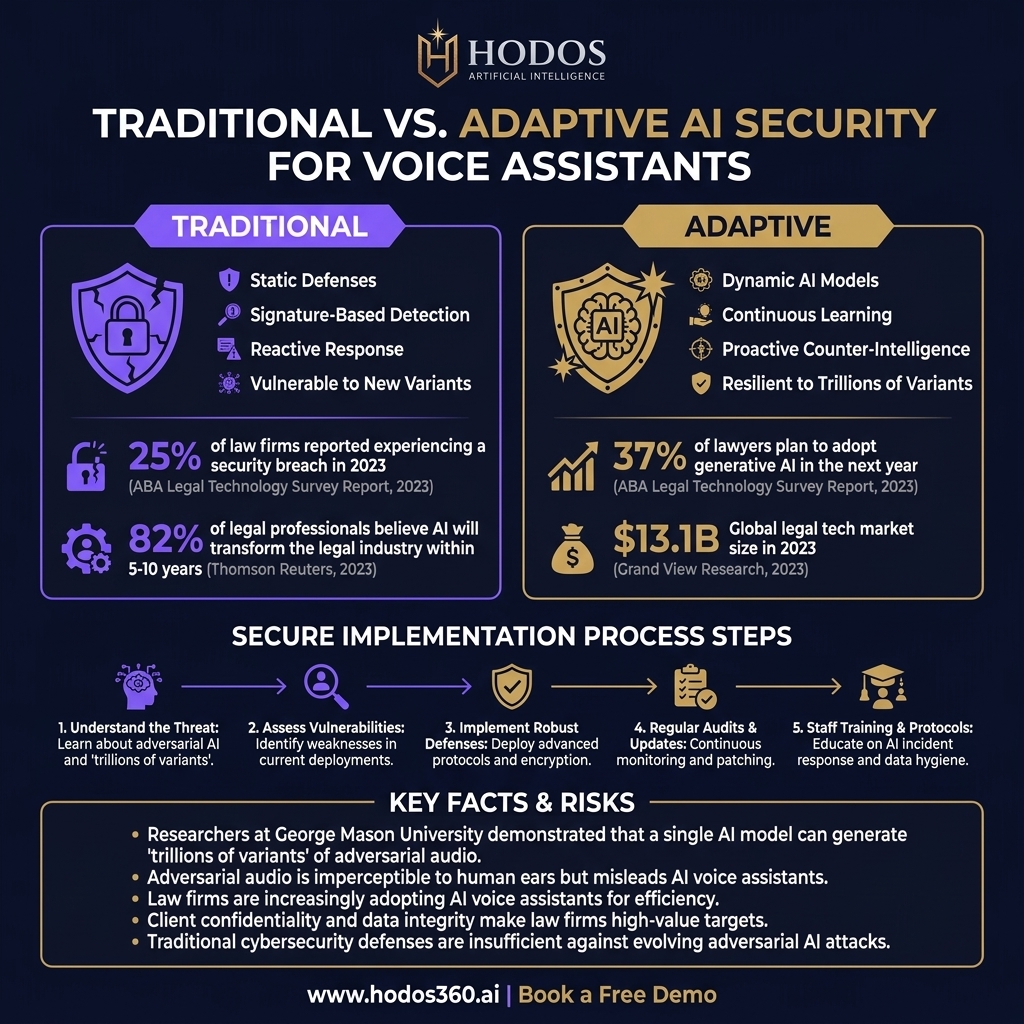
This challenge is magnified by the fact that many commercial AI voice assistants, including those used in the legal sector, are built upon foundational models that are then fine-tuned for specific applications. Learn more about AI Legal Assistants: Essential Tools, Not Staff Replacements. If the underlying model has a susceptibility, it propagates to all its derivatives. The speed at which these variants can be generated—milliseconds per variant—means that a mass attack can be launched and executed before human security teams or even traditional automated systems can react. This creates a critical window of vulnerability that attackers can exploit for a wide range of nefarious purposes, from impersonation and unauthorized access to data theft and manipulation. The legal sector, with its strict confidentiality requirements and high-value data, represents a prime target for such sophisticated attacks. Protecting against this demands a shift from reactive defense to proactive, AI-driven counter-intelligence, where systems are designed to anticipate and neutralize polymorphic threats rather than merely respond to known attack patterns. This requires continuous learning and adaptation, moving beyond static security protocols to dynamic, evolving defenses.
Safeguarding Law Firm Communications: Proactive Defense Strategies
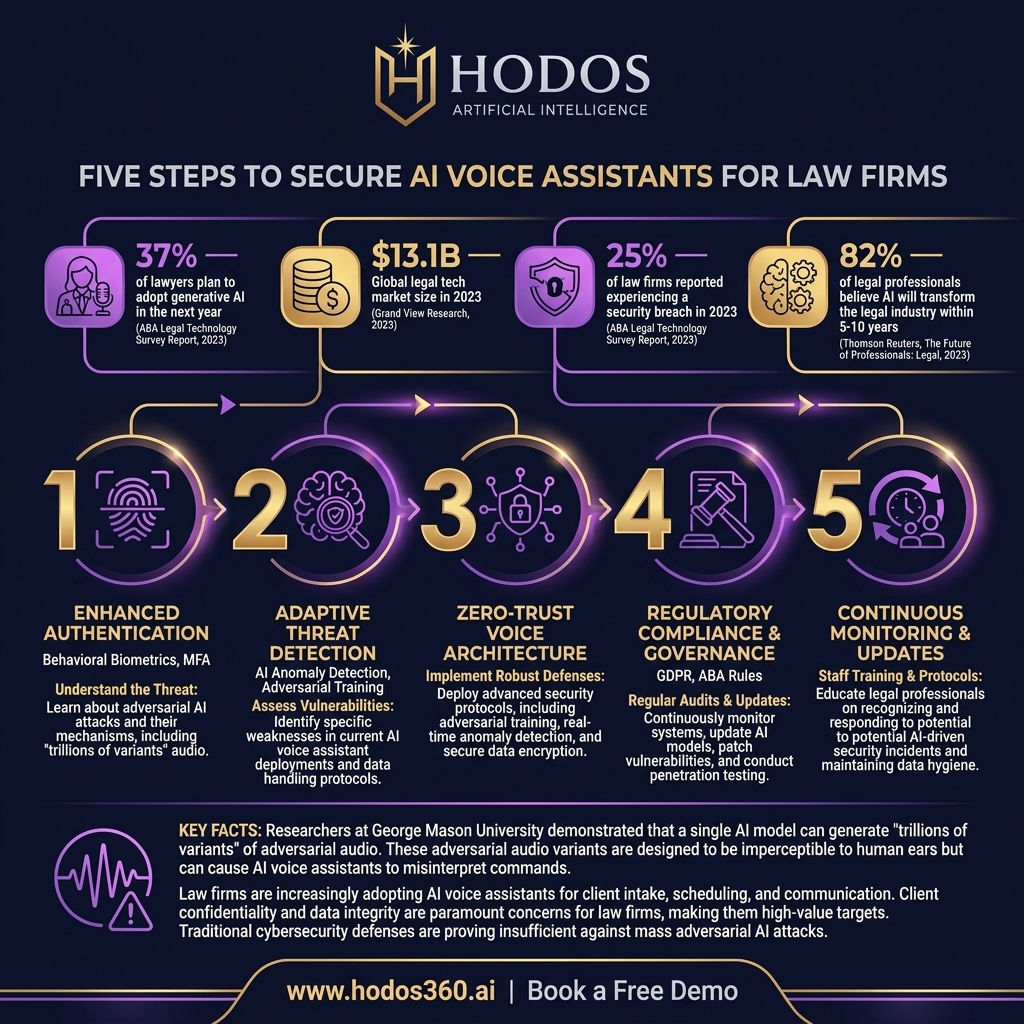
To effectively counter the 'trillions of variants' threat, law firms must adopt a multi-layered, proactive defense strategy that goes beyond conventional cybersecurity measures. The first line of defense involves robust authentication and verification protocols. This means moving beyond simple voice recognition to incorporate behavioral biometrics, such as analyzing speech patterns, cadence, and unique vocal characteristics that are harder to spoof. Companies like Pindrop and Nuance have been at the forefront of developing such technologies, using deep learning to identify subtle anomalies that betray a deepfake or adversarial audio input. Furthermore, integrating multi-factor authentication (MFA) into voice assistant interactions, where a voice command might trigger a secondary verification via a mobile app or email, adds another crucial layer of security. This approach significantly raises the bar for attackers, making it exponentially more difficult to gain unauthorized access or execute malicious commands through voice interfaces. Law firms should also consider implementing strict access control policies for their AI voice assistants, limiting the types of sensitive information they can access or process based on the authenticated user's role and permissions.
Beyond authentication, law firms must prioritize the deployment of AI-powered anomaly detection systems specifically trained to identify adversarial audio. These systems, distinct from general cybersecurity tools, use advanced machine learning models to analyze incoming voice inputs for subtle perturbations, noise patterns, or spectral inconsistencies that are characteristic of manipulated audio. The challenge, as highlighted by the DivNet research, is that these detection systems must be adaptive and continuously learning, capable of identifying novel variants as they emerge. Static detection models will quickly become obsolete. This requires investment in AI models that can perform real-time analysis and adapt their threat signatures on the fly. Firms should look for solutions that leverage techniques like adversarial training, where the defensive AI is exposed to a vast array of generated adversarial examples, including those from 'jev ai model' research, to harden its resilience. Learn more about Legal Technology Awards: Essential Insights for Innovators. This proactive approach ensures that the defense evolves as rapidly as the attack methods, creating a dynamic shield against emerging threats. The National Institute of Standards and Technology (NIST) AI Risk Management Framework provides a valuable guide for developing and deploying trustworthy AI systems, emphasizing governance, risk assessment, and continuous monitoring.
Moreover, the concept of 'zero-trust' architecture, long advocated in general cybersecurity, is particularly relevant for AI voice assistants. This means never implicitly trusting any voice input, even from seemingly legitimate sources, and always verifying. Every interaction should be treated as potentially malicious until proven otherwise. This involves not only strong authentication but also continuous monitoring of the AI assistant's behavior for any deviations from its expected operational parameters. For instance, an AI voice assistant suddenly attempting to access client files it typically doesn't handle, or making an unusual number of external calls, should trigger an immediate alert and investigation. This level of vigilance requires sophisticated logging and auditing capabilities, allowing firms to trace every interaction, identify potential breaches, and conduct thorough forensic analyses. Implementing such stringent protocols is crucial for maintaining compliance with regulations like HIPAA and GDPR, which mandate robust security for sensitive data. Law firms must also ensure regular security audits and penetration testing specifically targeting their AI voice assistant deployments, engaging third-party experts to identify and rectify vulnerabilities before they can be exploited. Firms that adopted early AI solutions without these robust security layers are now playing catch-up, demonstrating the critical importance of a security-first approach from the outset.
- ✓Implement Behavioral Biometrics: Move beyond simple voice recognition to analyze unique speech patterns and cadences, making spoofing significantly harder.
- ✓Deploy Multi-Factor Voice Authentication: Require secondary verification (e.g., mobile app prompt, secure code) for sensitive voice commands.
- ✓Utilize AI-Powered Anomaly Detection: Invest in adaptive machine learning models that can identify subtle, imperceptible perturbations in audio characteristic of adversarial attacks.
- ✓Adopt Zero-Trust Principles for Voice Interactions: Treat every voice input as potentially malicious until verified, with continuous monitoring of assistant behavior.
- ✓Conduct Regular Adversarial Training: Expose defensive AI systems to generated adversarial examples to enhance their resilience against novel 'trillions of variants' attacks.
- ✓Enforce Strict Access Controls: Limit the AI voice assistant's access to sensitive data and functionalities based on authenticated user roles and permissions.
- ✓Ensure Comprehensive Logging and Auditing: Maintain detailed records of all AI voice assistant interactions for forensic analysis and compliance.
The Role of Adaptive AI and Machine Learning in Counter-Intelligence
The battle against 'trillions of variants' attacks is fundamentally an AI vs. AI challenge. To win, law firms cannot rely solely on static defenses; they must leverage the power of adaptive AI and machine learning for counter-intelligence. This involves deploying defensive AI models that can learn, evolve, and anticipate new attack vectors in real-time. The DivNet research itself, while highlighting a vulnerability, also points to the potential for AI-driven solutions to combat these threats. By understanding how adversarial audio is generated, defensive AI can be trained to recognize the underlying patterns and characteristics of these attacks, even in their novel variant forms. This is akin to an immune system that learns to identify new pathogens by recognizing their core genetic structures, rather than just specific surface proteins. Companies like Google and Microsoft are heavily investing in this area, developing internal systems that constantly scan for and neutralize emerging AI threats across their vast product ecosystems. The principle is that for every offensive AI model, there must be a more sophisticated, adaptive defensive AI model.
Adaptive AI for security relies heavily on continuous data feedback loops. When an AI voice assistant encounters a suspicious input, that data point, even if initially undetected as malicious, should be fed back into the defensive AI's training model. This allows the system to refine its understanding of what constitutes an attack, improving its ability to detect future variants. This iterative process of learning and adaptation is crucial for staying ahead of attackers who are constantly innovating. Furthermore, collaborative intelligence among defensive AI systems across different firms or even industries could create a powerful collective defense. Learn more about Essential Legal AI Tools for Modern Law Firms & Counsel. Imagine a network where an attack detected by one law firm's AI voice assistant automatically informs and updates the defensive models of other participating firms, creating a real-time threat intelligence sharing mechanism. This kind of 'frontier intelligence' is what will ultimately safeguard the world against polymorphic AI attacks. The development of advanced NLP models and neural networks, as seen in projects like r.jina.ai and fable 5 ai model, also contributes to the sophistication of both offensive and defensive AI, making the stakes higher and the solutions more complex.
This continuous learning and adaptation are not just about technical prowess; they also reflect a strategic shift in cybersecurity. As Jensen Huang, CEO of NVIDIA, often emphasizes, the future of computing is accelerated and AI-driven. This applies equally to security, where the speed and scale of threats necessitate AI-powered responses. Law firms must recognize that their AI voice assistants are not isolated tools but part of a dynamic, interconnected digital ecosystem. Securing them requires a proactive engagement with advanced AI security research and technologies. This means collaborating with leading legal tech providers like HODOS 360, which are integrating state-of-the-art AI defenses into their platforms, ensuring their AI Voice Assistants are not just functional but resilient. The lifecycle management of an agent, as seen in various AI frameworks, must include continuous security updates and model retraining to maintain a 'champion' status against evolving threats. Without this adaptive approach, firms risk falling behind the curve, leaving their client communications vulnerable to the next wave of sophisticated AI-driven cyberattacks. The investment in adaptive AI is not merely an IT expense; it's a strategic imperative for long-term operational resilience and client trust.
Legal and Ethical Imperatives: Protecting Client Trust and Data
Beyond the technical challenge, the proliferation of AI voice assistants in law firms introduces significant legal and ethical imperatives. The bedrock of the legal profession is client trust, underpinned by the strict obligation of confidentiality. ABA Model Rule 1.6, Confidentiality of Information, requires lawyers to protect all information relating to the representation of a client. A breach originating from an inadequately secured AI voice assistant could lead to severe professional discipline, reputational damage, and substantial financial penalties. The ethical duty of technological competence, as reinforced by ABA Model Rule 1.1, Competence, mandates that lawyers understand the benefits and risks associated with relevant technology. This includes understanding the vulnerabilities of AI systems, such as those exposed by 'trillions of variants' attacks, and taking reasonable steps to mitigate those risks. Failing to do so could be seen as a dereliction of professional duty, exposing the firm to malpractice claims and regulatory scrutiny. The legal implications extend beyond confidentiality to data privacy regulations.
Global data privacy frameworks, such as the European Union's General Data Protection Regulation (GDPR) and various state-level regulations in the US like the California Consumer Privacy Act (CCPA), impose stringent requirements on how personal data, including voice data, is collected, processed, and secured. A data breach involving an AI voice assistant could trigger significant fines under these regulations, in addition to the costs of notification, investigation, and remediation. For instance, Article 32 of GDPR mandates appropriate technical and organizational measures to ensure a level of security appropriate to the risk, including the ability to restore availability and access to personal data in a timely manner in the event of a physical or technical incident. An AI voice assistant compromised by a mass attack would clearly fall under such an incident. Learn more about Legal AI Training: Essential Skills for Modern Law Firms. Furthermore, the ethical considerations extend to the potential for bias in AI models used for voice recognition or sentiment analysis, which could lead to discriminatory outcomes for clients. Law firms must ensure their AI tools are not only secure but also fair and transparent in their operations, adhering to principles of responsible AI development and deployment. This is an area where proactive legal tech governance is paramount, ensuring that the adoption of new technologies aligns with the highest ethical standards of the profession.
The legal sector has seen its share of high-profile data breaches, from the Panama Papers to various law firm hacks, underscoring the constant threat. Firms that leverage AI voice assistants must implement robust data governance policies that specifically address voice data, including retention schedules, consent mechanisms for data collection, and clear protocols for handling security incidents. This requires ongoing training for all staff, from attorneys to administrative personnel, on the secure use of AI tools and the identification of potential threats. The human element remains a critical link in the security chain. Firms must also carefully vet their legal tech vendors, ensuring that any third-party AI voice assistant providers have demonstrably strong security architectures, undergo regular audits, and are compliant with relevant legal and ethical standards. The reputational cost of a breach, particularly one involving client communications handled by an AI, can be devastating, eroding years of built-up trust. As Justice Elena Kagan once noted in the context of digital privacy, the law must adapt to "the challenges of new technologies." This means law firms must be at the forefront of securing their AI, not just for compliance, but for the very essence of their professional integrity.
Navigating Regulatory Compliance in the Age of AI Voice
The regulatory landscape for AI, particularly voice AI, is still evolving, but existing data privacy and professional conduct rules provide a clear framework for law firms. Compliance with regulations like the GDPR, CCPA, and industry-specific mandates is non-negotiable. For voice data, this means obtaining explicit consent for recording and processing, ensuring transparency about how data is used, and providing individuals with rights over their data, such as access and deletion. Firms must also consider the implications of biometric data laws, which are becoming more prevalent in various jurisdictions, as advanced voice authentication often involves biometric analysis. The Federal Rules of Civil Procedure, particularly regarding e-discovery, also indirectly impact AI voice data, as recordings and transcripts generated by these systems could be discoverable in litigation. Therefore, proper data lifecycle management, including secure storage, retention, and defensible deletion policies, is essential.
Furthermore, the forthcoming EU AI Act, expected to be fully enforced in the coming years, will classify AI systems based on their risk level, with "high-risk" AI facing stricter requirements for data governance, human oversight, and robustness. Learn more about Voice AI: The Ultimate Shift in Legal Client Service. While AI voice assistants for general client intake might not fall into the highest risk category, their use in sensitive legal contexts could elevate their classification. Law firms must proactively assess their AI voice assistant deployments against these emerging regulatory frameworks, ensuring their systems are robust, transparent, and accountable. This involves conducting regular AI impact assessments, documenting compliance efforts, and being prepared to demonstrate the security and ethical integrity of their AI tools to regulators. The legal profession, by its very nature, is tasked with upholding the law; therefore, law firms must lead by example in the responsible and secure deployment of AI technology, setting a benchmark for others to follow. Failure to navigate this complex regulatory environment effectively can result in significant legal and financial penalties, undermining both the firm's stability and its standing within the legal community.

Empowering Your Firm with Secure AI Voice Assistants
The emergence of 'trillions of variants' attacks signifies a new era in cybersecurity, one where the sophistication of threats matches the advanced capabilities of AI itself. For law firms, this isn't merely a technical challenge but a fundamental test of their commitment to client trust, data security, and ethical practice. The path forward demands a strategic embrace of adaptive AI defenses, stringent adherence to legal and ethical frameworks, and continuous vigilance against evolving threats. Firms must invest in solutions that offer not just convenience but also ironclad security, ensuring that their AI voice assistants are resilient against even the most advanced adversarial audio attacks. This includes leveraging behavioral biometrics, real-time anomaly detection, and a zero-trust approach to all voice interactions.
In this dynamic environment, partnering with a legal tech platform that prioritizes and integrates cutting-edge AI security is paramount. HODOS 360’s AI Voice Assistants are designed with these advanced considerations in mind, offering a robust, secure solution for 24/7 phone answering, lead qualification, and appointment booking. By incorporating state-of-the-art defensive AI and adhering to stringent data protection protocols, HODOS 360 empowers law firms to harness the full potential of AI voice technology without compromising security or compliance. Our platform continuously adapts to new threat landscapes, ensuring your firm's communications remain confidential and secure, even against the most sophisticated 'trillions of variants' attacks. The future of legal practice is undeniably intertwined with AI, but its success hinges on secure, trustworthy implementation. The choice is clear: embrace secure AI proactively or risk falling victim to the inevitable advancements in cyber warfare.
Ultimately, safeguarding AI voice assistants against mass attacks requires a holistic approach that combines technological innovation with a deep understanding of legal and ethical obligations. Law firms must recognize that security is not a one-time setup but an ongoing process of adaptation and refinement. By implementing robust defense strategies, staying informed about the latest threats, and partnering with secure technology providers, firms can transform potential vulnerabilities into strengths, ensuring their AI voice assistants remain powerful, trustworthy assets. The digital frontier of law demands nothing less than unwavering commitment to secure innovation. This proactive stance not only protects valuable client data but also reinforces the firm's reputation as a forward-thinking, secure, and client-centric legal entity. The legal industry has always adapted to societal changes; now, it must adapt to the accelerating pace of AI innovation and its inherent security challenges, turning potential disruption into sustained growth and trust.
Frequently Asked Questions
What are 'trillions of variants' attacks on AI voice assistants?+
'Trillions of variants' attacks refer to a new type of cyber threat where a single malicious AI model can generate an almost infinite number of subtly different adversarial audio inputs. These variants can bypass traditional security measures on AI voice assistants that use identical underlying models, allowing for widespread, mass attacks that are incredibly difficult to detect due to their polymorphic nature and rapid generation.
Why are these attacks particularly dangerous for law firms?+
Law firms handle highly sensitive and confidential client information. If an AI voice assistant is compromised by a 'trillions of variants' attack, it could lead to unauthorized access to privileged communications, data breaches, and exposure of client strategies. This poses severe risks to client confidentiality, professional ethics, firm reputation, and could result in significant legal and financial penalties under data privacy regulations like GDPR and CCPA.
What proactive defense strategies can law firms implement?+
Law firms should implement multi-layered defense strategies including behavioral biometrics for authentication, multi-factor voice authentication, and AI-powered anomaly detection systems capable of real-time, adaptive learning. Adopting a zero-trust architecture for all voice interactions, conducting regular adversarial training for defensive AI, and enforcing strict access controls are also crucial for robust protection against these sophisticated threats.
How does adaptive AI help in combating these attacks?+
Adaptive AI uses machine learning to continuously learn from new data, including previously undetected adversarial examples. This allows defensive AI models to evolve and anticipate new attack vectors, recognizing the underlying patterns of 'trillions of variants' even in novel forms. This real-time learning and adaptation are essential for staying ahead of attackers who are constantly innovating their methods, creating a dynamic shield against polymorphic threats.
What are the legal and ethical obligations for firms using AI voice assistants?+
Law firms have a strict ethical obligation under ABA Model Rule 1.6 to protect client confidentiality and an ethical duty of technological competence (ABA Model Rule 1.1). They must also comply with data privacy regulations like GDPR and CCPA, ensuring explicit consent for voice data collection, transparency in usage, and robust security measures. Failure to secure AI voice assistants against attacks can lead to professional discipline, reputational damage, and regulatory fines.