
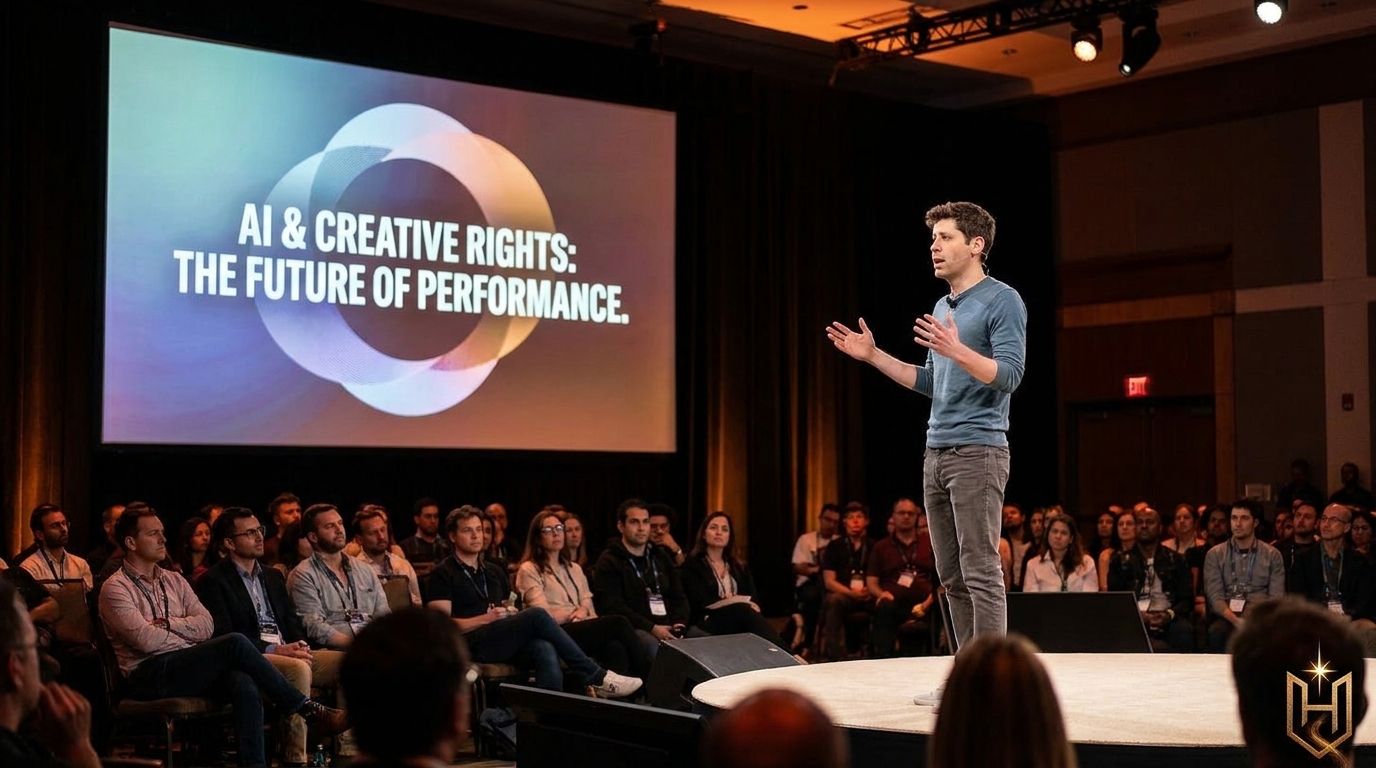
AI Voice Clones: The Ultimate Legal Battle for Control
The summer of 2023 saw Hollywood gripped by an unprecedented dual strike, with screenwriters and actors both walking off sets. While much of the public discourse centered on fair wages and streaming residuals, a quieter, yet profoundly impactful, battle was being waged over the future of human creativity in an AI-powered world: the fate of AI voice clones. As reported by Gulf Today, the tension among Hollywood voice actors regarding the use of their digital likenesses has reached a boiling point, embodying a broader societal and legal challenge that transcends the entertainment industry. This isn't merely a dispute over a new technology; it's a fundamental reckoning with intellectual property, personal autonomy, and the very definition of performance in the digital age. For law firms, this unfolding drama signals an urgent need to understand the complex legal frameworks emerging around synthetic media.
At the heart of the conflict lies the studios' desire to scan actors' likenesses and voices, creating AI voice clones that could be used perpetually, often for a single day's pay. Voice actor Stacy Rivera, based in Los Angeles, articulated the widespread fear among freelancers, stating, "I'm so afraid." This sentiment resonates deeply with countless performers who see their livelihoods threatened by the specter of their digital selves performing without their explicit, ongoing consent or fair compensation. SAG-AFTRA, led by President Fran Drescher and National Executive Director Duncan Crabtree-Ireland, made the regulation of AI a cornerstone of their negotiations, demanding clear consent protocols, fair compensation for subsequent uses, and robust protections against unauthorized cloning. Learn more about Legal Technology Awards: Essential Insights for Innovators. The union's efforts highlight a critical gap in existing legal precedent, pushing the boundaries of copyright, publicity rights, and labor law into uncharted territory. The dispute underscores that while technological advancements like generative AI offer efficiency, they also necessitate a rapid evolution of legal safeguards to protect human creators.
The implications of Hollywood's AI voice clones clash extend far beyond the silver screen, signaling a burgeoning area of litigation that law firms must be equipped to handle. From musicians whose unique vocal styles are mimicked by AI to public figures whose digital likeness is exploited for deepfake content, the legal challenges are diverse and complex. This trend demands that legal professionals develop a sophisticated understanding of emerging legal frameworks, ethical considerations, and the technical underpinnings of voice cloning technology. Learn more about Building an Essential AI Meeting Assistant for Law Firms. As the digital frontier expands, so too does the need for robust legal counsel capable of navigating these intricate issues, safeguarding individual rights, and establishing precedents that will shape the future of creativity and commerce in the age of artificial intelligence. Law firms that proactively engage with these challenges will be best positioned to advise clients on the complexities of AI governance and intellectual property in the coming years.
AI Voice Clones: Hollywood's Legal Battleground
The recent SAG-AFTRA strike brought the issue of AI voice clones into sharp focus, exposing a fundamental disagreement between talent and studios over ownership and control of digital identity. The union, representing 160,000 performers, was unequivocal in its demand for consent and compensation regarding the use of AI to replicate voices and likenesses. Duncan Crabtree-Ireland, SAG-AFTRA's chief negotiator, famously stated that the studios' initial proposal sought the right to scan a background performer's likeness, pay them for a single day, and then own that scan "in perpetuity, for any purpose whatsoever." This contentious point became a symbol of the broader struggle to prevent the commodification of human identity without fair recourse. Learn more about AI App Builders: Ultimate Guide for Law Firm Innovation. The narrative of freelancers like Stacy Rivera, fearing job displacement, contrasted starkly with reports of some established performers considering licensing their voices for lucrative AI replicas, creating a visible split within the community and highlighting the economic pressures driving these decisions.
The resolution of the SAG-AFTRA strike, which included provisions for AI consent and compensation, marked a significant, albeit initial, victory for performers. However, it's merely the first step in establishing comprehensive legal frameworks for AI voice clones. The agreement mandates that producers must obtain clear consent from actors for the creation and use of digital replicas, and negotiate fair compensation for such uses. This sets a crucial precedent, yet the nuances of what constitutes 'fair compensation' and the scope of 'consent' will undoubtedly be tested in future contractual disputes and litigation. Learn more about AI Law Firms: Essential for Construction Contract Mastery. The legal landscape is still nascent, with questions remaining about the applicability of existing copyright and right of publicity laws, especially across different jurisdictions. For instance, while California has strong publicity rights, other states may offer less protection, leading to a patchwork of legal interpretations.
The SAG-AFTRA Standoff and Industry Impact
The SAG-AFTRA negotiations weren't just about the terms of a contract; they were a bellwether for how industries globally will contend with generative AI. The union's proactive stance has inspired similar discussions in other creative groups and beyond, from musicians to authors. The tension between innovation and protection is palpable. While companies like OpenAI and Google DeepMind continue to push the boundaries of voice cloning technology, the legal and ethical guardrails are still being constructed. Learn more about AI Voice Assistant: Essential for Law Firm Client Experience. The European Union's AI Act, for example, represents a landmark effort to regulate AI, focusing on transparency, data governance, and risk assessment. While it doesn't directly address AI voice clones in the context of performance rights, its emphasis on responsible AI development will undoubtedly influence future legislation globally, creating a complex web of international regulations that law firms must comprehend for their clients operating across borders.
The industry impact extends to the entire creative ecosystem. Production studios are now navigating new compliance requirements, while talent agencies are adapting their contracts to include specific clauses for digital likeness and AI voice clones. This shift creates both challenges and opportunities. For law firms, the demand for specialized legal counsel in AI-related intellectual property, contract negotiation, and dispute resolution is set to skyrocket. Learn more about Legal AI: Ultimate Guide to Implementation for Law Firms. This trend is not confined to Hollywood; every industry that relies on human voice or likeness, from advertising to customer service, will grapple with these issues. The ability to provide informed, forward-thinking advice on AI governance and the protection of digital assets will become a cornerstone of successful legal practices in the coming decade, requiring a blend of technological understanding and legal acumen.
Navigating the Legal Labyrinth: IP, Consent, and Fair Use
The legal landscape surrounding AI voice clones is a complex tapestry woven from existing intellectual property laws, evolving right of publicity statutes, and the nascent field of AI-specific regulations. At its core, the challenge lies in applying pre-digital legal concepts to entirely new technological realities. For instance, traditional copyright law (e.g., the Copyright Act of 1976) protects original works of authorship but often struggles with the concept of a 'performance' when it is generated by AI. Is an AI voice clone of a famous singer performing a new song a derivative work, or is it merely using data from a public domain? The answer is far from clear and will likely require judicial interpretation or new legislative action. Moreover, the concept of fair use, typically a defense in copyright infringement, becomes incredibly murky when considering whether an AI's 'learning' from copyrighted material constitutes fair use, particularly when it leads to the creation of monetizable synthetic media that closely mimics an original.
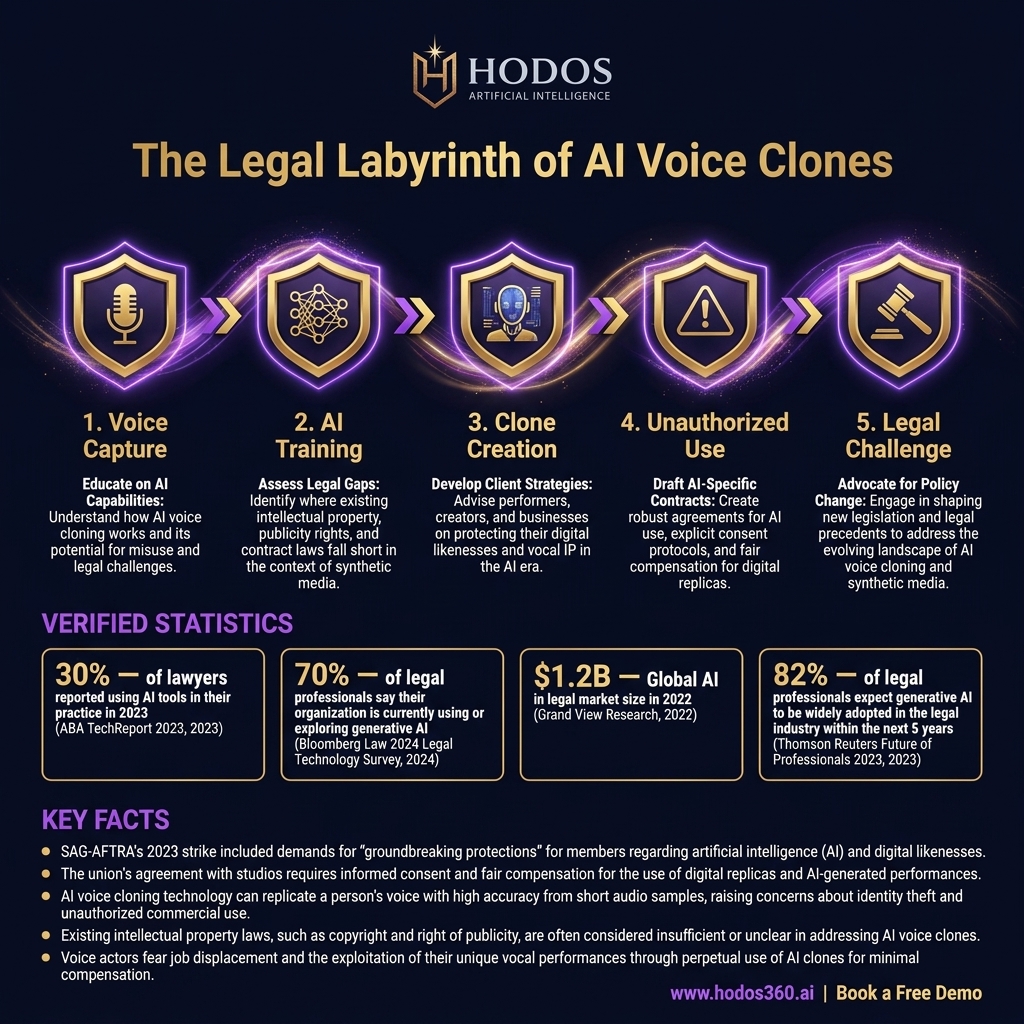
Beyond copyright, right of publicity laws offer a more direct avenue for protecting an individual's commercial value in their name, likeness, and voice. States like California, with its robust celebrity rights, provide some recourse against unauthorized commercial exploitation. However, these laws were largely conceived before the advent of AI voice clones and may not fully encompass the nuances of deepfake technology or the subtle appropriation of vocal styles. The consent required for the creation and use of these clones is another critical area. While SAG-AFTRA has pushed for explicit, informed consent, the practicalities of tracking and enforcing this across myriad uses and platforms present significant challenges. Imagine a scenario where a voice actor's clone is used in a video game, then a commercial, and then a political advertisement – each use potentially requiring separate consent and compensation. This granular level of control demands sophisticated legal tech solutions for tracking and managing digital rights.
The World Intellectual Property Organization (WIPO) has been actively exploring the intersection of AI and IP, recognizing the global implications of these technologies. Their discussions highlight the need for international cooperation to harmonize legal frameworks and prevent 'IP havens' for unauthorized cloning. A 2024 WIPO report underscored the economic potential of generative AI, but also warned of the risks to creators if protections aren't strengthened. This global perspective is crucial for law firms advising clients who operate internationally, particularly in the digital realm. The rise of AI voice clones also intersects with data privacy regulations, as the biometric data embedded in a voice print could be considered personal information, subject to GDPR or CCPA protections. This multi-layered legal complexity makes effective legal counsel indispensable for both creators and technology developers.
- ✓Explicit Consent: Mandating clear, granular consent for creating and deploying AI voice clones, specifying scope, duration, and platforms of use.
- ✓Fair Compensation Models: Developing new royalty or licensing structures for digital likeness use, moving beyond one-time payments to account for perpetual value.
- ✓Right to Erasure/Withdrawal: Establishing legal mechanisms for individuals to request the deletion of their AI voice clones or withdraw consent for future uses.
- ✓Attribution & Transparency: Requiring clear disclosure when synthetic media is used, distinguishing between human performance and AI-generated content.
- ✓Anti-Deepfake Legislation: Enacting laws specifically targeting malicious deepfakes and unauthorized voice cloning for fraudulent or defamatory purposes.
- ✓Jurisdictional Harmonization: Working towards international agreements to standardize intellectual property and right of publicity protections for AI-generated content.
- ✓Ethical AI Development: Encouraging developers to build AI tools with inherent safeguards for creator rights and to prevent misuse of voice cloning technology.
The Expanding Scope of Digital Likeness and Performance Rights
The concept of digital likeness is rapidly expanding beyond mere visual representation to encompass the unique attributes of a person's voice, mannerisms, and even their creative style. This evolution is largely driven by advancements in generative AI, which can not only replicate but also synthesize new content in an individual's signature style. The legal challenge lies in defining and protecting these ephemeral aspects of identity. For voice actors, their voice is their instrument, their livelihood. The ability of AI to produce high-fidelity AI voice clones that are indistinguishable from the original poses an existential threat. This isn't just about mimicry; it's about the creation of an entirely new digital entity that can perform tasks traditionally reserved for humans, often without the original human's involvement or benefit. The legal system is now grappling with how to extend performance rights to these digital doppelgangers, particularly when they are used commercially.
The rise of deepfakes and other forms of synthetic media has dramatically underscored the vulnerabilities associated with digital likeness. Beyond entertainment, these technologies have been weaponized for political disinformation, financial scams, and personal harassment. In 2024, the FBI reported a significant uptick in sophisticated phone scams using AI voice clones to impersonate family members or colleagues, demanding urgent money transfers. This criminal element adds another layer of urgency to the development of robust legal frameworks. Law firms are increasingly being asked to advise on cases involving identity theft via AI, defamation through deepfakes, and the unauthorized commercial use of celebrity voices. The stakes are high, not just for individual victims but for the integrity of public discourse and trust in digital content. A 2025 report by McKinsey & Company projected the generative AI market to reach over $1 trillion by 2030, highlighting the massive economic incentives driving these technologies and the corresponding need for legal oversight.
Beyond Voice: Deepfakes and Synthetic Media
The legal implications of AI voice clones are inextricably linked to the broader challenges posed by deepfakes and synthetic media. These technologies, powered by advanced machine learning models, can create incredibly realistic fake images, videos, and audio. While some applications are benign, such as enhancing film production or creating virtual assistants, the potential for misuse is vast. Legislators and courts are struggling to keep pace, often relying on existing laws that were not designed for the digital age. For example, while defamation laws might apply to a deepfake that harms a person's reputation, proving intent and establishing jurisdiction across global digital platforms can be incredibly difficult. The legal battle over AI voice clones is a microcosm of this larger struggle to control and regulate generative AI in a way that fosters innovation while protecting individual rights and societal norms. The development of robust AI governance policies is paramount.
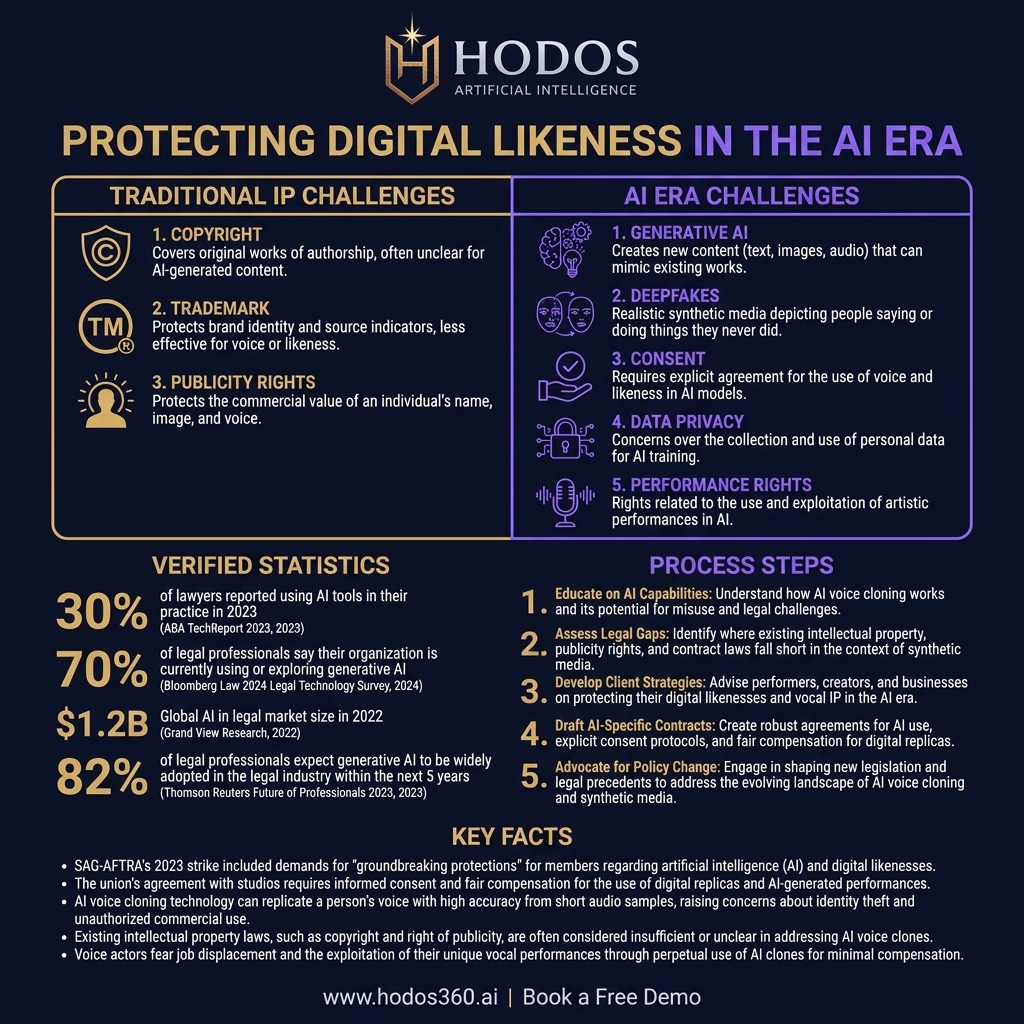
For law firms, staying ahead of these developments is not just about compliance; it's about competitive advantage. Clients, ranging from entertainment companies to tech startups, will require sophisticated advice on licensing agreements, intellectual property protection, and liability related to synthetic media. The ability to leverage legal tech solutions for identifying and analyzing AI voice clones or deepfakes will become increasingly valuable. Firms that invest in understanding the technical nuances of generative AI and its legal ramifications will be better equipped to serve their clients. The legal profession itself is undergoing a transformation, with tools like HODOS 360's AI Law Firm Management System and AI Voice Assistants helping firms automate routine tasks, allowing attorneys to focus on complex, high-value issues like those presented by the burgeoning field of AI and digital likeness disputes. This shift underscores the necessity for legal professionals to embrace technological competency, as highlighted by ABA Model Rule 1.1, which mandates competence in technology for lawyers.
Ethical AI and the Future of Legal Practice
The debate over AI voice clones forces the legal profession to confront fundamental ethical questions about the responsible development and deployment of artificial intelligence. For attorneys, this means understanding not only the letter of the law but also the ethical implications of advising clients on generative AI. ABA Model Rule 1.1, which requires lawyers to provide competent representation, now implicitly includes technological competence, particularly concerning AI's capabilities and risks. This extends to advising clients on the ethical sourcing of data for AI training, ensuring transparency in AI-generated content, and protecting against algorithmic bias. The unauthorized creation or use of AI voice clones can lead to significant reputational damage, privacy violations, and even emotional distress, all of which fall under the purview of ethical legal practice. Law firms must guide clients through these treacherous waters, emphasizing proactive ethical frameworks.
The future of legal practice will be deeply intertwined with the responsible adoption of ethical AI. Firms that integrate AI into their operations, such as for document automation or client intake automation, must do so with a clear understanding of the ethical guardrails. For instance, using AI voice assistants for client communication requires careful consideration of data privacy (ABA Model Rule 1.6 on confidentiality) and the potential for misinterpretation if clients are unaware they are interacting with AI. The legal profession has a unique responsibility to shape the ethical landscape of AI, not just react to it. This involves advocating for clear legal frameworks, participating in policy debates, and leading by example in the responsible use of AI within their own practices. The conversation around AI voice clones is a stark reminder that technology, while powerful, must always serve human values and rights.
Proactive Strategies for Legal Professionals
Law firms need to develop proactive strategies to address the challenges and opportunities presented by AI voice clones and generative AI. This includes advising clients on comprehensive AI governance policies that cover intellectual property rights, consent protocols, data privacy, and ethical usage. Firms should also invest in continuous education for their attorneys on emerging technologies and their legal ramifications. Understanding the technical capabilities of voice cloning and deepfakes is no longer optional; it's a necessity for effective counsel. Furthermore, legal professionals should consider how their own practices can leverage legal tech—like AI marketing tools or AI-powered website building—while maintaining ethical standards and client trust. The proactive firm will be the one that not only mitigates risks but also identifies new avenues for client service in this evolving digital landscape.
The ongoing clash over AI voice clones serves as a potent microcosm of the broader societal tension between technological advancement and human rights. As the capabilities of generative AI continue to accelerate, the legal profession is positioned at the forefront of defining the boundaries of what is permissible and ethical. By engaging deeply with these issues, understanding the nuances of digital likeness, performance rights, and the intricacies of AI governance, law firms can play a pivotal role in shaping a future where innovation flourishes responsibly. The lessons from Hollywood today will inform legal precedents for every industry tomorrow, underscoring the critical importance of informed, ethical, and technologically competent legal counsel.

Key Takeaways and Next Steps for Law Firms
The Hollywood actors' clash over AI voice clones is a powerful indicator of the profound legal and ethical shifts underway due to generative AI. For law firms, the key takeaway is clear: the era of digital likeness and synthetic media demands a new level of legal sophistication. Firms must prioritize developing expertise in intellectual property related to AI, consent frameworks for voice cloning, and the evolving landscape of performance rights. Educating clients on proactive AI governance strategies and helping them navigate potential litigation stemming from unauthorized AI voice clones or deepfakes will be paramount. This also means embracing legal tech not just for efficiency but as a strategic imperative to better serve clients in a rapidly changing legal environment. The firms that adapt quickly will define the future of legal service.
To effectively address these challenges, law firms should consider a multi-faceted approach: invest in specialized training on AI law, update client agreements to include AI-specific clauses, and leverage advanced legal tech platforms. HODOS 360’s comprehensive suite of services, including its AI Law Firm Management System and AI Voice Assistants, offers tools designed to streamline operations and free up attorneys to focus on these complex, high-value legal issues. By strategically integrating AI into their own practices, firms can not only enhance efficiency but also gain a deeper, practical understanding of the technology's implications, thereby providing more informed and forward-thinking counsel to clients grappling with the legal frontier of AI voice clones.
Frequently Asked Questions
What are AI voice clones and why are they a legal concern?+
AI voice clones are synthetic reproductions of a person's voice, created using artificial intelligence. They are a legal concern because their unauthorized use can infringe on intellectual property, right of publicity, and performance rights. Issues like lack of consent, unfair compensation, and potential for deepfakes to mislead or defame individuals are at the forefront of legal debates, as seen in the Hollywood actors' clash.
How do existing intellectual property laws apply to AI voice clones?+
Existing intellectual property laws, like copyright and trademark, offer some protection but are not fully equipped for AI voice clones. Copyright protects original works, but a synthetic voice might not be considered an 'original work.' Right of publicity laws, particularly in states like California, offer stronger protection against commercial exploitation of a person's digital likeness, including their voice. However, new legal frameworks are actively being debated.
What is the role of consent in the use of AI voice clones?+
Consent is paramount. The SAG-AFTRA strike highlighted the demand for explicit, informed consent from individuals before their voices can be used to create AI voice clones or for any subsequent commercial deployment. Without clear consent, the use of a digital likeness can lead to significant legal liabilities, including claims of misappropriation, privacy violations, and infringement of performance rights. This also extends to data privacy concerns.
What are the ethical implications for law firms regarding AI voice clones?+
For law firms, the ethical implications include ensuring technological competence (ABA Model Rule 1.1) when advising clients on generative AI. This means understanding the risks of unauthorized cloning, potential for deepfakes, and the need for robust AI governance. Firms must also uphold client confidentiality (ABA Model Rule 1.6) when using AI tools and advocate for ethical AI development that respects human creativity and individual rights, particularly for voice actors.
How can law firms prepare for litigation involving synthetic media and AI voice clones?+
Law firms can prepare by developing specialized expertise in AI law, including intellectual property and right of publicity in the digital age. They should invest in continuous education, monitor evolving legal frameworks and case law, and consider how legal tech can assist in identifying and analyzing synthetic media. Proactive client counseling on AI governance policies, robust contracts, and consent management will be crucial to mitigate future litigation risks related to AI voice clones and deepfakes.