

AI Web Development: Essential Strategies for Legal Liability
The legal landscape, traditionally cautious and deeply rooted in precedent, is now at the forefront of a technological revolution, particularly concerning its digital presence. Just hours ago, the legal tech community was once again stirred by Damon Burton’s insightful piece on HackerNoon, titled "Damon Burton on the New Reality of AI Web Development: Faster Builds, Bigger Liability."
Burton's review underscores a critical tension: the undeniable allure of AI-powered website building—promising rapid deployment and unparalleled efficiency—versus the profound, often hidden, legal and ethical risks it introduces. For law firms, whose digital storefronts are paramount for client intake, brand reputation, and information dissemination, this tension presents a complex challenge that demands immediate attention and strategic foresight.
The article's central premise, that AI-generated code, while fast, can harbor significant security flaws, technical debt, and compliance failures, resonates deeply within an industry where precision and trust are non-negotiable.
This new reality compels law firm owners and legal professionals to move beyond superficial engagements with AI.
It's no longer enough to simply adopt AI tools for marketing or case management; understanding the foundational layers of AI-driven infrastructure, like your firm's website, is now an ethical imperative. The stakes are higher than ever, with potential repercussions ranging from data breaches and intellectual property disputes to professional malpractice claims.
As firms increasingly rely on AI to generate content, optimize SEO, and manage client interactions through their online platforms, the overlooked risks associated with AI web development become a palpable threat. This comprehensive guide, informed by the concerns raised by Burton and other industry leaders, will delve into the multifaceted liabilities of AI web development, offering actionable strategies to navigate this complex terrain while harnessing the transformative power of AI responsibly.
We will explore how firms can embrace the reality of faster builds without succumbing to bigger liability, ensuring their digital presence is both innovative and legally sound.
The New Reality of AI Web Development: Speed vs. Scrutiny
The promise of AI in web development is undeniably attractive. Platforms like OpenAI’s DALL-E and Midjourney can generate stunning visual assets in seconds, while tools leveraging large language models (LLMs) like GPT-4 can draft website copy, code snippets, and even entire website structures with remarkable speed.
This acceleration in development cycles, as Damon Burton's HackerNoon review highlights, allows firms to launch new marketing campaigns or update their online presence with unprecedented agility. For a law firm, this could mean rapidly deploying a new micro-site for a specific practice area, A/B testing different landing page designs to optimize lead generation, or quickly updating legal resources in response to new legislation.
The efficiency gains are clear, promising to reduce development costs and time-to-market significantly. However, this speed often comes at the cost of thorough human oversight and scrutiny.
The core tension lies in the autonomous nature of AI-generated content and code. Learn more about AI Marketing: The Ultimate Platform Disrupting Agencies.
While an AI can produce a functional website structure, design elements, and even legal disclaimers, the underlying algorithms do not inherently understand the nuances of legal compliance, ethical obligations, or the specific risks associated with sensitive client data. As Jensen Huang, CEO of NVIDIA, has often emphasized regarding AI's broader impact, the tools are powerful, but human expertise remains critical in guiding and validating their output.
The rapid pace of AI development means that while the technology is constantly evolving, the regulatory and ethical frameworks are struggling to keep pace. This creates a significant gap where law firms, in their pursuit of innovation, can inadvertently expose themselves to legal pitfalls. The reality is that an AI-generated website, without rigorous validation by legal and technical experts, can become a conduit for liabilities rather than a competitive advantage.
Unpacking the Liabilities: From Code to Compliance
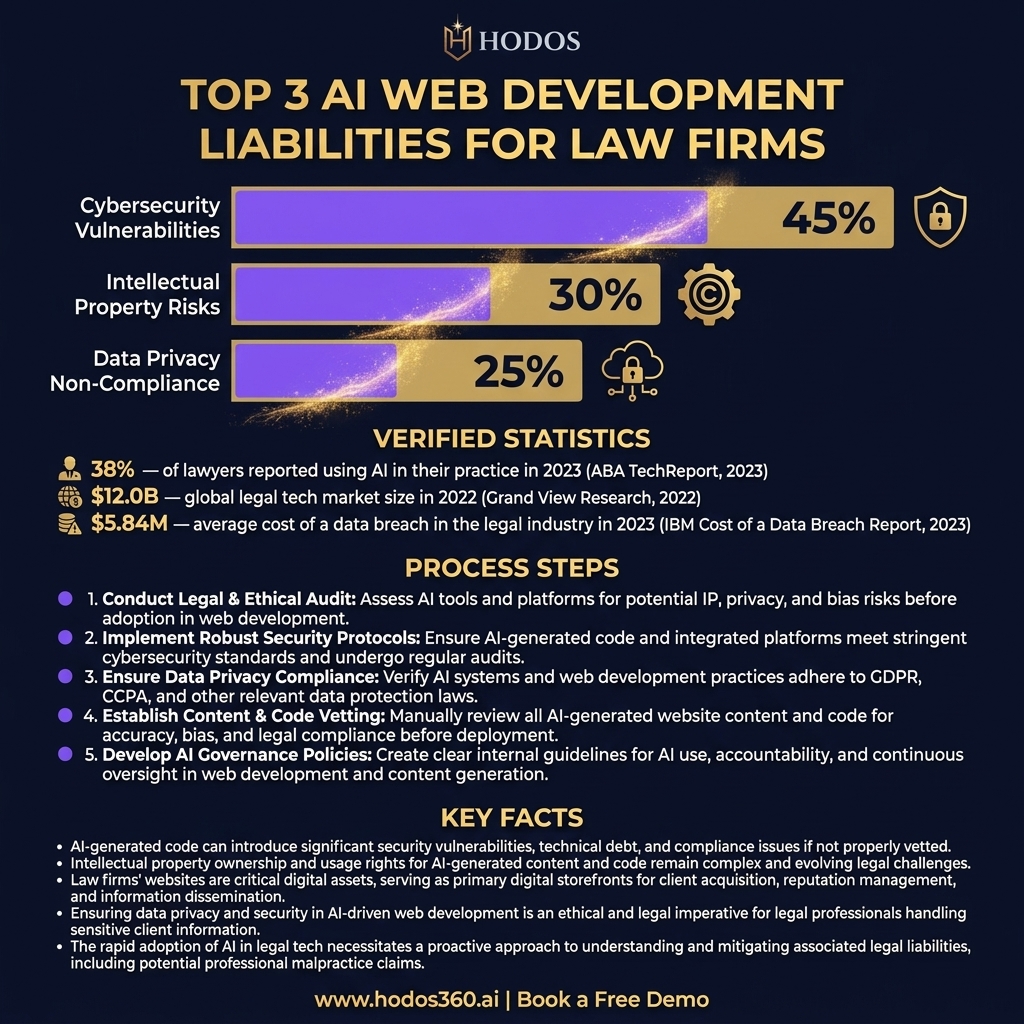
The liabilities associated with AI web development extend far beyond simple coding errors. One of the most prominent concerns, as detailed in Burton's white paper, is the potential for AI-generated code to contain security vulnerabilities. Unlike human developers who follow established security protocols and undergo peer reviews, AI models might inadvertently introduce exploitable flaws, backdoors, or rely on outdated libraries, making the website a target for cyberattacks.
A 2024 report by the ABA Journal indicated a substantial increase in cyberattacks targeting law firms, underscoring the critical need for robust digital security. Such vulnerabilities could lead to data breaches, compromising sensitive client information—a direct violation of ABA Model Rule 1.6 (Confidentiality of Information) and potentially resulting in severe penalties under regulations like CCPA or GDPR.
Beyond security, the implications for intellectual property (IP) are profound. When an AI generates website content, images, or even code, the origin of its training data becomes a critical question. Learn more about Legal AI: The Ultimate Guide to Transforming Law Firms. Is the AI inadvertently reproducing copyrighted material?
Who owns the IP of the AI-generated output? These questions are at the heart of ongoing legal battles, such as those faced by companies like Stability AI and Midjourney regarding their use of copyrighted images for training. For law firms, this could mean inadvertently infringing on third-party IP rights, leading to costly litigation and reputational damage.
The lack of clear precedent in this evolving area means firms must exercise extreme caution, ensuring that all AI-generated assets are thoroughly vetted for potential IP conflicts. The risks are not merely theoretical; they represent a tangible threat to a firm's legal and financial stability in the digital realm.
Intellectual Property and Licensing Challenges
The nebulous ownership of AI-generated content poses a significant hurdle. While some AI tools offer commercial licenses for their output, the provenance of the training data used to create that output remains a black box. If an AI model was trained on copyrighted works without proper licensing, any derivative work it produces, including website elements, could be considered infringing.
Law firms must consider the chain of custody for every asset on their website, whether human-created or AI-generated. Learn more about Essential Harvard AI & Web Development Courses for Law Firms. This extends to open-source components suggested or written by AI—are their licenses compatible with commercial use?
Firms must conduct thorough due diligence, potentially requiring specific contractual clauses with AI platform providers that explicitly guarantee the originality and clear licensing of AI-generated assets, or indemnify the firm against IP claims. The complexities surrounding IP in AI are so significant that organizations like the World Intellectual Property Organization (WIPO) are actively working on frameworks, yet clear legal precedents are still emerging.
Firms must act defensively, understanding that the burden of proof often falls on the user of the AI tool.
Ethical AI and Attorney Responsibility in Digital Presence
The ethical implications of using AI in web development for law firms are intertwined with an attorney's fundamental duties. ABA Model Rule 1.1 (Competence) mandates that lawyers provide competent representation, which, in the digital age, includes understanding the risks and benefits of technology relevant to their practice.
This extends to the technology underpinning their public-facing website. An AI-generated website that is inaccessible, misleading, or fails to protect client data could be seen as a breach of this duty. Furthermore, the ethical obligation to avoid misleading advertising (ABA Model Rule 7.1) requires that any content generated by AI for a firm's website—be it testimonials, case results, or practice area descriptions—must be accurate, verifiable, and not create unjustified expectations.
The sheer volume and speed of AI content generation make this oversight challenging but more critical than ever.
The need for human oversight is paramount. Learn more about AI Podcasts: Essential Voice Assistant Strategies for Law Firms. As Sam Altman, CEO of OpenAI, and Dario Amodei, CEO of Anthropic, have frequently articulated, AI is a powerful assistant, not a replacement for human judgment.
For law firms, this means that even if AI builds the website, a human attorney must review every piece of content, every design choice, and every functional element to ensure it aligns with ethical rules, professional standards, and the firm’s brand identity. This extends to ensuring accessibility standards (like WCAG) are met, which, while not always a direct ethical rule, reflects a commitment to public service and non-discrimination.
The ethical responsibility for the firm's digital presence ultimately rests with its partners, not with the algorithms. Failing to implement robust human review processes leaves firms vulnerable to ethical complaints, regulatory fines, and significant damage to their professional reputation, which is often their most valuable asset.
Data Privacy and Regulatory Compliance
A law firm's website is a crucial touchpoint for collecting sensitive information, from potential client inquiries to online payment processing. AI-powered web development, if not carefully managed, can inadvertently create compliance gaps. AI-generated forms, tracking scripts, or third-party integrations might not adhere to the strict data privacy regulations like GDPR, CCPA, or HIPAA.
For example, an AI might suggest a marketing cookie integration that automatically collects excessive user data without explicit consent, leading to significant fines. The EU AI Act, which is set to become enforceable, categorizes AI systems based on risk, and while website building might not be 'high-risk' in itself, the data collection and processing capabilities of an AI-powered site could fall under stricter scrutiny.
Learn more about Privilege & AI: The Ultimate Guide After US v. Heppner. Firms must implement a 'privacy-by-design' approach, ensuring that every AI-driven component of their website is scrutinized for its data handling practices. This includes understanding where data is stored, how it is processed, and who has access to it.
Thomson Reuters Institute reports consistently emphasize data privacy as a top concern for legal professionals, and AI only amplifies this challenge. The firm's website is not just a brochure; it's a data engine, and its compliance must be impeccable.
Strategic Safeguards: Building Secure AI-Powered Websites
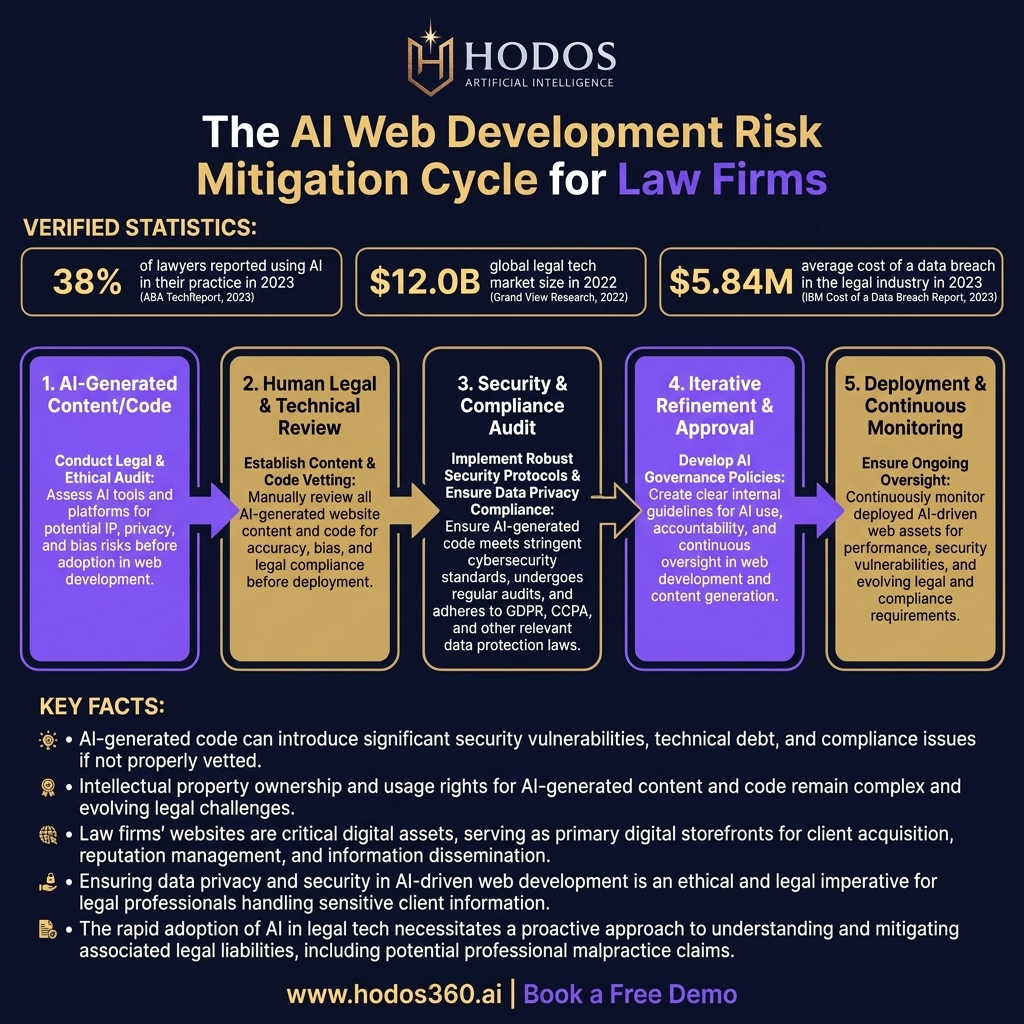
Mitigating the risks of AI web development requires a multi-layered strategic approach that combines advanced technology with rigorous human oversight. The first step is to implement a robust AI governance framework within the firm, defining clear policies for AI tool usage, data handling, and content review.
This framework should mandate that all AI-generated code and content undergo a comprehensive human audit by both legal and technical experts. Firms should consider engaging specialized cybersecurity firms to conduct regular penetration testing and vulnerability assessments on their AI-developed sites. This proactive security posture is essential, especially when dealing with the emergent and sometimes unpredictable nature of AI output.
Leaders in legal tech, like Clio, which acquired Lawyaw to enhance document automation, understand that integrating AI means integrating safeguards. It’s not just about using the latest tool, but using it securely and responsibly.
Furthermore, firms should prioritize AI platforms that offer transparency regarding their training data, security protocols, and compliance certifications.
Learn more about AI in MarTech: The Ultimate Guide to Predictive Power. When selecting an AI web development partner, inquire about their indemnification policies for IP infringement or data breaches resulting from their AI’s output. Implementing strong contractual agreements with AI vendors is a critical safeguard.
For instance, firms could emulate the due diligence applied by leading firms like Allen & Overy in their partnership with Harvey AI, focusing on secure integration and clear lines of responsibility. The goal is to establish a clear audit trail for all AI contributions to the website, making it possible to trace the origin of any problematic content or code.
This level of scrutiny, while adding an initial overhead, dramatically reduces long-term liability and protects the firm's reputation and client trust. It is about understanding that while AI offers faster builds, the 'bigger liability' can be managed through intelligent, proactive strategies.
The Imperative of Human Oversight and Auditing
No matter how sophisticated the AI, human oversight remains the ultimate safeguard. For every AI-generated element—from a single image to an entire landing page—a qualified human must review, verify, and approve its use. This isn't just about catching errors; it's about ensuring alignment with the firm's specific brand voice, ethical obligations, and legal accuracy.
For instance, an AI might generate a blog post about a complex legal topic that, while grammatically correct, misses critical nuances or presents information in a way that could be misconstrued. A human attorney, knowledgeable in that specific practice area, must provide the final editorial pass.
Similarly, a technical expert should review AI-generated code for efficiency, security, and adherence to best practices, looking for the 'overlooked risks' that Burton's article emphasizes. Regular, scheduled audits of the entire website, including both human and AI-generated components, are essential to maintain compliance and security.
This iterative process of AI generation followed by human validation creates a robust framework that minimizes exposure to the inherent uncertainties of AI output. It is the fusion of AI's speed with human intellect's scrutiny that truly future-proofs a law firm's digital assets.

The Future-Proof Law Firm: Embracing AI with Due Diligence
The narrative around AI in legal tech is often polarized: either it's an existential threat or a panacea. The reality, as Damon Burton's recent HackerNoon piece reminds us, is far more nuanced, especially concerning AI web development. For law firms, the path forward is not to shy away from AI, but to embrace it with a clear-eyed understanding of its capabilities and limitations.
This means investing in continuous education for your team on AI ethics, data privacy, and cybersecurity best practices. It means fostering a culture of due diligence, where every technological adoption, particularly those involving AI, is subjected to rigorous legal and ethical review. The future-proof law firm will be one that leverages AI's power to build faster, more efficient digital platforms, but does so with an unwavering commitment to professional responsibility and client protection.
The transformation of the legal industry by AI is inevitable, but its direction is shaped by the choices firms make today. By understanding and proactively addressing the 'bigger liability' side of the equation, firms can ensure AI truly serves their mission of justice and client advocacy.
HODOS 360 understands these challenges intimately. Our AI-powered Web & Mobile Development services for law firms are built on a foundation of security, compliance, and ethical design. We provide AI-powered website building with responsive design, SEO optimization, and high-converting templates, all while integrating the necessary safeguards and expert oversight to mitigate the risks highlighted by industry experts.
Our approach ensures that your firm's digital presence is not only cutting-edge and efficient but also robustly protected against the evolving landscape of AI-related liabilities. By partnering with HODOS 360, law firms can confidently navigate the new reality of AI web development, transforming potential liabilities into strategic advantages and securing their place at the forefront of the legal profession.
Frequently Asked Questions
What are the primary liabilities associated with AI web development for law firms?+
Primary liabilities include cybersecurity vulnerabilities in AI-generated code, intellectual property infringement risks from AI-created content, and potential non-compliance with data privacy regulations (e.g., GDPR, CCPA) if AI tools are not properly configured or overseen. Additionally, ethical concerns regarding attorney competence and misleading advertising can arise if AI output is not rigorously reviewed by human legal experts.
How can law firms mitigate the cybersecurity risks of AI-generated websites?+
Law firms can mitigate cybersecurity risks by implementing a robust AI governance framework, conducting thorough human audits of all AI-generated code and content, and engaging specialized cybersecurity firms for regular penetration testing and vulnerability assessments. Prioritizing AI platforms with transparent security protocols and strong contractual indemnification clauses also adds a crucial layer of protection.
What are the intellectual property concerns with using AI for website content?+
The main IP concerns stem from the training data of AI models. If AI generates content or images based on copyrighted material without proper licensing, the firm could face infringement claims. Firms must vet all AI-generated assets, ensure clear licensing guarantees from AI providers, and consider the 'chain of custody' for content to avoid inadvertently using infringing material.
How does AI web development impact a law firm's compliance with data privacy laws?+
AI web development can impact data privacy compliance if AI-generated forms, tracking scripts, or integrations fail to adhere to regulations like GDPR or CCPA. Firms must adopt a 'privacy-by-design' approach, meticulously scrutinizing how AI components collect, store, and process user data, ensuring explicit consent mechanisms are in place, and regularly auditing for compliance with evolving data protection laws.
Why is human oversight crucial when using AI for a law firm's website?+
Human oversight is crucial because AI, while efficient, lacks the nuanced understanding of legal ethics, specific firm branding, and complex regulatory requirements. A human attorney must review all AI-generated content for accuracy, ethical compliance, and alignment with professional standards. This ensures the website remains competent, truthful, and protective of client interests, fulfilling an attorney's fundamental duties.