

AI Website Readability: Essential Strategies for Law Firms
Imagine Sarah Chen, a managing partner at a boutique intellectual property firm, Chen & Associates. Her firm recently invested heavily in a sleek, visually stunning website, packed with interactive elements and high-resolution multimedia. The goal was to impress potential clients and showcase their modern approach to legal services. Yet, a recent report from DesignRush highlighted a sobering reality: 'AI Systems Can't Read a Quarter of the Average Homepage.' This startling statistic underscores a growing disconnect between how humans perceive a website and how advanced AI systems—the very engines powering tomorrow's search and discovery—interpret its content. For law firms like Chen & Associates, this isn't merely a technical glitch; it represents a significant hurdle to their digital presence and client acquisition efforts in an increasingly AI-driven world.
This challenge is amplified by the rapid ascent of generative AI in search. Google's rollout of AI Overviews, for instance, fundamentally alters how users interact with search results, emphasizing direct answers derived from web content. If a law firm's website isn't structured for optimal AI readability, its valuable insights, attorney profiles, and service offerings risk being overlooked by these powerful AI systems. As Dario Amodei, CEO of Anthropic, has often articulated, the ability of large language models to accurately parse and synthesize information is contingent on the quality and structure of their input data. A visually appealing but semantically opaque website, designed primarily for human eyes, can become a digital black hole for AI, effectively rendering a significant portion of its content invisible. The stakes are high: firms that fail to adapt risk diminished website visibility, reduced organic traffic, and ultimately, a weaker competitive edge in the crowded legal market.
The Silent Struggle: Why AI Systems Miss Your Homepage
The DesignRush report, citing data from Adobe, painted a stark picture of the current state of web readability for AI systems. Their findings indicate that complex rendering, heavy reliance on JavaScript for critical content, and intricate interactive elements often create barriers for AI crawlers and language models attempting to parse a page. Unlike human visitors who can easily discern visual hierarchies and intuitive navigation, AI primarily processes the underlying code and structured data. If key information—such as practice area descriptions, attorney bios, or contact details—is buried within non-standard HTML, dynamic scripts, or even embedded images without proper alt text, AI struggles to identify and contextualize it. This isn't a flaw in AI per se, but rather a misalignment between traditional web design practices and the evolving demands of machine comprehension. Firms might invest thousands in stunning visual designs, only to find that their sophisticated homepage is largely incomprehensible to the very algorithms dictating online discovery.
Consider the implications for legal research and client intake. Prospective clients increasingly use conversational AI interfaces or advanced search queries to find legal assistance. Learn more about Legal AI Demo Day: Ultimate Insights for Law Firms. These interfaces rely on robust AI models that scour the web for relevant and authoritative information. If a law firm's website presents a 'black box' to these AI systems, it directly impacts their ability to surface the firm's expertise. As Google's Sundar Pichai emphasized at a recent developer conference, the future of search is deeply intertwined with AI's capacity to understand and synthesize information across diverse digital formats. The challenge isn't just about SEO keywords; it's about the fundamental structure and semantic clarity of the entire site. Firms must move beyond merely having a website to ensuring their websites are *intelligently designed* for both human engagement and machine interpretation, especially as AI-driven traffic continues to grow across all sectors, including legal services. The problem isn't the AI's intelligence, but the web's design for an outdated paradigm.
Beyond the Surface: Crafting AI-Readable Content for Legal Practices
Achieving AI readability goes beyond merely stuffing keywords. It requires a strategic approach to content creation and website architecture that prioritizes clarity, structure, and semantic richness. For legal practices, this means presenting complex legal information in a way that is both accessible to potential clients and easily digestible by AI systems. The American Bar Association (ABA) Model Rules of Professional Conduct, particularly Rule 7.1 concerning communications about a lawyer's services, implicitly encourages clear and honest communication. While not directly addressing AI, the spirit of transparency and accurate representation extends to how AI interprets a firm's online presence. Firms should embrace semantic HTML, using appropriate tags (like ` for main titles, for paragraphs, ` for lists) to delineate content hierarchy. This provides AI with a clear roadmap, allowing it to understand the relationships between different sections and extract key information more effectively. Moreover, embedding structured data using Schema.org markup for legal services, attorney profiles, and firm contact details significantly enhances machine comprehension, offering explicit cues about the nature of the content.
Furthermore, the language used on a legal website plays a crucial role. Learn more about Conversational AI: Essential Strategies for Legal Success. While legal precision is paramount, content should strive for clarity and conciseness where appropriate, avoiding overly convoluted sentences or unnecessary jargon that could confuse AI systems trying to identify entities and relationships. Consider the difference between a dense legal brief and a client-facing blog post explaining a legal concept. While both require accuracy, the latter benefits from a more direct, informative style that AI can more readily process. Law firms should also ensure that critical information is presented in text rather than solely within images or embedded PDFs, which are notoriously difficult for AI to parse without advanced OCR (Optical Character Recognition) capabilities. Regular content audits, perhaps using AI-powered tools, can help identify areas where readability might be compromised for machines. By adopting these practices, legal firms can ensure their valuable expertise is not just seen, but truly *understood* by the AI algorithms shaping the future of online legal discovery.
Structuring Content for AI Comprehension
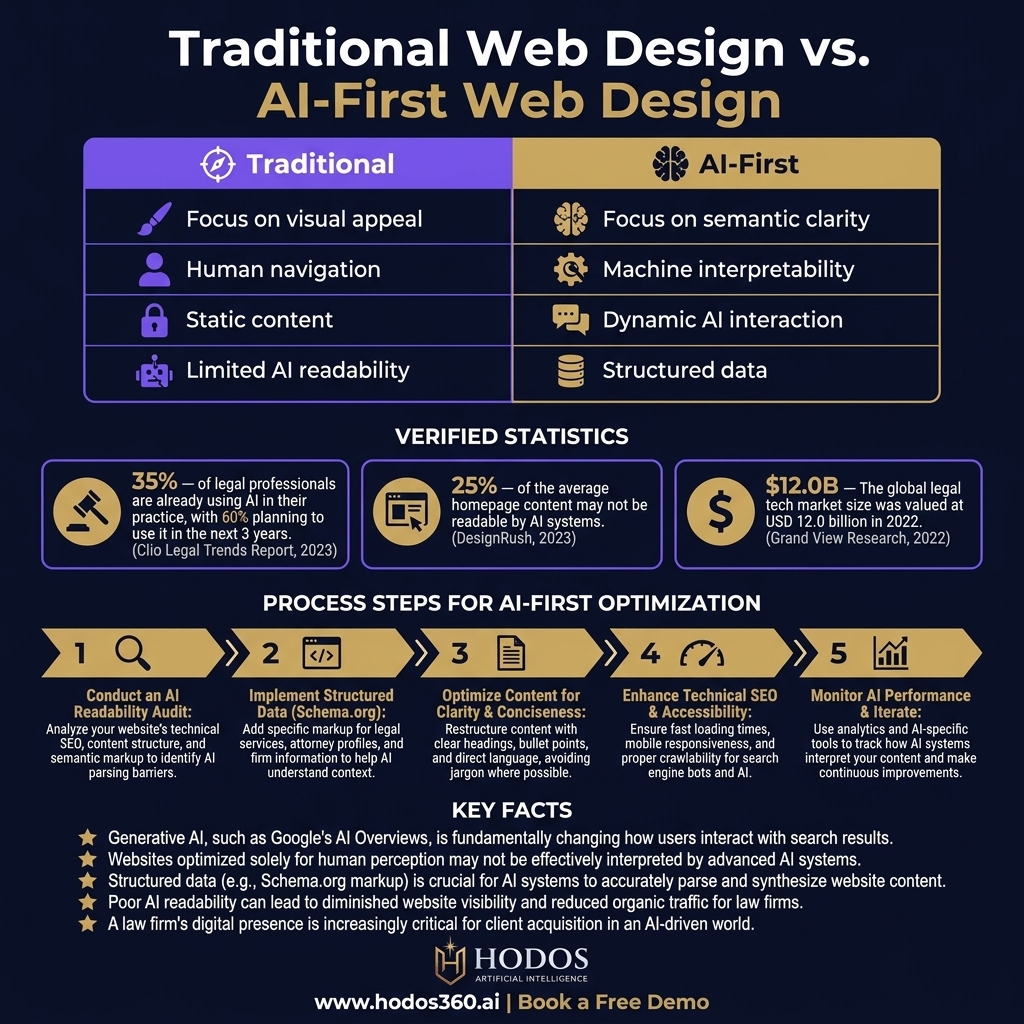
Effective content structuring is the bedrock of AI readability. For law firms, this means thinking beyond visual appeal and focusing on the underlying architecture that AI systems scan. First, employ a logical heading structure (H1, H2, H3, etc.) to outline your content, much like a table of contents for a legal brief. This helps AI identify main topics and sub-topics, establishing a clear hierarchy of information. Second, ensure that key legal terms, practice areas, and attorney names are consistently and clearly presented. AI systems utilize Named Entity Recognition (NER) to identify and categorize specific entities, making it easier for them to connect your firm with relevant legal queries. Learn more about AI Adoption in Legal: An Essential Guide to Scaling GenAI. Third, leverage bullet points and numbered lists to break down complex information into digestible chunks. This not only improves user experience for human readers but also allows AI to quickly extract key facts and summarize arguments. Finally, consider implementing advanced semantic markup, such as JSON-LD, to explicitly define your firm's services, reviews, and contact information. This structured data provides explicit signals to Google AI Overviews and other AI models, significantly boosting your content's chances of being accurately interpreted and presented in AI-driven search results. These structural elements are critical for enhancing your firm's digital presence in an AI-first web.
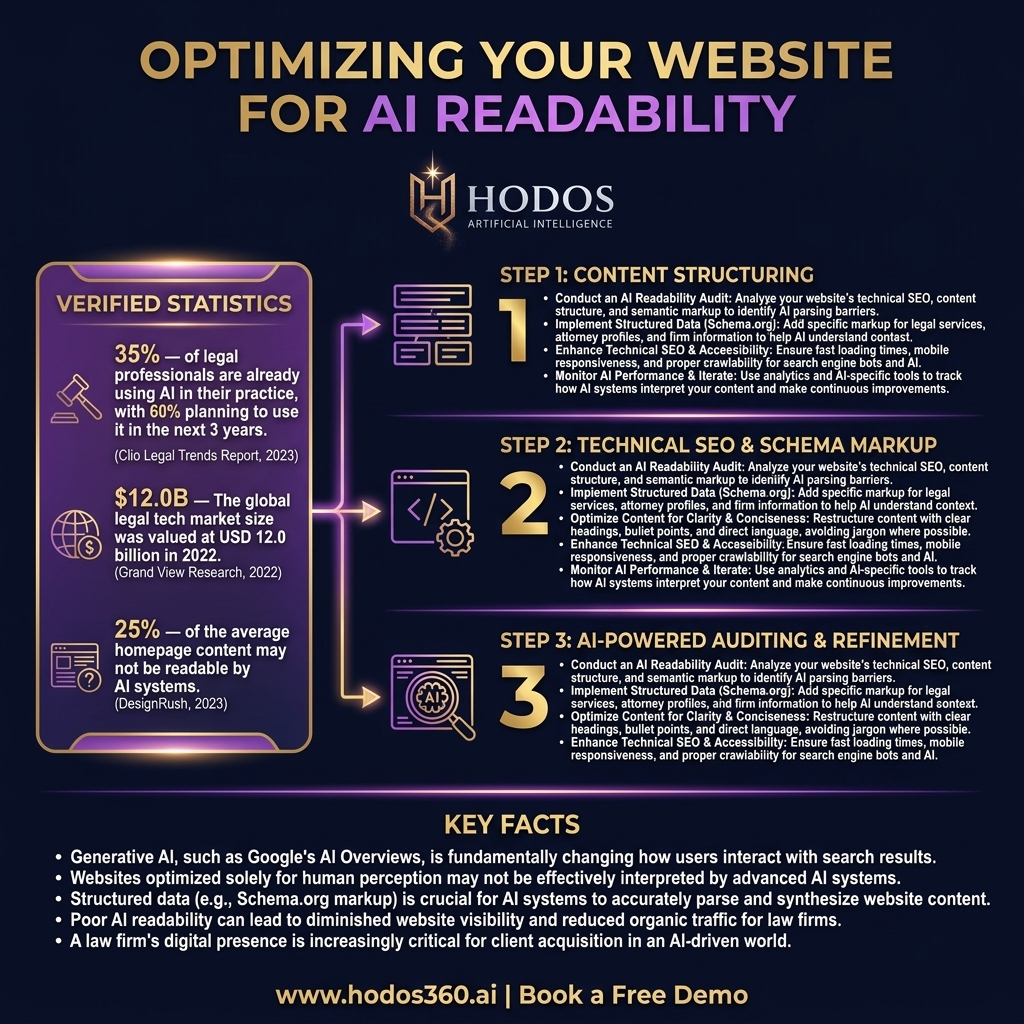
- ✓Semantic HTML Usage: Employ proper HTML5 tags (e.g., `, , `) to give context to your content, guiding AI systems through your website's structure.
- ✓Clear Content Hierarchy: Organize information with a logical flow using H1-H6 headings. Ensure your H1 accurately reflects the page's primary topic for optimal AI readability.
- ✓Schema Markup Implementation: Use Schema.org types like LegalService, Attorney, and LocalBusiness to provide explicit, machine-readable data about your firm and its offerings, crucial for Google AI Overviews.
- ✓Text-First Approach: Prioritize crawlable text for all critical information. Avoid burying essential details in images, complex JavaScript, or PDFs without text equivalents.
- ✓Accessibility Standards (WCAG): Adhering to Web Content Accessibility Guidelines often improves AI readability by promoting well-structured, semantically rich content for all users.
- ✓Internal Linking Strategy: Create a robust internal linking structure using descriptive anchor text. This helps AI systems understand the relationships between your website's pages and reinforces topical authority.
- ✓Regular Content Audits: Utilize AI systems and tools to periodically assess your website's readability score, identify broken links, and ensure all content remains optimized for machine comprehension.
Navigating the AI-First Web: Optimizing Your Firm's Digital Presence
The transition to an AI-first web is fundamentally reshaping how law firms must approach their digital presence. No longer is it enough to simply rank high for a few keywords; now, content must be understood, synthesized, and trusted by sophisticated AI systems that power search engines and virtual assistants. The rise of Google AI Overviews, which provide summarized answers directly within the search results, presents both an opportunity and a challenge. While appearing in an AI Overview can significantly boost a firm's authority and visibility, content that lacks AI readability will simply be bypassed. Recent studies, including some referenced by competitor analyses, suggest that AI Overviews can significantly impact traditional click-through rates (CTR), with some reporting a 61% reduction for certain queries if content isn't optimized for this new format. This isn't just about SEO; it's about being present and authoritative in the new digital conversation.
Law firms must recognize that their website is increasingly a data source for AI, not just a brochure for humans. Learn more about Agentic AI Unleashed: 2026's Power in Legal Work. This paradigm shift demands a focus on generating high-quality, verifiable content that AI systems can confidently cite. Building domain authority through authoritative external links and maintaining a robust internal linking structure become even more critical, signaling to AI that your content is trustworthy and relevant. As legal tech platforms like Harvey AI demonstrate, AI systems are becoming adept at understanding legal nuances and context. Firms that invest in AI-powered website building and search engine optimization strategies, ensuring their content is semantically rich and structurally sound, will be the ones that capture the attention of both AI and the clients it serves. The goal is to create a symbiotic relationship where AI helps disseminate your firm's expertise, rather than inadvertently obscuring it.
The Impact of Google AI Overviews
The introduction of Google AI Overviews marks a pivotal moment in search engine optimization for law firms. These AI-generated summaries, appearing prominently at the top of search results, aim to provide immediate, comprehensive answers to complex queries. For a law firm, being featured in an AI Overview for a specific legal question or practice area can be an unparalleled boon for website visibility and perceived authority. However, this coveted placement is exclusively reserved for content that AI systems can confidently parse, understand, and verify as accurate and authoritative. This means that firms must not only produce expert legal content but also present it in a way that aligns with AI's information retrieval capabilities. Learn more about Legal AI ROI: Maximizing Law Firm Value in 2026. Content needs to be factual, well-structured, and semantically clear, often incorporating data points and clearly stated conclusions. The readability for AI is paramount; if your site's content is ambiguous, disorganized, or hidden behind technical barriers, it will be overlooked by Google's sophisticated AI models, regardless of its underlying quality. Firms must proactively audit their content to ensure it's not just informative but also AI-ready to capitalize on this transformative shift in search.
The Future of Legal Web Development: Integrating AI for Enhanced Visibility
The future of legal web development is inextricably linked with AI. Firms that proactively integrate AI systems into their website building and content strategy will gain a significant competitive advantage. This isn't about replacing human designers or content creators, but empowering them with AI tools to enhance efficiency and effectiveness. AI-powered platforms can now assist in identifying optimal content structures, suggesting relevant keywords for search engine optimization, and even generating drafts of blog posts or service descriptions that are inherently more AI-readable. Imagine an AI tool that analyzes your website and points out exactly which sections are confusing to AI systems, or suggests schema markup improvements with a click. This level of insight and automation, offered by platforms like HODOS 360's Web & Mobile Development service, transforms a reactive approach to digital presence into a proactive, data-driven one.
Beyond just optimizing for readability, AI can also personalize user experience, leading to higher engagement and conversion rates. Learn more about AI Document Workflows: Revolutionize Your Firm in 2026 for Maximum ROI. AI-driven analytics can track how users (and AI crawlers) interact with your site, identifying bottlenecks and opportunities for improvement. For instance, understanding which legal queries lead to specific practice area pages, and how AI might summarize those pages, offers invaluable insights for content refinement. As the legal industry continues its rapid digital transformation, fueled by advancements like those seen at LegalTech NYC 2026, the firms that embrace AI-powered website building and continuous optimization will be the ones best positioned to attract and retain clients in an increasingly competitive landscape. This strategic integration of AI ensures that a firm's online assets are not just visually appealing but also intelligently optimized for the algorithms that govern modern digital discovery, securing their website visibility for years to come.
Ethical AI in Web Design
As law firms leverage AI systems for web development and content optimization, ethical considerations become paramount. The EU AI Act, for example, sets a global standard for responsible AI deployment, emphasizing transparency, data privacy, and accountability. For website building, this translates to ensuring that AI-generated content is clearly identified where appropriate, and that algorithms used for personalization or content suggestions do not introduce bias or discriminate. Law firms, as guardians of justice, have a heightened responsibility to uphold these ethical principles in their digital presence. This includes ensuring that any AI-powered tools used for search engine optimization or content creation operate transparently, without engaging in deceptive practices. Furthermore, data privacy, as outlined in regulations like GDPR and CCPA, must be meticulously observed when collecting and processing user data, even if for AI systems to improve user experience. The goal is to build an AI-readable website that is not only effective but also trustworthy and compliant with evolving legal and ethical frameworks, reinforcing the firm's reputation for integrity in the digital realm.

Key Takeaways and Next Steps
The DesignRush report serves as a critical wake-up call for law firms: an aesthetically pleasing website is no longer sufficient. In an era dominated by AI systems and Google AI Overviews, ensuring your firm's AI website readability is an essential component of its digital presence and client acquisition strategy. Firms must meticulously review their online content and technical architecture, focusing on semantic structure, clear language, and robust schema markup. Embracing AI-powered website building and search engine optimization is not a luxury but a necessity for maintaining website visibility and relevance. Proactive adaptation to the AI-first web is the only way to ensure your firm's expertise is not just available online, but truly discoverable and comprehensible to the algorithms shaping tomorrow's legal landscape. By making your website truly AI-readable, your firm will be well-positioned to thrive.
Frequently Asked Questions
What does 'AI website readability' mean for law firms?+
AI website readability refers to how easily and accurately AI systems can parse, understand, and extract meaningful information from your law firm's website. This involves the site's technical structure, content organization, and semantic clarity, ensuring AI can interpret your legal expertise, practice areas, and attorney information effectively, especially for services like Google AI Overviews.
Why is AI website readability important for law firms now?+
With the rise of generative AI in search and virtual assistants, AI systems are increasingly mediating how potential clients discover legal services. If your website isn't AI-readable, your firm risks reduced website visibility, being overlooked in AI-generated summaries, and missing out on valuable organic traffic from an evolving digital landscape. It's crucial for a strong digital presence.
What are common issues that make a law firm's website hard for AI to read?+
Common issues include heavy reliance on JavaScript for critical content, complex interactive elements, information buried in images or PDFs without text alternatives, and a lack of semantic HTML or structured data (Schema.org). These elements, while sometimes visually appealing, can create 'black boxes' for AI systems trying to interpret your homepage and other pages.
How can law firms improve their website's AI readability?+
Law firms can improve AI website readability by using clear semantic HTML, structuring content with logical headings (H1-H6), implementing Schema.org markup for legal services, prioritizing text-based content, and ensuring consistent, clear language. Regular audits and leveraging AI-powered website building tools can also identify and fix readability problems for AI systems.
Will optimizing for AI readability negatively impact the user experience?+
No, quite the opposite. Optimizing for AI readability often enhances the overall user experience. Practices like clear content structure, logical navigation, and accessible design benefit both AI systems and human visitors. A well-organized, semantically rich website is easier for everyone to understand, leading to better engagement, improved website visibility, and more effective communication of your firm's services.