

Voice AI: Essential for Africa's Enterprise Legal Evolution
In the bustling tech hubs of Lagos and Nairobi, a quiet revolution is taking hold—one powered not by screens, but by sound. Consider the story of Attorney Ngozi Okoro, a partner at a mid-sized law firm in Abuja, Nigeria. For years, her firm grappled with the immense challenge of serving a diverse clientele across vast distances, many of whom preferred oral communication or spoke one of Nigeria's hundreds of indigenous languages. Traditional client intake was a bottleneck, phone lines were often overwhelmed, and the cost of maintaining a large, multilingual support staff was prohibitive. It was a common narrative across the continent, where mobile phone penetration far outstrips internet access, and digital literacy varies wildly. The promise of digital inclusion often stumbled at the interface.
Then came the shift. Inspired by the rapid advancements in conversational AI and observing companies like Safaricom's M-Pesa leveraging simple mobile interfaces for complex financial transactions in Kenya, Okoro's firm began exploring Voice AI. This wasn't just about automated answering; it was about intelligent, empathetic, and multilingual engagement. The initial skepticism within the firm, particularly from senior partners accustomed to paper files and direct human interaction, was palpable. Many saw AI as a threat, a dehumanizing force. Yet, the stark reality of missed opportunities and inaccessible legal services for a significant portion of the population presented a compelling counter-argument. The firm's managing partner, Mr. Emeka Ndubuisi, a forward-thinker who had attended LegalTech NYC 2026, returned convinced that voice was not just an option but an imperative for the African legal landscape.
This burgeoning trend, highlighted by recent reports like "Why voice will become Africa’s most important enterprise interface" from Business News Nigeria, underscores a profound truth: for a continent defined by its linguistic diversity and mobile-first population, Voice AI offers an unparalleled pathway to digital transformation. It's a technology poised to shatter traditional barriers to legal services, offering a scalable, accessible, and culturally resonant solution. For law firms navigating the complexities of growth in Africa, understanding and strategically implementing advanced voice technologies is no longer a futuristic fantasy but an immediate competitive necessity. It represents a paradigm shift from inaccessible legal advice to ubiquitous, on-demand support, fundamentally reshaping how justice is accessed and administered.
Ready to transform your firm's client engagement? Discover the power of HODOS 360's AI Voice Assistants. Learn more and book a free demo today!
The Reshaping Power of Voice AI in African Enterprises
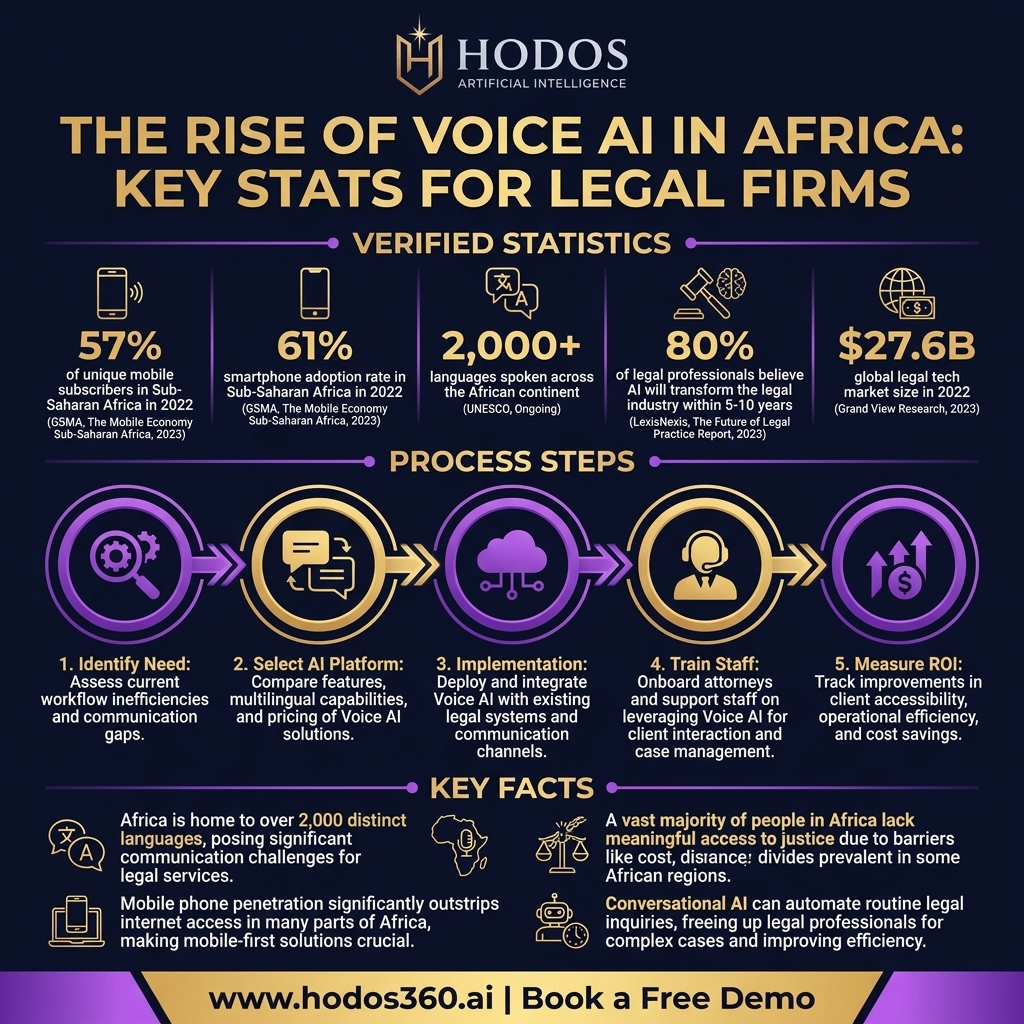
The narrative of digital transformation in Africa often focuses on mobile applications and internet connectivity. However, the unique socio-economic and infrastructural realities of the continent elevate Voice AI to a particularly strategic position. According to a 2023 report by the GSMA, over 80% of African internet users access services primarily through mobile devices, and a significant portion of the population still relies on feature phones. Furthermore, Africa is home to over 2,000 distinct languages, a linguistic tapestry that presents both a rich cultural heritage and a formidable barrier to standardized digital services. Traditional text-based interfaces inherently exclude vast segments of the population who may struggle with literacy in colonial languages or simply prefer their native tongue. This is where voice technology shines, offering an intuitive, natural, and universally accessible mode of interaction.
For businesses across various sectors, from fintech to healthcare, the adoption of voice interfaces is not merely an innovation but a necessity for achieving true market penetration. Consider the success of companies like Viamo, which uses interactive voice response (IVR) systems to deliver critical information to millions in local languages, or the growing number of African startups developing voice-enabled agricultural platforms. These enterprises recognize that the 'next billion' users will largely interact with technology through speech. Jensen Huang, CEO of NVIDIA, has frequently emphasized the democratization of computing through natural language, a vision that resonates deeply with Africa's context. His insights into the power of conversational AI underscore its potential to unlock economic opportunities by making complex services understandable and usable for everyone, regardless of their prior digital experience or educational background.
The competitive landscape in Africa demands a keen understanding of these dynamics. Learn more about AI Search Visibility: The Ultimate Guide for Law Firms. Firms that embrace Voice AI are not just adopting a new tool; they are strategically positioning themselves to tap into underserved markets and build deeper, more inclusive relationships with clients. This isn't theoretical; it's being implemented by forward-thinking leaders. For instance, in the banking sector, Absa Group in South Africa has been experimenting with conversational AI to handle customer queries, significantly reducing call center load and improving customer satisfaction. While these are early days for the legal sector, the blueprint for success is clear: simplify access, personalize interaction, and scale operations through intelligent voice. This move promises to redefine what it means to be an 'inclusive' enterprise in the African context, shifting from mere presence to genuine engagement.
The implications for law firms are profound. Imagine a small business owner in rural Kenya needing legal advice on a contract, but unable to read complex legal jargon in English or Swahili. A Voice AI assistant, capable of conversing in their local dialect and simplifying legal concepts, transforms a daunting process into an accessible conversation. This level of personalized, on-demand support is not just a convenience; it's a fundamental shift in how legal services can be delivered, particularly in jurisdictions with high legal illiteracy rates. The challenge, as highlighted by legal tech expert Richard Susskind, is not merely to digitize existing processes, but to reimagine the delivery of legal services entirely, and voice is a critical component of that reimagination.
Navigating Linguistic Diversity with Voice AI
One of the most significant advantages of Voice AI in Africa is its inherent ability to bridge linguistic divides. Law firms often struggle with the sheer number of languages spoken by potential clients, leading to communication barriers, misunderstandings, and the need for expensive human translators. A robust AI Voice Assistant, particularly one powered by advanced natural language processing (NLP) models, can offer multilingual support, conversing fluently in multiple local and international languages. This capability is not just about translation; it's about understanding nuance, dialect, and cultural context, which are critical in legal interactions. For example, a client in South Africa might prefer to discuss their case in Zulu or Xhosa, while a client in Ghana might prefer Twi or Ga. A single, intelligent voice interface can cater to all, ensuring that language is no longer a barrier to accessing justice.
Furthermore, the evolution of speech-to-text and text-to-speech technologies, driven by companies like Google and OpenAI, has made these multilingual capabilities remarkably sophisticated. Learn more about Ultimate Inbound Marketing AI Guide for Law Firms. While initial iterations of voice recognition struggled with diverse accents and non-standard speech patterns, modern Voice AI models are trained on vast datasets, including regional variations, making them highly accurate and adaptable. This technological maturity means that law firms can confidently deploy voice assistants that truly understand and respond to their diverse client base. The investment in such technology is not just an operational upgrade; it's a strategic move towards unparalleled market reach and client satisfaction, fostering trust and inclusion that traditional methods simply cannot match. It ensures that legal services are not just available, but genuinely accessible and understandable to every individual, irrespective of their linguistic background or digital proficiency.
Bridging the Accessibility Gap: Voice AI for Legal Inclusion
Access to justice remains a persistent global challenge, and nowhere is this more acutely felt than in many parts of Africa. The American Bar Association (ABA) has consistently highlighted the justice gap, estimating that a significant portion of the population cannot afford or access necessary legal services. In Africa, this challenge is exacerbated by geographical barriers, limited legal aid infrastructure, and low legal literacy rates. Voice AI emerges as a powerful equalizer, capable of democratizing legal information and initial consultations. Imagine a scenario where a farmer in a remote village, without access to a computer or reliable internet, can simply call a dedicated number and speak to an AI assistant about land rights, contractual disputes, or family law matters in their local language. This transforms legal advice from a privilege into a widely available resource.
Leading legal tech platforms are recognizing this potential. Firms partnering with solutions like HODOS 360's AI Voice Assistants are deploying 24/7 phone answering services that do more than just take messages. These intelligent assistants can qualify leads, answer frequently asked questions about legal procedures, provide basic information on legal rights, and even book appointments directly into a lawyer's calendar. This always-on availability is revolutionary for regions where business hours might be limited or where clients have irregular access to communication. The ability to engage with a legal service at any time, from any basic mobile phone, eliminates significant barriers that have historically kept countless individuals from seeking the legal help they desperately need. This is a profound step towards fulfilling the promise of equal access to justice, as articulated in global frameworks and national constitutions, by leveraging technology to overcome systemic limitations.
Furthermore, the integration of Voice AI with other legal tech tools amplifies its impact. Learn more about AI Legal Partnership: The Ultimate Guide to Enterprise AI. When a voice assistant qualifies a lead and books an appointment, that data can seamlessly flow into an AI Law Firm Management System, automatically creating a client profile, initiating document automation workflows, and assigning tasks to the relevant legal team. This end-to-end automation reduces administrative burden, minimizes human error, and ensures that even initial interactions are efficient and productive. The legal sector, traditionally slow to adopt technological shifts, is now at a critical juncture where the imperative for inclusion and efficiency demands innovative solutions. Firms that embrace this synergy are not just modernizing; they are actively contributing to a more just and equitable society, demonstrating a commitment to their communities that extends beyond billable hours. The ethical considerations around AI in law, such as competence and communication (see ABA Model Rule 1.1 on Competence and Rule 1.4 on Communication), are critical, and responsible deployment ensures that AI enhances, rather than diminishes, the lawyer's duty to their client.
The human element remains paramount. While Voice AI handles routine inquiries and initial triage, it frees up legal professionals to focus on complex legal analysis, strategy, and personalized client advocacy. This division of labor allows lawyers to operate at the top of their license, dedicating their expertise to the nuanced problems that truly require human judgment. Imagine the impact on attorney burnout, a pervasive issue in the legal profession, if administrative burdens are significantly reduced. Firms can improve work-life balance for their teams while simultaneously expanding their client reach. This strategic application of voice technology doesn't replace lawyers; it empowers them, enabling them to serve more people more effectively, fostering a more sustainable and impactful legal practice across Africa.
Streamlining Client Intake and Communication
Client intake is often the first point of contact and a critical determinant of client satisfaction and retention. Traditionally, this process is resource-intensive, involving phone calls, email exchanges, and manual data entry. Voice AI revolutionizes this by providing an intelligent, automated front desk. When a prospective client calls, the AI assistant can guide them through a structured intake process, asking relevant questions to gather essential information such as their name, contact details, the nature of their legal issue, and even preliminary facts of their case. This information is then accurately transcribed and integrated directly into the firm's CRM or case management system, eliminating the need for manual transcription and reducing the risk of data entry errors.
Beyond initial data collection, advanced Voice AI can also handle routine follow-up communications, sending automated reminders for appointments or document submissions, and answering common questions about firm policies or legal timelines. Learn more about AI Ethics: Essential Safeguards for Law Firm Accountability. This proactive communication keeps clients informed and reduces the volume of inbound calls for basic inquiries, allowing legal staff to focus on more complex tasks. For firms like ENSafrica or Bowmans, which operate across multiple African jurisdictions, the ability to centralize and standardize client intake across diverse regions and languages through a single voice interface presents enormous operational advantages. It ensures a consistent, high-quality client experience, regardless of where or how the client initially connects with the firm. This level of efficiency and consistent service quality is a significant competitive differentiator in a rapidly evolving legal market.
Operational Efficiency and ROI for African Law Firms
The business case for adopting Voice AI in African law firms is compelling, extending beyond mere accessibility to tangible operational efficiencies and a significant return on investment (ROI). Law firms, like any enterprise, operate under budget constraints and the pressure to maximize profitability. The traditional model of staffing a large reception or call center team to handle client inquiries, especially in a multilingual environment, incurs substantial overheads in salaries, benefits, and infrastructure. A study by McKinsey & Company on AI adoption in service industries indicated that firms leveraging AI for customer service can see cost reductions of 15-20% while simultaneously improving service quality and speed. For law firms, this translates directly into a healthier bottom line and the ability to reallocate resources to higher-value legal work.
Consider the scalability factor. As a law firm grows, or during peak periods of client demand, scaling a human team quickly and efficiently is challenging and expensive. Voice AI assistants, however, can handle an exponential increase in call volume without additional per-call costs. This elasticity means firms can manage high volumes of inquiries without compromising service quality or incurring prohibitive labor costs. This is particularly relevant in African markets experiencing rapid economic growth and increasing demand for legal services. Firms that invest in scalable AI solutions are better positioned to capitalize on these growth opportunities, expanding their client base and market share without proportional increases in operational expenditure. The agility offered by voice technology allows firms to adapt quickly to market fluctuations and maintain a competitive edge.
Beyond cost savings, Voice AI significantly enhances the client experience, which is a critical driver of client retention and new business. Clients today expect immediate responses and seamless interactions. Learn more about AI Marketing: The Ultimate Guide to Self-Optimizing Law Firms. Waiting on hold or navigating complex phone trees can lead to frustration and ultimately, lost clients. An AI Voice Assistant provides instant, accurate responses, 24/7, in the client's preferred language. This responsiveness creates a positive first impression and builds client loyalty. According to a Thomson Reuters Legal Executive Institute report, client experience is now a top strategic priority for law firms, with technology playing a pivotal role in meeting these expectations. By delivering consistent, high-quality service around the clock, firms differentiate themselves in a competitive market, attracting and retaining clients who value efficiency and accessibility. This improved client satisfaction directly contributes to the firm's reputation and long-term success.
The strategic deployment of Voice AI also offers invaluable data and analytics. Every interaction with a voice assistant generates data that can be analyzed to identify common client queries, pain points, and trends. This information is gold for law firm management, providing insights that can inform marketing strategies, refine service offerings, and optimize internal processes. For instance, if data reveals a high volume of inquiries about a specific legal issue, the firm can proactively develop content or services addressing that need. This data-driven approach, powered by HODOS 360's analytics capabilities, allows law firms to make informed decisions, continuously improve their services, and stay ahead of market demands. The investment in Voice AI is thus not just an expense, but a strategic asset that delivers both immediate operational gains and long-term strategic intelligence.
- ✓24/7 Multilingual Support: Provide round-the-clock service in diverse African languages, ensuring no client query goes unanswered due to time zones or language barriers.
- ✓Intelligent Lead Qualification: Automatically identify and prioritize high-value leads by asking pertinent questions and routing them to the appropriate legal professional, optimizing lawyer time.
- ✓Automated Appointment Booking: Seamlessly schedule client meetings directly into firm calendars, reducing administrative overhead and eliminating scheduling conflicts.
- ✓Reduced Operational Costs: Significantly lower expenses associated with hiring and training large support teams, freeing up resources for core legal activities.
- ✓Enhanced Client Experience: Offer instant, consistent, and personalized responses, improving client satisfaction and fostering loyalty.
- ✓Data-Driven Insights: Capture valuable data from client interactions to identify trends, refine services, and inform strategic business decisions.
- ✓Scalability on Demand: Effortlessly handle fluctuating call volumes without compromising service quality, enabling firms to grow and adapt efficiently.
Beyond Basic Answering: Intelligent Lead Qualification
One of the most powerful applications of Voice AI for law firms extends far beyond simply answering phones. Modern AI Voice Assistants are equipped with sophisticated natural language understanding (NLU) capabilities that allow them to perform intelligent lead qualification. This means they can engage in dynamic conversations, assess the urgency and complexity of a client's legal issue, and determine if it aligns with the firm's practice areas and client profile. For instance, if a potential client calls about a personal injury case, the AI can ask about the date of the incident, the nature of the injuries, and if police were involved, using this information to score the lead's potential value.
This intelligent filtering process ensures that lawyers only spend their valuable time on highly qualified leads, rather than on initial inquiries that may not be a good fit for the firm. It transforms the intake process from a passive reception into a proactive, strategic lead generation tool. Learn more about AI Website Security: Essential Defenses for Law Firms. Firms like Allen & Overy, which has famously partnered with Harvey AI for legal research, understand the value of leveraging AI to optimize professional time. Similarly, a well-implemented Voice AI system acts as a highly efficient pre-screening mechanism, routing urgent and complex matters directly to attorneys, while providing self-service options or directing less critical inquiries to other resources. This not only enhances efficiency but also ensures that critical legal matters receive prompt attention, improving overall client outcomes and firm productivity.
The Future Landscape: Voice AI and the Evolving Legal Professional
The integration of Voice AI into the legal sector is not an isolated phenomenon but a key component of a broader digital transformation that is fundamentally reshaping the role of the legal professional. As technology continues to evolve at an unprecedented pace, driven by breakthroughs from companies like Anthropic with their Claude models, the legal industry must adapt to remain relevant and effective. The future legal landscape will demand lawyers who are not just experts in jurisprudence but also adept at leveraging technological tools to augment their capabilities. The EU AI Act, set to be fully enforced in the coming years, signals a global trend towards regulating AI, underscoring the need for legal professionals to understand these technologies, not just as users but also as advisors on their ethical and compliant deployment. This understanding will be crucial for guiding clients through the complexities of an AI-driven world.
Moreover, the rise of Voice AI signals a shift towards more dynamic and interactive legal service delivery. The days of purely transactional legal interactions are giving way to a more continuous, relationship-based engagement, facilitated by intelligent interfaces. Law firms that embrace this evolution are preparing their teams for a future where collaboration with AI is standard practice. This means investing in training for legal staff on how to effectively utilize AI tools, understanding their capabilities and limitations, and adapting workflows to incorporate automated processes. The tension between traditional legal education and the demands of a tech-forward practice creates a 'human conflict' within the profession, where some embrace innovation while others cling to established methods. Firms that champion the former are attracting top talent and positioning themselves as leaders in the industry.
The strategic importance of Voice AI also extends to internal firm operations. Beyond client-facing interactions, voice technology can streamline internal communication, assist with legal research queries, and automate routine administrative tasks for legal teams. Imagine a lawyer dictating case notes directly into a secure system, or querying internal knowledge bases using natural language. This internal efficiency frees up valuable time for strategic thinking and complex problem-solving, enhancing overall firm productivity and innovation. The legal profession has always been about information management, and Voice AI offers a powerful new paradigm for how that information is accessed, processed, and utilized, both for clients and for internal teams. It represents a significant step towards creating truly 'smart' law firms that are agile, responsive, and highly efficient.
Ultimately, the future of the legal profession in Africa and globally will be defined by its ability to harness technologies like Voice AI to expand access to justice, improve operational efficiency, and empower legal professionals. This is not about replacing human lawyers, but about augmenting their capabilities, allowing them to focus on the uniquely human aspects of law: empathy, judgment, and complex advocacy. The 'young people' of Africa, increasingly tech-savvy and digitally native, will be the driving force behind this adoption, demanding legal services that are as modern and accessible as the other digital experiences they encounter daily. Law firms that proactively engage with these trends, integrating advanced voice solutions, will not only thrive but will also play a pivotal role in shaping a more accessible and equitable legal future for the continent.
Integrating Voice AI with AI Law Firm Management
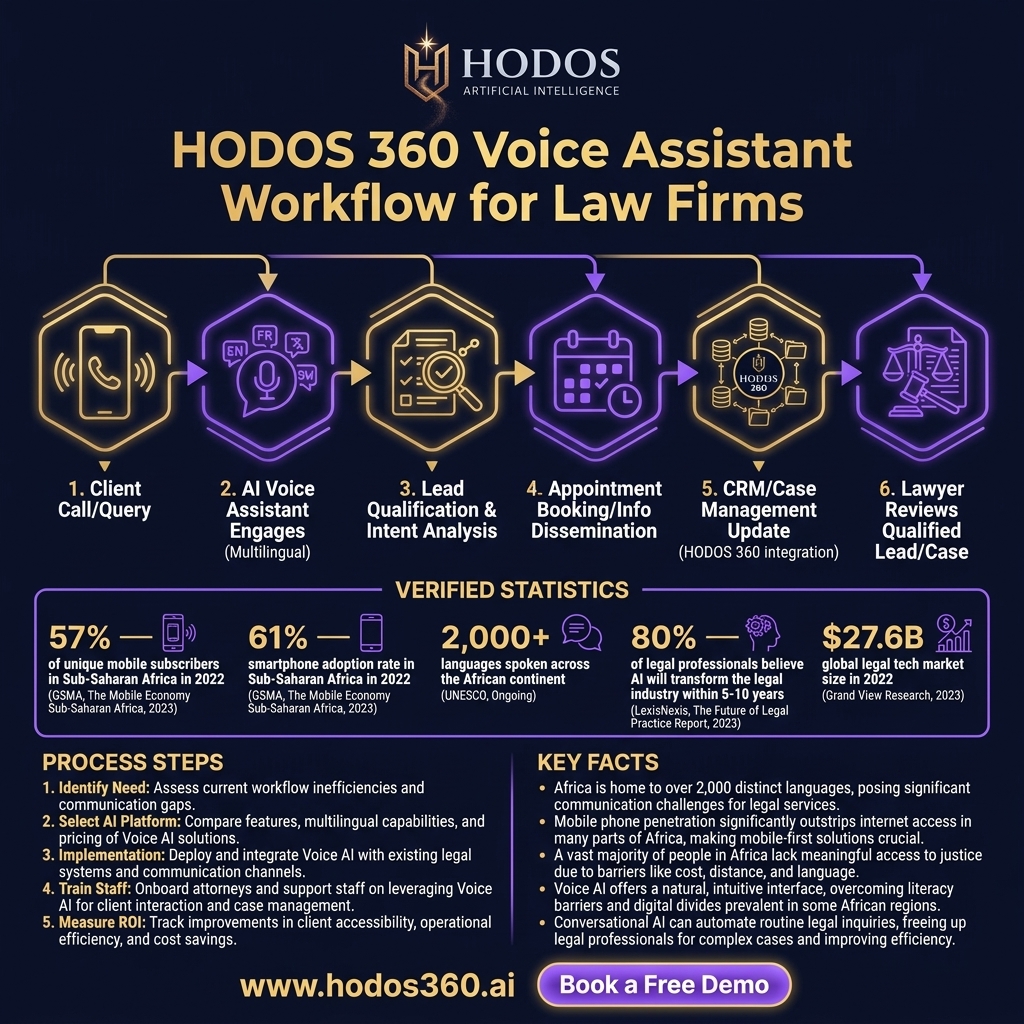
The true power of Voice AI within a modern law firm is realized when it is seamlessly integrated with a comprehensive AI Law Firm Management System. This integration creates an intelligent ecosystem where client interactions, case data, and administrative tasks are synchronized and automated. For instance, when HODOS 360's AI Voice Assistant qualifies a lead and books an appointment, this information isn't siloed. It automatically triggers a series of actions within the firm's AI Law Firm Management System: a new client profile is created, the appointment is added to the relevant attorney’s calendar, an initial intake form is generated, and even a follow-up email with necessary documents can be automatically drafted. This level of integration eliminates manual data transfer, reduces errors, and ensures that every client interaction contributes directly to the firm's operational workflow.
This interconnected approach extends to other services offered by comprehensive platforms. Data gathered by the Voice AI can feed into an AI Marketing Platform to refine client outreach strategies based on common inquiries, or inform document automation processes for frequently requested legal documents. The synergy across these AI-powered services means that law firms are not just adopting individual tools, but building a cohesive, intelligent infrastructure that optimizes every aspect of their operations. This holistic approach, exemplified by platforms like HODOS 360, provides a competitive advantage, allowing firms to deliver superior client service and achieve unprecedented levels of efficiency and productivity.

Key Takeaways and Next Steps
The journey towards a digitally empowered legal profession in Africa is accelerating, and Voice AI stands as a cornerstone of this transformation. From bridging vast linguistic divides to democratizing access to justice and significantly enhancing operational efficiencies, the benefits for law firms are undeniable. The stories of firms like Ngozi Okoro's, which have moved from skepticism to strategic adoption, illustrate a powerful shift in mindset—one that sees technology not as a challenge, but as a profound opportunity to serve clients better and operate more effectively.
For law firm owners and legal professionals across Africa, the message is clear: embracing Voice AI is no longer optional; it's a strategic imperative. Firms that prioritize this technology will not only gain a significant competitive edge but will also play a crucial role in expanding access to justice and fostering legal inclusion across the continent. Begin by assessing your firm's current client communication bottlenecks and identifying areas where multilingual support and 24/7 availability could make the most impact. Explore solutions that offer robust integration with your existing practice management systems to ensure a seamless workflow. The future of legal services in Africa is conversational, accessible, and intelligent.
To explore how these cutting-edge capabilities can be integrated into your practice, consider HODOS 360's AI Voice Assistants. Our platform is designed to empower African law firms with intelligent, multilingual client engagement, lead qualification, and appointment booking, all seamlessly integrated with a comprehensive AI Law Firm Management System. This ensures that your firm is not just keeping pace with technological advancements, but leading the charge towards a more efficient, accessible, and profitable future. The time to transform your legal practice with Voice AI is now.
Frequently Asked Questions
What is Voice AI and how does it apply to law firms in Africa?+
Voice AI refers to artificial intelligence that understands and responds to human speech. For law firms in Africa, it means automated systems that can answer client calls, qualify leads, book appointments, and provide basic legal information in multiple local languages, 24/7. This bridges communication gaps and enhances accessibility for a diverse, mobile-first population.
How can Voice AI help law firms overcome language barriers in Africa?+
Africa has immense linguistic diversity. Advanced Voice AI assistants are trained on vast datasets, enabling them to converse fluently in numerous local and international languages, including dialects. This allows firms to serve a broader client base effectively, ensuring legal advice and information are accessible and understandable regardless of the client's preferred language.
What are the key benefits of implementing Voice AI for law firm operations?+
Implementing Voice AI offers benefits like 24/7 client service, reduced operational costs by automating routine tasks, improved client intake and lead qualification, and enhanced client satisfaction through instant, personalized responses. It also frees up legal professionals to focus on complex legal work, improving overall firm efficiency and profitability.
Is Voice AI secure for handling sensitive client information?+
Yes, reputable Voice AI platforms prioritize data security and compliance. They employ advanced encryption, secure cloud infrastructure, and adhere to data protection regulations (e.g., GDPR, local privacy laws). Firms must choose providers with robust security protocols to ensure the confidentiality and integrity of client communications and sensitive legal data.
How does Voice AI integrate with existing law firm management systems?+
Modern Voice AI solutions are designed for seamless integration with AI Law Firm Management Systems. When a voice assistant interacts with a client, the gathered information can automatically update client profiles, populate calendars, trigger document automation, and create tasks within the firm's existing software, ensuring a cohesive and efficient workflow.